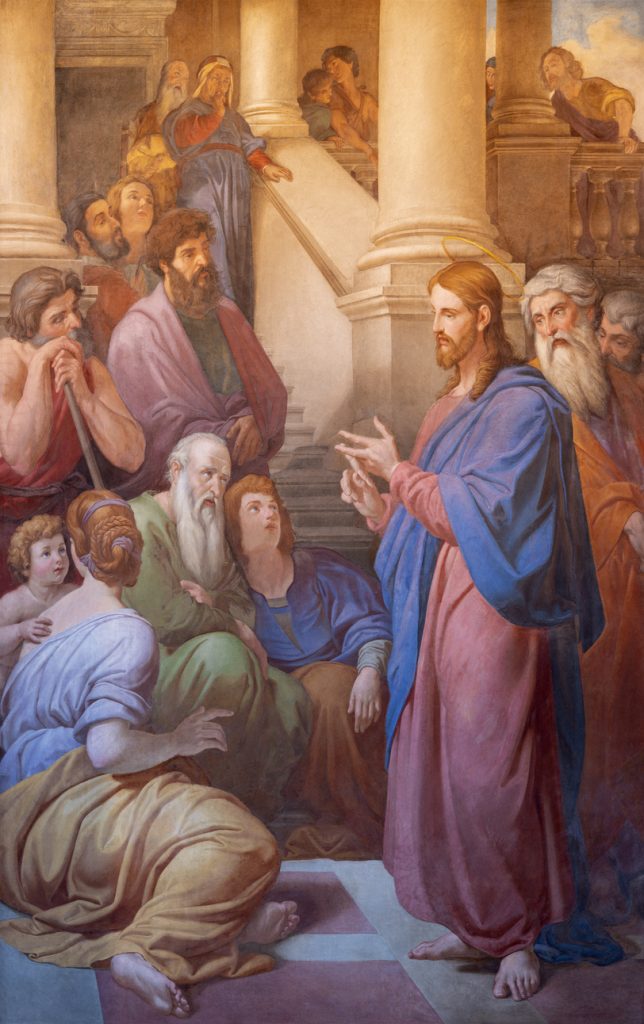
Rome – The fresco of Jesus teaching in the church Santa Maria in Monticelli
“You call me ‘Teacher’ and ‘Lord,’ and rightly so, for that is what I am.” John 13:13
Jesus is asked many questions in the Gospels; he rarely answers any of them directly. Some may see Jesus as cleverly evading the questioner. Yet I argue that Jesus’s “questioning questioners” is His vital teaching tool to awaken and involve his listeners in spiritual formation. In this context, Jesus typically responds to questions with another question, either through an indirect claim or a specific revelatory aim. Always! Jesus reframes the terms of a pressing topic and sheds light on his interlocutors’ root motives and spiritually compromised perspectives.
In John 13:13, Jesus tells his disciples, “You call me ‘Teacher’ and ‘Lord,’ and rightly so, for that is what I am” (cf. Matt 23:10; 26:18). As a teacher, Jesus adopts different teaching styles for formative reasons. As God anointed, Jesus speaks and embodies the message of God’s reign. He aligns with the prophets of Israel’s past, including John, his immediate predecessor. Jesus seeks to heal and to reveal. Divine revelation aims to open and purify the heart before God. This prepares people to receive God’s Torah written on their hearts (Jer. 31:33). The new covenant transforms the heart from within, and this transformation lies at the center of faithful living.
The Teacher of the Coming Kingdom
To be specific, we must set forth the “givens” of Jesus as a teacher from the context of His ministry and mission. First, Jesus came to proclaim the coming of the Kingdom of God. Second, He is to make disciples, to “seek and save the lost”; “to give His life as a ransom for many”; “to save sinners”; “to save the sick”; and to do all this by summoning His hearers to metanoia, which means calling forth repentance before the coming of the reign of God. To fulfill this goal, Jesus is willing to say to His own disciples what He also said to those who approach, question, and dispute with Him. Therefore, Jesus clearly accepts and even promotes an environment conducive to dialogue, questioning, and discussion.
The Prophet of the Heart
As a theologian, I am quick to point out that Jesus does not have educational exchanges to get the facts. He debates to fulfill God’s will. He exposes and shapes the listener’s core desires, assumptions, and perspectives. Jesus is NOT willing to engage a question directly when the basic question and exchange have already been molded to be anti-kingdom. Jesus’s pedagogy is not aimed at the heart to access commitments, intentions, desires, and core thoughts. Jesus grappled with reason to access the heart for the Kingdom. Jesus is fiercely consistent, whether in response to a question or a straightforward demand. In Luke 12:13–14 (NIV), someone in the crowd said to him, “Teacher, tell my brother to divide the inheritance with me.” Jesus replies, “Man, who appointed me a judge or an arbiter between you?” Rather than simply saying, “No, I won’t do that,” Jesus’s question functions as a claim: why are you trying to use me or manipulate me to resolve your family’s financial dispute? In Luke 12, Jesus confronts greed, worry, and conflict over material security as crucial issues that can obstruct sincere acceptance of proclamation. This is, however, just one instance of Jesus questioning the nature of one’s actions to address a broader, perennial challenge to entering the way of the kingdom. Jesus ultimately seeks to reveal and transform a person’s bedrock desires and intentions so they may see and enter the way of God’s reign. Shalom.
Heavenly Father,
Today, we choose to pay close attention to wisdom and listen intently to understanding. Help us to trust in the Lord with all our heart and lean ONLY on your understanding. In all our ways, may we acknowledge Jesus. And we ask you to direct our paths. We ask you to remove our proud hearts so that we can trust in You. In Jesus’ precious name we pray. Amen
“The Lord is good to all; he has compassion on all he has made.” Psalm 145:9 (NIV)
Have you ever wondered whether our words about God are big enough?
The longer we walk with Christ, the more we realize that human language struggles to describe divine reality. We speak of God as Father, Shepherd, King, Redeemer, and Friend. Scripture provides us with these images, yet none of them fully captures the mystery of who God is.
This is not a weakness of faith. It is a reminder of God’s greatness.
Why We Need Metaphors
Much of our language about God is metaphorical. We call God our Rock, yet we do not mean that He is a literal stone. We describe Him as our Shepherd, though He does not walk behind flocks carrying a staff.
These images help us understand aspects of God’s character. They are gifts that enable finite people to speak about an infinite God.
Metaphors do more than decorate language. They help us see truth. They create bridges between what we know from everyday life and what we are trying to understand about God’s nature.
The Importance of Careful Language
The words we use matter because language shapes perception.
If we reduce God to a single image or description, we risk creating a picture that is too small. Scripture itself employs a rich variety of images and descriptions because no single metaphor can contain the fullness of God.
Good theology is not merely about choosing the correct words. It is about recognizing both the power and limitations of those words.
God’s Kindness Revealed
One of the most beautiful truths in the Christian faith is that God is not distant from humanity. The biblical story reveals a God who creates, calls, redeems, forgives, and restores.
When we speak of the kindness of God, we are speaking of His gracious movement toward His creation. We see this kindness in the Incarnation, in the Cross, and in the daily mercies that sustain us.
God’s kindness is not sentimental. It is active. It reaches into broken lives and offers hope, healing, and renewal.
Humility in Theology
There is a certain humility required when talking about God.
We must speak because God has revealed Himself. Yet we must also remember that our words can never exhaust the mystery of the One we worship.
Theologians, pastors, and everyday believers share the same responsibility: to use language faithfully while remaining open to wonder.
A Final Reflection
Perhaps the goal of theological language is not to place God neatly inside our definitions but to draw us deeper into relationship with Him.
Every biblical image, every metaphor, and every doctrine ultimately points beyond itself to the living God.
And when our words fall short, His kindness remains greater than our ability to describe it.
“Now we see only a reflection as in a mirror; then we shall see face to face” (1 Corinthians 13:12).
Resource
Soskice, Janet Martin. The Kindness of God : Metaphor, Gender, and Religious Language. Oxford ; Oxford University Press, 2007.
A Greek Reading of Romans 12 and the Shape of Worship
by Dee Ann Loving-Tackitt
“I appeal to you therefore, brothers and sisters, by the mercies of God, to present your bodies as a living sacrifice, holy and acceptable to God, which is your spiritual worship” (Romans 12:1).
The Rhythm of Worship in Everyday Life
We often assume worship ends when the singing stops. But Paul suggests something far more searching—and far more beautiful. We do not leave our worship behind when we walk out of the sanctuary. It lingers with us, like a melody still echoing after the final note has faded. It follows us into the quiet of our homes, into conversations at the table, into moments of weariness, and into the unseen spaces where faith becomes real. What was lifted in song begins to take shape in service. What was spoken in prayer becomes a posture of the heart throughout the day.
Somewhere between Sunday morning and the ordinary rhythm of the week, we begin to sense that worship was never meant to be something we merely attend, but something we carry—something that continues in how we think, how we love, and how we offer ourselves back to God in the smallest and most sacred ways. It meets us in the hard conversation, in the hidden prayer, in the choice to serve when no one notices. Worship, it seems, refuses to stay contained within walls or schedules—it breathes, it moves, it lives.
It is in this movement—from gathered worship into lived worship—that Romans 12 begins to open with new clarity. What can first feel like a series of separate instructions is, in truth, a deeply connected vision of the Christian life. Paul is not handing us a scattered collection of commands; he is showing us how the mercies of God reshape the whole person. Worship becomes the thread that holds everything together—our minds, our relationships, our service, and our love—until faith is no longer confined to a moment, but expressed through the offering of an entire life.
The Priesthood of Every Believer
Paul begins with the language of offering: to “present your bodies as a living sacrifice” is unmistakably priestly language. It reaches back into the Old Testament, where priests brought offerings before God, yet in Christ that holy calling is no longer limited to a few. Scripture now names the whole church as “a chosen race, a royal priesthood” (1 Peter 2:9), a vision that helps illuminate why Romans 12 speaks of worship in such embodied and daily terms.
Worship, then, is not merely something we attend; it is something we become.
Our lives—our thoughts, actions, relationships, and service—are now the offering. This transforms the ordinary into the sacred. Nothing is outside the reach of worship when it is given back to God.
Transformation Before Expression
Yet Paul does not move from offering straight into outward action. Before he speaks of gifts, relationships, or service, he turns to the inner work that makes true worship possible: “Do not be conformed to this world, but be transformed by the renewing of your mind” (Romans 12:2).
This renewal matters because worship always flows from what shapes our vision. If our minds are formed primarily by the world, our devotion can become shallow, distracted, or distorted. But when truth renews the way we think, we begin to discern the will of God—what is good, acceptable, and perfect—and our lives start to align with what we behold.
True worship begins inwardly before it is ever expressed outwardly.
A Humble and Connected Body
A renewed mind does not remain private for long. It begins to shape the way we see ourselves and the people around us. That is why Paul moves naturally from inward transformation to shared life, calling believers to humility: “not to think of himself more highly than he ought to think” (Romans 12:3).
This is not a call to diminish ourselves, but to see clearly. Each of us belongs to something greater—“we, though many, are one body in Christ, and individually members one of another” (Romans 12:5). Worship dismantles pride because it reorients our identity. Life is no longer about personal prominence; it is about participating in the life of Christ’s body.
Gifts as Acts of Worship
Once Paul has reminded us that we belong to one body, he turns to the grace at work within that body. God has distributed gifts—graciously and intentionally—and each one is meant to serve the life of the whole. Whether we serve, teach, exhort, give, lead, or show mercy, these gifts are not platforms for recognition but expressions of worship.
When we use what God has given us for the good of others, we are offering something holy. Ministry itself becomes an act of devotion. Teaching becomes worship. Serving becomes worship. Giving becomes worship. Every gift, rightly exercised, becomes a living sacrifice before God.
The Heart of It All: Genuine Love
And yet Paul does not allow the chapter to rest in giftedness alone. Beneath every act of service lies a deeper foundation, and at the center of everything he writes is this anchoring truth: “Let love be genuine” (Romans 12:9).
This is not just one instruction among many—it is the heartbeat of the entire passage. Love is what gives meaning to every gift and every act of service. Without it, even the most impressive expressions of ministry become empty. As Paul teaches elsewhere, “If I… have not love, I gain nothing” (1 Corinthians 13:3).
Genuine love is not surface-level kindness. It is rooted in truth. It “abhors what is evil” and “holds fast to what is good” (Romans 12:9). It is both discerning and devoted.
A Life Overflowing With Worship
Once love takes root, it does not remain an idea for long—it becomes visible in everyday life. It is expressed in devotion to others, in honoring them above ourselves, in diligence, in spiritual fervor, and in faithful service to the Lord. It rejoices in hope, endures through trials, and perseveres in prayer. It sees needs and responds with generosity. It opens doors in hospitality, welcoming others into grace-filled spaces. It is present when we choose patience instead of sharpness, forgiveness instead of resentment, or quiet faithfulness in work that feels unseen.
What emerges here is not a checklist, but a portrait—a lived-out theology. These are not isolated commands meant to weigh us down, but living expressions of what it looks like when worship fills a life.
Not a Checklist, but an Invitation
That is why Romans 12 is best received not as a ledger of spiritual performance, but as an invitation into a way of life. When we read it only as a list of requirements, it can feel overwhelming, and we may quietly think, “I don’t measure up.” But Paul’s intention is not to crush us under impossible standards; it is to draw us more deeply into the life made possible by God’s mercy.
Instead of asking, “Am I doing all of this perfectly?” we begin to ask, “How is God inviting me to worship today?” Perhaps it is through encouraging a weary heart, persevering in unseen prayer, opening our home even when it feels inconvenient, or choosing humility in a moment that tempts us toward self-protection.
Seen this way, Romans 12 gently but powerfully expands our understanding of worship far beyond gathered moments. It reminds us that worship happens in quiet places, in difficult seasons, in ordinary conversations, and in faithful obedience—in the hospital room, in the classroom, in the kitchen, and in the stillness of prayer. It is found wherever a life is surrendered to God.
A Living Offering
In the end, this passage is not about striving harder but about surrendering more fully. Because of God’s mercy, our lives become the altar, and upon that altar we offer ourselves—not once, but continually. The song of worship does not end when the service closes; it follows us into the world as a living offering.
Living. Breathing. Serving. Loving.
And in that offering, God is pleased.
Prayer Heavenly Father, teach us to worship You not only with our songs, but with our lives. Renew our minds, humble our hearts, and make us faithful in the ordinary places where devotion is quietly formed. Let love be genuine in us. Shape our service, our words, our work, and our rest into a living offering that is pleasing to You. And when the music fades and the week unfolds before us, may the song of Your mercy continue in us—living, breathing, serving, and loving for Your glory. In Jesus name we pray. Amen.
Culy, Martin M. “Romans 12:9-13: Greek Grammar and How to Worship God.” Journal of the Evangelical Theological Society 65, no. 4 (2022): 719–32.
Opening Scripture “For I desire mercy, not sacrifice, and acknowledgment of God rather than burnt offerings.” (Hosea 6:6; cf. Matthew 9:13)
The Tension Between Legalism and Mercy
Legalism has always been uncomfortable with mercy. It clings tightly to rules, even when God Himself shows that mercy is the deeper law. Yet the New Testament does not erase the Law—it reveals its heart. Jesus does not come to dismantle what God established; He fulfills it (Matthew 5:17), uncovering what the Law was always pointing toward: the mercy of God extended to His people through relationship, not mere regulation. Mercy Woven Throughout the Old Testament
All throughout Scripture, we see that mercy was never an afterthought—it was always central. David, fleeing for his life, ate the consecrated bread reserved for priests, and God did not condemn him (1 Samuel 21:1–6). The Hebrew midwives disobeyed Pharaoh’s command to kill the male infants, preserving life instead of submitting to wicked authority, and Scripture says God blessed them (Exodus 1:17–21). Rahab hid the spies, defying her king and risking her life, and rather than being judged, she was redeemed and woven into the very lineage of Christ (Joshua 2; Matthew 1:5). Again and again, mercy did not break God’s will—it fulfilled it.
Jesus Reveals the Fullness of the Law
Jesus brings this truth into full light. When He walks among the people, He heals on the Sabbath (Mark 3:1–5). He reaches for those labeled “unclean” and restores them (Mark 1:40–42). He sits with sinners and calls them into new life (Luke 5:30–32). And He declares plainly, “I desire mercy, not sacrifice” (Matthew 9:13). In every act, Jesus shows us that the Law was never meant to burden or crush—it was meant to guide hearts toward God, to open the way for redemption, and to reflect His compassion.
The Law Points to Christ
So here is the truth we must hold onto: if a law does not point us to Christ, if it does not reflect His mercy, if it does not move people toward redemption, then it is no longer functioning as God intended. The Law is a signpost—and every signpost must point to Jesus. When we cling to rules without mercy, we miss the destination. But when we walk in mercy, we step into the very heart of God.
Closing Prayer Heavenly Father, thank You for revealing the true heart of Your Law through Jesus. Forgive us for the times we have clung to rules without reflecting Your mercy. Teach us to see people the way You see them—with compassion, grace, and a desire for their redemption. Help us to walk in truth without losing love, and to uphold Your Word in a way that points others to Christ. Let our lives be signposts that lead others to You as we share mercy and Your Truth.
I’ve been scribing the Gospels lately—just twenty verses into Mark chapter 1—and I finally decided it was time. I needed to call Mark into the Writing Center. Yes, that Mark. The one who wrote the shortest, fastest, most breathless Gospel in the New Testament. The one who can’t seem to write a paragraph without sprinting.
So I sat him down, slid the manuscript across the table, and said, “Mark, we need to talk about your grammar.”
He blinked at me, probably wondering how he got here and why a woman from the 21st century was holding a red pen over his sacred text. But I pressed on.
“Mark, About These Sentences…”
“Listen,” I told him, “I know this is translated from your original language. I know Koine Greek doesn’t follow modern English rules. I know your Gospel was meant to be read aloud, fast-paced, urgent, breathless. But let’s not make excuses here.”
I tapped the page.
“You have sentences that run on for half a mile. You start half your paragraphs with ‘And.’ You leave out verbs. You splice commas like you’re trying to knit with punctuation. And honestly, Mark… I love it.”
He looked relieved.
Because the truth is, Mark’s grammar may be chaotic, but his message is not. His Gospel moves like a wildfire—quick, bright, unstoppable. It reads like someone who cannot wait another second to tell you about Jesus. And maybe that’s why his grammar feels like it’s sprinting. His heart is sprinting.
The Gospel That Changed Lives
I leaned back in my chair and said, “Mark, your grammar may give English teachers heart palpitations, but your Gospel has changed the world.”
He nodded, because he knows.
His Gospel has:
called sinners to repentance
revealed Jesus as the Son of God
shown demons fleeing at His voice
displayed the heavens torn open
carried the cross to the center of history
proclaimed resurrection with trembling joy
Mark didn’t write to impress scholars. He wrote to save souls. He wrote so the church—then and now—could hear the good news with urgency and clarity.
And maybe that’s why his grammar feels like a man running out of breath. He wasn’t polishing sentences. He was proclaiming salvation.
Why I Love Mark’s “Bad Grammar”
So I told him, “Mark, your grammar may be questionable, but your theology is flawless.”
He grinned.
Because the Gospel of Mark is not a literary masterpiece—it is a spiritual earthquake. It shakes the ground under our feet. It tears open the heavens. It drives Jesus into the wilderness and drives demons out of people. It calls fishermen from their boats and calls us from our old lives.
Mark writes like a man who has seen the kingdom of God break in and cannot slow down long enough to breathe, much less diagram a sentence.
And honestly? I love it!
Father, Thank You for the gift of Your Word—perfect in truth even when our grammar isn’t. Thank You for inspiring Mark to write with urgency, passion, and Holy Spirit fire, reminding us that the Gospel is not about polished sentences but about a Savior who changes lives. As we read, study, and even laugh our way through these verses, let Your Spirit open our eyes to see Jesus more clearly. Give us hearts that respond as quickly as Mark writes—immediately, joyfully, and obediently. May Your Word run swiftly through our lives, accomplishing everything You send it to do. In Jesus’ name, Amen.
“God is Spirit, and those who worship Him must worship in spirit and in truth.” — John 4:24
Worship begins where Jesus begins—with the Spirit. Before we ever lift a song, raise a hand, or open a hymnal, Jesus sets the foundation: true worship is Spirit‑led. It is not confined to a building, a style, or a tradition. It flows from hearts shaped by the Holy Spirit and anchored in the truth of God’s Word. When we start here, every act of worship becomes more than sound; it becomes surrender.
Why Hymns Matter More Than We Realize
For generations, hymns have been the church’s way of teaching the faith. They were the catechism of the common believer, the seminary of the shepherd and the seamstress, the farmer and the fisherman. When people could not read Scripture, they sang Scripture. When they could not articulate doctrine, they memorized doctrine through melody.
Hymns are not just music; they are memory. They are not just poetry; they are proclamation. They are not just tradition; they are testimony. And when we sing them with hearts yielded to the Holy Spirit, they become a lifeline—carrying truth into places our minds may forget but our spirits remember.
The Cross Teaches Us to Sing
At the cross, sorrow becomes song. At the cross, suffering becomes strength. At the cross, theology becomes doxology.
This is why the church has always sung—not because life is easy, but because Christ is worthy. Not because we have all the answers, but because we know the One who does. When we sing, we preach to ourselves, we preach to one another, and we preach to the watching world. And in that preaching, hope rises.
Paul echoes this when he writes, “Sing and make music from your heart to the Lord” (Ephesians 5:19). Spirit‑led worship is not performance; it is participation in the life of God.
A New Song for a New People
Psalm 40:3 declares, “He put a new song in my mouth, a hymn of praise to our God.” That means the song is not self‑generated—it is Spirit‑given. The melody of redemption is placed in us by the One who redeemed us. When God rescues us, He doesn’t just change our circumstances—He changes our song.
This is why hymns endure. They are not merely human creativity; they are human response to divine revelation. They become Scripture in the heart, shaping us long after the final note fades.
Closing Reflection
Worship is not only something we study—it is something we sing. And every time we lift our voices, we join the great cloud of witnesses who have sung their way through suffering, through joy, through doubt, through faith, and always toward the cross. May every song we sing be Spirit‑breathed, Scripture‑rooted, and Christ‑centered.
Closing Prayer
Heavenly Father, Thank You for giving us a new song—one shaped by Your Spirit and anchored in Your truth. Teach us to worship as Jesus commanded: in spirit and in truth. Let every hymn, every melody, and every whispered prayer draw us closer to the cross. Fill our hearts with gratitude, our mouths with praise, and our lives with the sound of redemption. May our worship honor You and bear witness to Your hope in a world that desperately needs it. In Jesus name we pray. Amen.
by Dee Ann Loving-Tackitt, Liberty University Online Writing Center Tutor (Host)
House of Prayer Ministry
My mission: To teach with clear purpose and light, Through grammar and structure done right, With witness through art, And Christ at the heart, Helping students grow as Champions for Christ.
When Writing Becomes Part of Discipleship
We often think of writing as something reserved for teachers, authors, or students, but it can also be a faithful part of the Christian life. The words we write can encourage, teach, comfort, and point people toward truth. Whether we are tutoring a student, sending a note of encouragement, or reflecting on what God is teaching us, writing can become one more way we serve Him. Scripture connects writing and teaching. Habakkuk 2:2 says to “write the vision” and make it plain, and 2 Timothy 2:2 emphasizes passing truth on so that others can teach it as well. Writing can be part of discipleship because it teaches us to reflect prayerfully, speak truthfully, and serve patiently.
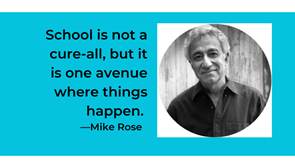
What Mike Rose Helped Me See About Teaching Writing
This reflection grows out of my preparation to tutor university students. As I step into that work, I want to do so with humility, wisdom, and a real desire to serve. One article that has helped me think more carefully about that calling is Mike Rose’s Remedial Writing Courses: A Critique and a Proposal. His ideas challenge some common assumptions about teaching writing, and they also remind me that students need more than correction. They need guidance, dignity, and room to grow.
Rose argues that remedial writing courses often fail students because they are too disconnected from actual university writing. Rather than preparing students for college-level work, these courses may rely on simple, personal assignments that do not reflect the kind of reading, analysis, and argument students will eventually be expected to do. As a result, students may complete remedial courses without developing the skills they need for authentic academic writing.
More Than Simple Topics and Grammar Fixes
Rose also criticizes the common use of simple topics and the heavy emphasis on error correction. He argues that easier topics do not necessarily motivate students, nor do they prepare them for more demanding writing tasks. In the same way, an overemphasis on grammar can cause students to think writing is only about avoiding mistakes rather than developing ideas, communicating clearly, and engaging thoughtfully with an audience.
Writing, Reading, and Thinking Belong Together
Another important point in the article is that writing should not be separated from reading and thinking. Academic writing depends on all three. Students must interact with texts, process ideas, and organize their thoughts in meaningful ways. Rose suggests that remedial instruction is most effective when it treats writing as an integrated process rather than as a collection of isolated skills.
Structure Can Support Growth
Finally, Rose argues that academic writing should not be seen as restrictive or lifeless. Students need to learn structures such as analysis, comparison, and argument, but those structures are not meant to limit thought. Instead, they can help students think more clearly and communicate more effectively. For Rose, remedial writers are not deficient; they are capable learners who need meaningful practice, thoughtful guidance, and gradual exposure to authentic academic work.
What This Means for Serving Students Well
This matters to me as I prepare to tutor university students. Rose’s article reminds me that tutoring should involve more than correcting errors. It should help students grow in confidence, think more clearly, and approach academic writing as a meaningful form of communication. Good tutoring should treat students with dignity, patience, and hope, helping them grow rather than simply fixing sentences.
Why This Matters for Christian Service
In that sense, tutoring writing can also be an act of discipleship. It is a way of helping others grow through truth, patience, and instruction. Discipleship involves learning, teaching, and building others up, and writing can participate in that holy work. As Matthew 28:19–20 shows, disciples are called to teach, and Psalm 102:18 reminds us that what is written can serve future generations. Writing, tutoring, and discipleship come together when words are used with care to guide, strengthen, and bless others.
Ways Christians Can Use Writing as Witness
Writing can be a form of witness because it helps us teach, encourage, and preserve truth. It gives us a way to slow down, pay attention, and put into words what God may be teaching us. It can also bless the people around us. Some research suggests that writing can support reflection, well-being, and emotional processing, and studies on expressive writing have found that practices such as gratitude writing and reflective writing may support positive affect and personal growth. That does not make writing a cure-all, but it does remind us that thoughtful writing can do real good.
That is one reason writing can be such a meaningful part of discipleship. I recently joined a group that has pledged to write out the Bible from Genesis to Revelation, and even that simple act feels like a way of lingering over God’s Word with greater attention. Others blog, write letters to shut-ins, help those who are ill record memories for loved ones, create children’s books, write devotionals, or compose hymns. The opportunities are endless, and each one can become a quiet offering of service.
The encouraging part is that getting started is easier than ever. Writing methods, prompts, and guides are widely available online and in bookstores, and self-publishing has become far more accessible through print-on-demand and e-book platforms. Writing is no longer only for professional authors. It is something ordinary believers can use in extraordinary ways. If God has given you something to say, writing may be one of the ways He invites you to serve. A few faithful words, offered to the Lord, can become a source of witness, comfort, and encouragement to someone else.
For Adults Who Want to Improve Writing
Zinsser, William. On Writing Well: The Classic Guide to Writing Nonfiction. New York: HarperCollins, 2016.
Lamott, Anne. Bird by Bird: Some Instructions on Writing and Life. New York: Anchor Books, 1995.
Strunk, William Jr., and E. B. White. The Elements of Style. 4th ed. New York: Longman, 1999.
Pink, Daniel H. A Whole New Mind: Why Right-Brainers Will Rule the Future. New York: Riverhead Books, 2006.
Clark, Roy Peter. Writing Tools: 55 Essential Strategies for Every Writer. New York: Little, Brown, 2006.
Graff, Gerald, and Cathy Birkenstein. They Say / I Say: The Moves That Matter in Academic Writing. 4th ed. New York: W. W. Norton, 2018.
For Children & Young Writers
Cleary, Beverly. Dear Mr. Henshaw. New York: HarperCollins, 1990.
Cummings, Troy. The Notebook of Doom Series. New York: Scholastic, 2013–.
Gutman, Dan. My Weird School Series. New York: HarperCollins, 2004–.
Scieszka, Jon. The Stinky Cheese Man and Other Fairly Stupid Tales. New York: Viking, 1992.
Arnold, Tedd. Fly Guy Series. New York: Cartwheel Books, 2005–.
DiCamillo, Kate. Because of Winn-Dixie. Cambridge, MA: Candlewick Press, 2000.
These resources encourage writers at every stage—from early readers to adult learners—to grow in clarity, confidence, and voice. Whether writing devotionals, testimonies, or academic reflections, the goal is the same: to communicate truth with grace, purpose, and understanding so that others may hear and respond.
Resource
Rose, Mike. “Remedial Writing Courses: A Critique and a Proposal.” College English 45, no. 2 (February 1983): 109–128.
Resonance, purity, and the call to continue the music of Christ.
“The women fled from the tomb, trembling and bewildered, and they said nothing to anyone because they were afraid.” Mark 16:8
Resonance and Truth
When a crystal goblet is struck, it sings only one pure note. That clarity comes from the way it was created: every goblet has a natural frequency, a pitch woven into its very shape, and the purity of the crystal allows the sound to linger long after the touch is gone. Its rim vibrates in delicate standing waves, and when a wet finger circles the edge, each tiny slip adds just enough energy to awaken the goblet’s true voice. It reminds me of the way our barbershop chorus, The Pride of West Texas Show Chorus, begins every song with the soft, steady tone of the electronic pitch pipe — the single note that gathers scattered voices and tunes us into one purpose.
Mark opens his Gospel in the same way. His first words strike the pitch that sets everything else in motion, and John the Baptist becomes that first vibration in the wilderness — the clear, resonant sound preparing us to hear the Good News of Jesus.
The Pure Note of the Gospel
Jesus Christ serves and suffers, and He is the Son of God, our Savior who lives and gives life. This truth is the truest and purest note of grace the world has ever known. Even in the “plunk” of crosses dropping into the ground, there is beautiful music: the voices of believers who refuse to give up the faith. From the dreariest Roman dungeons, the night air once came alive with hymns. Mark is telling us that if we listen closely, we can still hear the sound of that music.
The Men Behind the Message
And then there are the two men behind this Gospel — Peter and Mark. One a denier, the other a dropout. Yet together, carried by the wind of the Holy Spirit, they give us a Gospel written with compassion, precision, urgency, and hope. Mark did not know he was writing Scripture for the ages; he only knew he was writing “the beginning of the gospel of Jesus Christ, the Son of God.”
The Unfinished Gospel
Some theologians call Mark “The Unfinished Gospel,” because the most ancient manuscripts end at 16:8:
“The women fled from the tomb, trembling and bewildered, and they said nothing to anyone because they were afraid.”
The chord is not resolved. It is as if the Composer set down His pen and the Holy Spirit carried the melody into our hearts to complete. Mark gives us the beginning — the opening pitch, the first vibration, the pure note of truth — and then hands the song to us.
The ending is up to us.
A Closing Prayer
Heavenly Father,
tune our hearts to Your truth. Let Your Gospel be the pure note that steadies our steps, aligns our desires, and calls us into harmony with Your Spirit. As Mark handed the unfinished melody to the early church, help us carry it faithfully in our own generation. Give us courage like John, humility like Peter, and clarity like Mark. May our lives ring with the sound of Your grace, resonating in every place You send us. In Jesus name we pray,
Amen.
Reflection Question
Where is the Holy Spirit inviting you to continue the “unfinished Gospel” this week — through your words, your worship, or your witness?
Resource
Wessel, Walter W. The Communicator’s Commentary: Mark. Vol. 2. Waco, TX: Word, 1982.
Further Reading
If you’d like to meditate further on the themes in this post, spend time with these passages from Mark’s Gospel:
Mark 1:1–8 — The beginning of the Good News and the voice in the wilderness
Mark 8:27–30 — Peter’s confession of Christ
Mark 10:45 — The Son of Man who came to serve and give His life
Mark 14:27–31 — Peter’s denial foretold
Mark 15:33–39 — The crucifixion and the centurion’s confession
Mark 16:1–8 — The “unfinished” ending that invites us to continue the story
The beginning of the gospel of Jesus Christ, the Son of God. As it is written in Isaiah the prophet, “Behold, I send my messenger before your face, who will prepare your way, Mark 1:1-2
Today, I found myself smiling at a funny little thought while working on my commentary on Mark’s Gospel. I imagined Mark himself sitting across from me at the Writing Center—scroll unrolled, ink still fresh—sliding his opening lines in front of me and asking, “Does this sound right?”
So I read his words slowly:
“The beginning of the gospel of Jesus Christ, the Son of God. As it is written in Isaiah the prophet…”
And I couldn’t help it—I slipped right into tutor mode.
“Mark,” I would say gently, “your ideas are beautiful. Truly. But you’re writing like a first-century Jewish author… and my job is to help modern English readers understand you.”
First, I’d point to that opening sentence. “Friend,” I’d smile, “you don’t have a verb here. Now, in Greek, that works just fine. It’s powerful, almost like a bold title carved into stone. But in English, it reads like a fragment. If this were a paper, I’d just ask you to add one simple word: is.”
And suddenly the line breathes a little differently:
“This is the beginning of the good news about Jesus Christ, the Son of God.”
Clear. Direct. Complete.
Then we’d move on to the second line. “Mark,” I’d continue, “you’ve written ‘as it is written in Isaiah,’ but your first quotation actually comes from Malachi. Now, I know why you did that. In your world, you name the major prophet even when you blend passages. That’s a perfectly acceptable practice in your time. But modern readers might get confused.”
So I’d suggest something like:
“As the Scriptures say—first in Malachi, and then in Isaiah…”
And then I’d lean back, smile, and say, “You didn’t do anything wrong. You’re just writing from your own time, your own tradition, your own rhythm. And it works—it really does.”
Because the truth is, Mark’s Gospel doesn’t begin with careful, polished explanations. It bursts onto the page. It feels like someone who can’t wait another second to tell the story of Jesus. There is urgency in his voice. There is movement. There is life.
And maybe that’s the deeper lesson for all of us walking this prayer path.
Sometimes we worry so much about getting every word right, every detail perfect, every sentence polished… that we forget the joy of simply telling the good news. Mark reminds us that the gospel is not primarily about flawless grammar—it is about a living Savior.
He doesn’t linger long in introductions. He doesn’t slow down for perfection. He simply begins:
“This is the beginning of the good news…”
And what a beginning it is.
Prayer
Heavenly Father, Thank You for the writers of Scripture, who spoke Your truth with passion, urgency, and faith. Thank You for Mark, whose words remind us that the gospel is living and powerful, not confined to perfect sentences but alive in every heart that receives it.
Help us not to hold back out of fear of saying things imperfectly. Give us courage to share the good news boldly, joyfully, and faithfully. Teach us to love Your Word deeply, to understand it responsibly, and to speak it with grace.
And Lord, let our lives themselves become part of that unfolding story—evidence that the good news is still being written today.
“Therefore, there is now no condemnation for those who are in Christ Jesus.” — Romans 8:1
Living Free in Christ: Baptist Doctrine
Bernie and I recently joined First Baptist Lubbock, and in this season, we have been intentionally studying Baptist doctrine together. As I’ve leaned into that—especially as a doctoral student in Biblical Studies at a Baptist university—I’ve found something that has deeply encouraged my heart… something I am truly thankful for.
As I studied the doctrine, this is what I found:
At its core, Baptist theology carries a beautiful truth for struggling Christians: receiving new mercies is part of the Christian life —the steady rhythm of God’s grace.
This truth is deeply reflected in Baptist doctrine.
Salvation by grace reminds us that we are not defined by our past, but justified through Christ.
The priesthood of all believers tells us we can come directly to God—boldly and immediately
Soul competency reminds us that we stand personally before God, responsible to Him above all.
Sanctification reminds us that growth is ongoing… and stumbling is not the end
And I found myself thinking:
This is amazing grace.
📖 What Does Scripture Say?
As a Bible student, I had to ask:
What does Scripture actually say about living in ongoing renewal without shame through the steady rhythm of God’s grace?
From the very beginning, we see that shame entered through sin.
In the Garden, Adam and Eve didn’t just feel guilty—they hid. Shame whispered, “This is who you are now.” It shifted identity.
But the Gospel tells a different story.
Jesus meets people in their shame—and He restores them.
He does not define them by their failure. He redefines them through His grace.
In John 8, when the woman was brought before Him, Jesus had every right to condemn her… but instead, He extended mercy, called her out of sin, and lifted her from the shame that once held her. And, He told her to go and sin no more.
What We Are Reminded of in Scripture
“If we confess our sins, He is faithful and just to forgive us…” (1 John 1:9)
“As far as the east is from the west, so far has God removed our transgressions from us.”(Psalm 103:12)
““Therefore, if anyone is in Christ, the new creation has come: The old has gone, the new is here!” (2 Corinthians 5:17)
Here is the truth:
Shame may enter through sin, but it is broken through the finished work of Christ.
When Jesus said, “It is finished,” He wasn’t just paying for sin—He was breaking the power of sin and removing the guilt that once defined us, restoring our identity in Him.
Doctrine and Scripture Together
When I compare what I found in Baptist doctrine with what I found in Scripture, they align so beautifully:
Doctrine says we can come boldly → Scripture says there is no condemnation for those in Christ.
Doctrine says we have access to God → Scripture says we are cleansed and made new for those in Christ.
Doctrine says growth is ongoing → Scripture says grace is sufficient for those in Christ.
And this is what I am most thankful for:
Being made new is a natural part of the Christian life—the steady, faithful rhythm of God’s grace.
🤍 Why the Church Family Matters
From my heart, I want to say this:
This is why being part of a church family matters so much.
Yes, we can come to God individually—and that is a beautiful truth. But we were never meant to walk this out alone.
We need a place where:
grace is spoken out loud
Truth is lived in community
restoration is seen
And people remind us who we are when we forget
The church becomes living proof that starting again is possible… not just once, but daily.
🌸 Living This Out
In our home, in our church, and through The House of Prayer, this is what Bernie and I are learning to live: Daily priesthood means daily renewal Daily renewal means we keep walking forward—restored, renewed, and covered in grace.
🙏 Prayer
Father, Thank You for the gift of grace that continually renews us in Christ. Thank You that in Christ, we are not defined by our past or our sin, but made new in Christ.
Teach us to come boldly to You—not hiding, not hesitating, but trusting in Your mercy. Help us receive Your forgiveness fully and walk in the new identity You have given us.
Strengthen us to keep growing, keep turning, and keep trusting You. And thank You for the gift of the church—for people who speak truth, extend grace, and walk alongside us.
Let our lives reflect the rhythm of Your grace—again and again.