Tag Archives: God’s Faithfulness

When the Song Follows Us Home: Paul’s Vision of a Living Offering

A Greek Reading of Romans 12 and the Shape of Worship

by Dee Ann Loving-Tackitt
“I appeal to you therefore, brothers and sisters, by the mercies of God, to present your bodies as a living sacrifice, holy and acceptable to God, which is your spiritual worship” (Romans 12:1).

The Rhythm of Worship in Everyday Life

We often assume worship ends when the singing stops. But Paul suggests something far more searching—and far more beautiful. We do not leave our worship behind when we walk out of the sanctuary. It lingers with us, like a melody still echoing after the final note has faded. It follows us into the quiet of our homes, into conversations at the table, into moments of weariness, and into the unseen spaces where faith becomes real. What was lifted in song begins to take shape in service. What was spoken in prayer becomes a posture of the heart throughout the day.

Somewhere between Sunday morning and the ordinary rhythm of the week, we begin to sense that worship was never meant to be something we merely attend, but something we carry—something that continues in how we think, how we love, and how we offer ourselves back to God in the smallest and most sacred ways. It meets us in the hard conversation, in the hidden prayer, in the choice to serve when no one notices. Worship, it seems, refuses to stay contained within walls or schedules—it breathes, it moves, it lives.

It is in this movement—from gathered worship into lived worship—that Romans 12 begins to open with new clarity. What can first feel like a series of separate instructions is, in truth, a deeply connected vision of the Christian life. Paul is not handing us a scattered collection of commands; he is showing us how the mercies of God reshape the whole person. Worship becomes the thread that holds everything together—our minds, our relationships, our service, and our love—until faith is no longer confined to a moment, but expressed through the offering of an entire life.

The Priesthood of Every Believer

Paul begins with the language of offering: to “present your bodies as a living sacrifice” is unmistakably priestly language. It reaches back into the Old Testament, where priests brought offerings before God, yet in Christ that holy calling is no longer limited to a few. Scripture now names the whole church as “a chosen race, a royal priesthood” (1 Peter 2:9), a vision that helps illuminate why Romans 12 speaks of worship in such embodied and daily terms.

Worship, then, is not merely something we attend; it is something we become.

Our lives—our thoughts, actions, relationships, and service—are now the offering. This transforms the ordinary into the sacred. Nothing is outside the reach of worship when it is given back to God.

Transformation Before Expression

Yet Paul does not move from offering straight into outward action. Before he speaks of gifts, relationships, or service, he turns to the inner work that makes true worship possible: “Do not be conformed to this world, but be transformed by the renewing of your mind” (Romans 12:2).

This renewal matters because worship always flows from what shapes our vision. If our minds are formed primarily by the world, our devotion can become shallow, distracted, or distorted. But when truth renews the way we think, we begin to discern the will of God—what is good, acceptable, and perfect—and our lives start to align with what we behold.

True worship begins inwardly before it is ever expressed outwardly.

A Humble and Connected Body

A renewed mind does not remain private for long. It begins to shape the way we see ourselves and the people around us. That is why Paul moves naturally from inward transformation to shared life, calling believers to humility: “not to think of himself more highly than he ought to think” (Romans 12:3).

This is not a call to diminish ourselves, but to see clearly. Each of us belongs to something greater—“we, though many, are one body in Christ, and individually members one of another” (Romans 12:5). Worship dismantles pride because it reorients our identity. Life is no longer about personal prominence; it is about participating in the life of Christ’s body.

Gifts as Acts of Worship

Once Paul has reminded us that we belong to one body, he turns to the grace at work within that body. God has distributed gifts—graciously and intentionally—and each one is meant to serve the life of the whole. Whether we serve, teach, exhort, give, lead, or show mercy, these gifts are not platforms for recognition but expressions of worship.

When we use what God has given us for the good of others, we are offering something holy. Ministry itself becomes an act of devotion. Teaching becomes worship. Serving becomes worship. Giving becomes worship. Every gift, rightly exercised, becomes a living sacrifice before God.

The Heart of It All: Genuine Love

And yet Paul does not allow the chapter to rest in giftedness alone. Beneath every act of service lies a deeper foundation, and at the center of everything he writes is this anchoring truth:
“Let love be genuine” (Romans 12:9).

This is not just one instruction among many—it is the heartbeat of the entire passage. Love is what gives meaning to every gift and every act of service. Without it, even the most impressive expressions of ministry become empty. As Paul teaches elsewhere, “If I… have not love, I gain nothing” (1 Corinthians 13:3).

Genuine love is not surface-level kindness. It is rooted in truth. It “abhors what is evil” and “holds fast to what is good” (Romans 12:9). It is both discerning and devoted.

A Life Overflowing With Worship

Once love takes root, it does not remain an idea for long—it becomes visible in everyday life. It is expressed in devotion to others, in honoring them above ourselves, in diligence, in spiritual fervor, and in faithful service to the Lord. It rejoices in hope, endures through trials, and perseveres in prayer. It sees needs and responds with generosity. It opens doors in hospitality, welcoming others into grace-filled spaces. It is present when we choose patience instead of sharpness, forgiveness instead of resentment, or quiet faithfulness in work that feels unseen.

What emerges here is not a checklist, but a portrait—a lived-out theology. These are not isolated commands meant to weigh us down, but living expressions of what it looks like when worship fills a life.

Not a Checklist, but an Invitation

That is why Romans 12 is best received not as a ledger of spiritual performance, but as an invitation into a way of life. When we read it only as a list of requirements, it can feel overwhelming, and we may quietly think, “I don’t measure up.” But Paul’s intention is not to crush us under impossible standards; it is to draw us more deeply into the life made possible by God’s mercy.

Instead of asking, “Am I doing all of this perfectly?” we begin to ask, “How is God inviting me to worship today?” Perhaps it is through encouraging a weary heart, persevering in unseen prayer, opening our home even when it feels inconvenient, or choosing humility in a moment that tempts us toward self-protection.

Seen this way, Romans 12 gently but powerfully expands our understanding of worship far beyond gathered moments. It reminds us that worship happens in quiet places, in difficult seasons, in ordinary conversations, and in faithful obedience—in the hospital room, in the classroom, in the kitchen, and in the stillness of prayer. It is found wherever a life is surrendered to God.

A Living Offering

In the end, this passage is not about striving harder but about surrendering more fully. Because of God’s mercy, our lives become the altar, and upon that altar we offer ourselves—not once, but continually. The song of worship does not end when the service closes; it follows us into the world as a living offering.

Living. Breathing. Serving. Loving.

And in that offering, God is pleased.

Prayer
Heavenly Father, teach us to worship You not only with our songs, but with our lives. Renew our minds, humble our hearts, and make us faithful in the ordinary places where devotion is quietly formed. Let love be genuine in us. Shape our service, our words, our work, and our rest into a living offering that is pleasing to You. And when the music fades and the week unfolds before us, may the song of Your mercy continue in us—living, breathing, serving, and loving for Your glory. In Jesus name we pray.  Amen.

Culy, Martin M. “Romans 12:9-13: Greek Grammar and How to Worship God.” Journal of the Evangelical Theological Society 65, no. 4 (2022): 719–32.
The Gospel That Rings True

Resonance, purity, and the call to continue the music of Christ.

“The women fled from the tomb, trembling and bewildered, and they said nothing to anyone because they were afraid.” Mark 16:8

Resonance and Truth

When a crystal goblet is struck, it sings only one pure note. That clarity comes from the way it was created: every goblet has a natural frequency, a pitch woven into its very shape, and the purity of the crystal allows the sound to linger long after the touch is gone. Its rim vibrates in delicate standing waves, and when a wet finger circles the edge, each tiny slip adds just enough energy to awaken the goblet’s true voice. It reminds me of the way our barbershop chorus, The Pride of West Texas Show Chorus,  begins every song with the soft, steady tone of the electronic pitch pipe — the single note that gathers scattered voices and tunes us into one purpose.

Mark opens his Gospel in the same way. His first words strike the pitch that sets everything else in motion, and John the Baptist becomes that first vibration in the wilderness — the clear, resonant sound preparing us to hear the Good News of Jesus.

The Pure Note of the Gospel

Jesus Christ serves and suffers, and He is the Son of God, our Savior who lives and gives life. This truth is the truest and purest note of grace the world has ever known. Even in the “plunk” of crosses dropping into the ground, there is beautiful music: the voices of believers who refuse to give up the faith. From the dreariest Roman dungeons, the night air once came alive with hymns. Mark is telling us that if we listen closely, we can still hear the sound of that music.

The Men Behind the Message

And then there are the two men behind this Gospel — Peter and Mark. One a denier, the other a dropout. Yet together, carried by the wind of the Holy Spirit, they give us a Gospel written with compassion, precision, urgency, and hope. Mark did not know he was writing Scripture for the ages; he only knew he was writing “the beginning of the gospel of Jesus Christ, the Son of God.”

The Unfinished Gospel

Some theologians call Mark “The Unfinished Gospel,” because the most ancient manuscripts end at 16:8:

“The women fled from the tomb, trembling and bewildered, and they said nothing to anyone because they were afraid.”

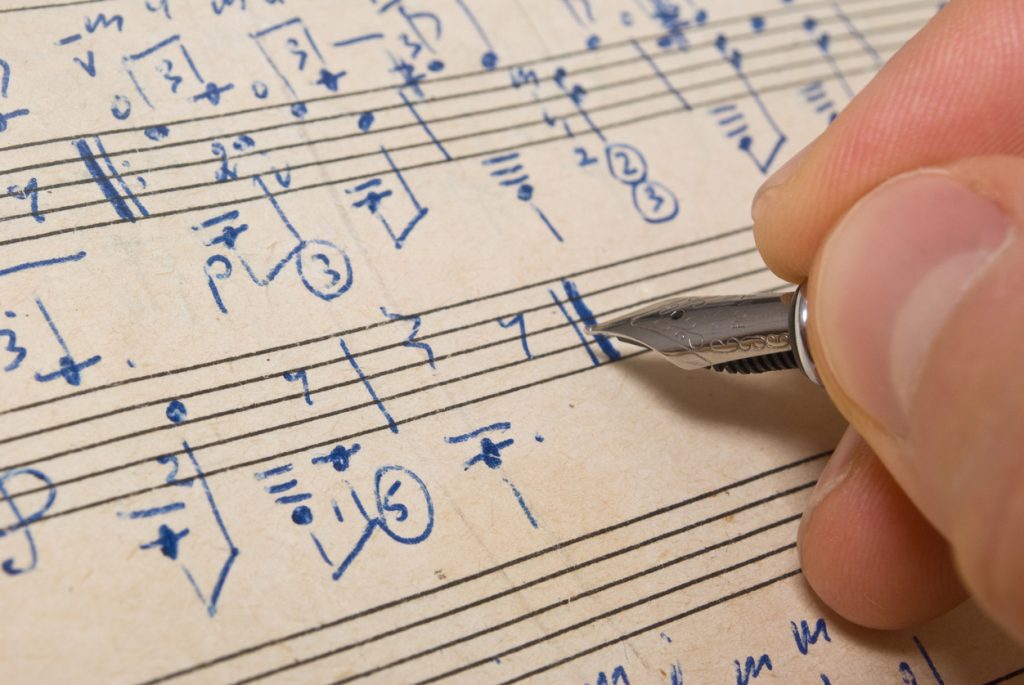
The chord is not resolved. It is as if the Composer set down His pen and the Holy Spirit carried the melody into our hearts to complete. Mark gives us the beginning — the opening pitch, the first vibration, the pure note of truth — and then hands the song to us.

The ending is up to us.

A Closing Prayer

Heavenly Father,

tune our hearts to Your truth. Let Your Gospel be the pure note that steadies our steps, aligns our desires, and calls us into harmony with Your Spirit. As Mark handed the unfinished melody to the early church, help us carry it faithfully in our own generation. Give us courage like John, humility like Peter, and clarity like Mark. May our lives ring with the sound of Your grace, resonating in every place You send us. In Jesus name we pray,

Amen.

Reflection Question

Where is the Holy Spirit inviting you to continue the “unfinished Gospel” this week — through your words, your worship, or your witness?

Resource

Wessel, Walter W. The Communicator’s Commentary: Mark. Vol. 2. Waco, TX: Word, 1982.

Further Reading

If you’d like to meditate further on the themes in this post, spend time with these passages from Mark’s Gospel:

  • Mark 1:1–8 — The beginning of the Good News and the voice in the wilderness
  • Mark 8:27–30 — Peter’s confession of Christ
  • Mark 10:45 — The Son of Man who came to serve and give His life
  • Mark 14:27–31 — Peter’s denial foretold
  • Mark 15:33–39 — The crucifixion and the centurion’s confession
  • Mark 16:1–8 — The “unfinished” ending that invites us to continue the story

Amazing Grace

Scripture, Doctrine, and the Church Family


📖 Scripture

“Therefore, there is now no condemnation for those who are in Christ Jesus.”
— Romans 8:1


Living Free in Christ: Baptist Doctrine

Bernie and I recently joined First Baptist Lubbock, and in this season, we have been intentionally studying Baptist doctrine together. As I’ve leaned into that—especially as a doctoral student in Biblical Studies at a Baptist university—I’ve found something that has deeply encouraged my heart… something I am truly thankful for.

As I studied the doctrine, this is what I found:

At its core, Baptist theology carries a beautiful truth for struggling Christians: receiving new mercies is part of the Christian life —the steady rhythm of God’s grace.

This truth is deeply reflected in Baptist doctrine.

  • Salvation by grace reminds us that we are not defined by our past, but justified through Christ.
  • The priesthood of all believers tells us we can come directly to God—boldly and immediately
  • Soul competency reminds us that we stand personally before God, responsible to Him above all.
  • Sanctification reminds us that growth is ongoing… and stumbling is not the end

And I found myself thinking:

This is amazing grace.


📖 What Does Scripture Say?

As a Bible student, I had to ask:

What does Scripture actually say about living in ongoing renewal without shame through the steady rhythm of God’s grace?

From the very beginning, we see that shame entered through sin.

In the Garden, Adam and Eve didn’t just feel guilty—they hid. Shame whispered, “This is who you are now.” It shifted identity.

But the Gospel tells a different story.

Jesus meets people in their shame—and He restores them.

He does not define them by their failure.
He redefines them through His grace.

In John 8, when the woman was brought before Him, Jesus had every right to condemn her… but instead, He extended mercy, called her out of sin, and lifted her from the shame that once held her. And, He told her to go and sin no more.


What We Are Reminded of in Scripture

  • “If we confess our sins, He is faithful and just to forgive us…” (1 John 1:9)
  • “As far as the east is from the west, so far has God removed our transgressions from us.(Psalm 103:12)
  • “Therefore, if anyone is in Christ, the new creation has come: The old has gone, the new is here!” (2 Corinthians 5:17)

Here is the truth:

Shame may enter through sin, but it is broken through the finished work of Christ.

When Jesus said, “It is finished,” He wasn’t just paying for sin—He was breaking the power of sin and removing the guilt that once defined us, restoring our identity in Him.


Doctrine and Scripture Together

When I compare what I found in Baptist doctrine with what I found in Scripture, they align so beautifully:

  • Doctrine says we can come boldly → Scripture says there is no condemnation for those in Christ.
  • Doctrine says we have access to God → Scripture says we are cleansed and made new for those in Christ.
  • Doctrine says growth is ongoing → Scripture says grace is sufficient for those in Christ.

And this is what I am most thankful for:

Being made new is a natural part of the Christian life—the steady, faithful rhythm of God’s grace.


🤍 Why the Church Family Matters

From my heart, I want to say this:

This is why being part of a church family matters so much.

Yes, we can come to God individually—and that is a beautiful truth.
But we were never meant to walk this out alone.

We need a place where:

  • grace is spoken out loud
  • Truth is lived in community
  • restoration is seen
  • And people remind us who we are when we forget

The church becomes living proof that starting again is possible… not just once, but daily.


🌸 Living This Out

In our home, in our church, and through The House of Prayer, this is what Bernie and I are learning to live: Daily priesthood means daily renewal
Daily renewal means we keep walking forward—restored, renewed, and covered in grace.


🙏 Prayer

Father,
Thank You for the gift of grace that continually renews us in Christ.
Thank You that in Christ, we are not defined by our past or our sin, but made new in Christ.

Teach us to come boldly to You—not hiding, not hesitating, but trusting in Your mercy.
Help us receive Your forgiveness fully and walk in the new identity You have given us.

Strengthen us to keep growing, keep turning, and keep trusting You.
And thank You for the gift of the church—for people who speak truth, extend grace, and walk alongside us.

Let our lives reflect the rhythm of Your grace—again and again.

In Jesus’ name,
Amen.

Consider the Lilies: Walking the Prayerful Path of Trust

Matthew 6:28

I spent a beautiful afternoon with the Lubbock Christian Women’s Connection, and from the moment I walked in, I knew it would be special. One of our fearless leaders greeted me with such kindness, looked straight into my eyes, and said, “Dee Ann, we need you to be a table hostess.”

Now I will be honest with you—there is an old fear that sometimes tries to rise up in moments like that. It grabs hold of my words and makes them want to dance into a stutter. For just a second, I felt it coming. But instead of letting fear speak, I quietly reached for Jesus’ hand and said, “Of course.”

And oh, how the Lord provides.

Karen Wood became my buddy for the day. By God’s grace, I managed to get us both safely to the Country Club, and we were ready to celebrate sisterhood. But what meant the most was this—Karen leaned in and said so gently, “I’ve been a hostess before… we can do it together.”

Isn’t that just like Jesus?

I whispered a quiet thank-you to Him in that moment—for a sweet friend, for His steadying presence, and for the courage to step into a responsibility I might have once avoided.

The afternoon itself was rich with beauty. Lindy Woods filled the room with songs that seemed to settle right into our hearts, preparing us for what God had in store. Then we heard from Leana Neagle of Willis, Texas, whose message, “On the Heels of Grace,” felt like holy ground.

Her story of miraculous healing was truly unforgettable.

After surviving a horrific wreck—something she should not have lived through—she faced the very real possibility of losing her legs. Doctors doubted. Healing seemed uncertain. Even walking again felt out of reach. And yet, in that place of deep trial, she encountered a word she had never fully understood before: testify.

Through the power and mercy of God, not only did she keep her legs, but she went on to do what once seemed impossible—she walked a marathon. And there she stood before us, whole, strong, and full of faith, declaring the goodness of God.

It was more than a testimony—it was a living picture of grace in motion.

The theme of our gathering was flowers, and as I sat at the table, my heart turned to Scripture:

“And why are you anxious about clothing? Consider the lilies of the field, how they grow: they neither toil nor spin.”
— Matthew 6:28

At Table 4, we gathered as women carrying responsibilities, hopes, and even quiet burdens. And Jesus, knowing hearts like ours, pointed us to something as tender as a flower to teach us about trust.

Throughout Scripture, flowers quietly preach truth:

God’s Provision
Lilies do not strive or strain, yet God clothes them in beauty. If He tends to something so fleeting, how much more will He care for you?

Human Frailty
We are like flowers of the field—here for a moment, then gone. Yet the Word of our God stands forever.

Restoration and Hope
God causes deserts to bloom again. Dry places are never beyond His reach.

Love and Delight
Flowers in Song of Solomon remind us that we are not simply sustained—we are cherished and delighted in.

Flowers bloom for a season, but they return again and again. Their rhythm mirrors our own lives—flourishing, fading, and blooming again through the faithful hand of God.

And after hearing Leana’s story, those flowers seemed to say even more:

God restores what seemed lost.
God strengthens what seemed broken.
God brings life where there was once only fear.

So as I looked at the flowers on our table—and at the women gathered around it—I sensed the Lord gently whispering:

You are seen.
You are sustained.
You are deeply loved.

To the Lubbock Christian Women’s Connection, thank you for such a lovely afternoon, for your warm welcome, and for creating a space where faith and sisterhood bloom so beautifully.

May we all continue walking this Prayerful Path… learning to trust the One who tends every petal.


Prayer

Heavenly Father,

thank You for the gentle lessons You place all around us. In flowers, in friendships, and in testimonies of grace, You remind us that You are always at work.Help us to trust You the way the lilies do—without striving, without fear, simply resting in Your care. Thank You for stories like Leana’s that remind us You still heal, You still restore, and You still call us to testify to Your goodness.For every woman reading this, let Your peace settle deeply.
Where there is weariness, bring rest.
Where there is fear, bring courage.
Where there is dryness, bring new life.Teach us to bloom in every season and to walk faithfully wherever Your grace leads.We love You, Lord.
Amen.

The Moment Good News Broke In

The House of Prayer Bible Commentary

Bernie and I are so excited to begin a new journey together—we are writing a Bible commentary for The House of Prayer. We’re starting where our hearts always seem to go first: the Gospels, and especially the fast-moving, powerful account of Mark. What you’re reading here is a “commentary on the commentary,” a glimpse into our very first entry, Mark 1:1. Our prayer is that these reflections will not only inform but draw others closer to Jesus as His Word comes alive line by line.

The beginning of the gospel of Jesus Christ, the Son of God.

Mark 1:1

Some beginnings simply introduce a story, but others announce that everything is about to change. Mark wastes no time easing his readers in. With striking clarity and urgency, he opens: “The beginning of the gospel of Jesus Christ, the Son of God” (Mark 1:1). In a single line, he sets the tone, declares his purpose, and invites us to step into something far greater than a narrative—a divine revelation unfolding in real time.

From the earliest words of Scripture, we see how powerful a beginning can be. Genesis 1:1 tells us who God is and what He has done with sweeping authority. Likewise, Mark follows this pattern of clarity, but with remarkable brevity. He answers the essential questions immediately. The “who” is Jesus Christ. The “what” is the gospel—the good news. Yet, even in this simplicity, there is depth that cannot be contained in one sentence. Mark does not aim to say everything at once; instead, he opens a doorway into a story that will reveal its fullness as it unfolds.

The phrase “the Son of God” carries both theological weight and a sense of mystery. Some early manuscripts omit it, yet the Gospel itself resounds with its truth. From the voice of the Father at Jesus’ baptism to the confession at the cross, Mark consistently reveals Jesus’ divine identity. Even when Jesus does not frequently speak the title Himself, His actions, authority, and obedience testify to it. He is not merely a teacher or prophet—He is the One through whom God’s power is made known, the obedient Son who walks the path of suffering and surrender for the sake of the world.

What is especially striking is Mark’s use of the phrase “the beginning.” This is not just a starting point in time; it is the launch of something eternal. It reaches back into the promises spoken by the prophets, now coming into fulfillment. It stands firmly in the present moment, where God’s redemptive plan is actively unfolding. And it stretches into the future, where the full impact of this good news will be realized. Mark’s beginning is not confined to a moment—it is the inauguration of a kingdom.

And then there is the word “gospel.” Mark introduces it without explanation, allowing its meaning to emerge through the life, ministry, death, and resurrection of Jesus. The good news is not delivered as a definition, but as a living reality. It is seen in healing, heard in teaching, and ultimately revealed in sacrifice and victory. Mark invites us not just to understand the gospel, but to encounter it.

As readers, we are not positioned as distant observers. From the very first verse, we are drawn in. We are invited to recognize who Jesus is, to receive the good news He brings, and to follow where this beginning leads. Mark’s Gospel reminds us that when God begins something, it is never small. It carries the weight of eternity and the power to transform every life it touches.

This is where the good news begins—and it is where our salvation begins as well.

Prayer
Heavenly Father,

thank You for the power and clarity of Your Word. Thank You for sending Jesus, the Son of God, as the good news our hearts long for. Help us to see beyond the surface and recognize the depth of what You have begun. Draw us into Your story, and give us faith to follow where You lead. Let Your truth shape us, and let Your gospel come alive in our lives each day. In Jesus’ name, amen.

Resources:

Broadman Bible Commentary, vol. 8. Nashville, TN: Broadman Press, 1969.

Rydelnik, Michael, and Michael Vanlaningham, eds. The Moody Bible Commentary. Chicago, IL: Moody Publishers, 2014.

Further Reading

  • Genesis 1:1 – “In the beginning, God created the heavens and the earth.”
  • Isaiah 40:3 – “A voice of one calling: ‘In the wilderness prepare the way for the Lord…’”
  • Malachi 3:1 – “I will send my messenger, who will prepare the way before me…”
  • Mark 1:11 – “And a voice came from heaven: ‘You are my Son, whom I love; with you I am well pleased.’”

Cast It Anyway: Trusting God in the Unknown

by Dee Tackitt

Most mornings, I grind wheat berries and begin making homemade bread. It is a long process. The grain has been planted, grown, harvested, ground, mixed, and kneaded—long before it ever reaches my kitchen table. And even then, I still have to trust the process. I place the dough aside, not rushing it, not forcing it… just waiting.

There is a letting go in breadmaking.
You do your part—and then you trust what you cannot see.

Ecclesiastes 11 speaks to that same kind of faith.


Ecclesiastes 11:1-6

Ship your grain across the sea;
    after many days you may receive a return.
Invest in seven ventures, yes, in eight;
    you do not know what disaster may come upon the land.

If clouds are full of water,
    they pour rain on the earth.
Whether a tree falls to the south or to the north,
    in the place where it falls, there it will lie.
Whoever watches the wind will not plant.
    Whoever looks at the clouds will not reap.

As you do not know the path of the wind,
    or how the body is formed[a] in a mother’s womb,
so you cannot understand the work of God,
    the Maker of all things.

Sow your seed in the morning,
    and at evening let your hands not be idle,
for you do not know which will succeed,
    whether this or that,
    or whether both will do equally well.


🌊 Cast Your Bread (vs. 1)

“Cast your bread upon the waters…”

At first, it sounds like a loss. Like letting go of something valuable without a guarantee of return.

But this is not waste—it is trust.

The bread we cast is the Word of God.
The waters are the movement of the Holy Spirit.

And here is the quiet promise:
When the Word is released into the current of the Spirit, God carries it where it needs to go.

You may not see the result today.
You may not even recognize it when it returns.

But it will not be wasted.


🌱 Don’t Hold Back (vs. 2)

“Invest in seven ventures, yes, in eight…”

Live open-handed.

Love more than feels safe.
Serve in more places than feel comfortable.
Speak truth even when you don’t know how it will be received.

Seven reminds us of God’s perfect work.
Eight reminds us of resurrection—new life where none seemed possible.

When we sow into the gospel—Jesus Christ and Him crucified—we are sowing into eternal life.

And you don’t know which seed will take root…
or if God will cause many to flourish at once.


🌧️ Trust Where It Lands (vs. 3)

“If clouds are full of water, they pour rain…
If a tree falls… there it will lie.”

Some outcomes are simply not yours to control.

Life does not always unfold neatly.
Ministry does not always land where you hoped.
People do not always respond the way you prayed they would.

And yet—God is not hindered by where things fall.

Wherever the seed lands,
wherever the rain pours,
God is still able to bring life.


🌬️ Don’t Wait for Perfect Conditions (vs. 4)

“Whoever watches the wind will not plant…”

If we wait until everything feels certain, we will never begin.

There will always be:

  • One more reason to hesitate
  • one more unknown
  • one more “what if”

But faith does not wait for perfect weather.

Faith plants anyway.
Faith sows anyway.
Faith trusts anyway.


👶 Rest in the Mystery (vs. 5)

“As you do not know… how the body is formed in a mother’s womb…”

There are sacred things only God understands.

A baby growing in secret.
The movement of the wind.
The quiet work of God beneath the surface of your obedience.

You may not see it forming.
You may not feel progress.

But something holy is happening.

God is working—deep, unseen, and sure.


🌅 Keep Sowing (vs. 6)

“Sow your seed in the morning, and at evening let your hands not be idle…”

This is steady faith.

Not rushed.
Not anxious.
Just faithful.

Morning—sow.
Evening—sow again.

Pray.
Encourage.
Speak truth.
Show up.

Because you do not know which effort will bear fruit…

“…or whether both will do equally well.”

And sometimes—
in the kindness of God—
Both do.

A Prayer for the Path

Heavenly Father,

We come to You with open hands.
So much of what we do feels like casting—releasing what we love into places we cannot control.

Teach us to trust You in the letting go.

When we sow Your Word, remind us that it is never wasted.
When we feel uncertain, steady our hearts in Your promises.
When we are tempted to wait for perfect conditions, give us courage to act in faith.

Lord, we confess—we like to understand everything.
But You are the Maker of all things, and Your ways are higher than ours.

So help us rest in the mystery of Your work.

As a child is formed in the womb, unseen but full of life,
let Your purposes grow in ways we cannot yet see.

Give us diligence to sow in the morning and in the evening.
Keep our hands from becoming idle and our hearts from growing weary.

And when the harvest comes—whether soon or after many days—
remind us that every good thing has come from You.

We trust You with the seed.
We trust You with the outcome.
We trust You with the waiting.

In Jesus’ name,
Amen.

Resources:

Beetham, Christopher A., and Nancy L. Erickson, eds. The NIV Application Commentary on the Bible. NIV Application Commentary. Grand Rapids, MI: Zondervan Academic, 2024.

Everett, Gary H. The Book of Ecclesiastes. Study Notes on the Holy Scriptures. 2011.

Hale, Thomas. The Applied Old Testament Commentary. Colorado Springs, CO; Ontario, Canada; East Sussex, England: David C. Cook, 2007.

Scripture for Further Reflection

  • Proverbs 11:24–25 – The principle of generous sowing and return
  • Isaiah 55:10–11 – God’s Word accomplishing His purpose
  • Hosea 10:12 – Sowing righteousness and reaping steadfast love
  • Matthew 13:3–9, 18–23 – The parable of the sower
  • Luke 16:10 – Faithfulness in small things
  • 1 Corinthians 3:6–7 – God gives the increase
  • 2 Corinthians 9:6–8 – Sowing generously
  • Galatians 6:7–9 – Reaping in due season
  • James 1:5 – Trusting God’s wisdom
  • Hebrews 11:1 – Faith in what we do not see

IT WAS NEVER ABOUT small FAITH

Let’s pour a cup of coffee and sit with Jesus for a minute.

Some mornings I’ve looked at my life—my people, my city, my calling—and thought, “Lord, I don’t feel like I have much today.” Maybe you’ve felt that, too. We often stare at our faith like it’s a measuring cup: Do I have enough? Is it big enough? Strong enough? But a mustard seed never looks at itself and wonders if it’s big enough to be a tree. A seed doesn’t measure—it grows. And that is exactly where Jesus meets us.

“The kingdom of heaven is like a mustard seed, which a man took and planted in his field. Though it is the smallest of all seeds, yet when it grows, it is the largest of garden plants and becomes a tree, so that the birds come and perch in its branches.” — Matthew 13:31–32 (NIV)

“It is like a mustard seed, which is the smallest of all seeds on earth. Yet when planted, it grows and becomes the largest of all garden plants, with such big branches that the birds can perch in its shade.” — Mark 4:31–32 (NIV)

I love how Jesus takes something ordinary and reveals something unstoppable. He’s not giving a botany lesson about the tiniest seed; He’s showing us that God’s kingdom—and the faith God plants—cannot stay small. It carries His life inside it. It carries a future. It carries shelter for others.


A Conversation Over Coffee: So… what did Jesus mean?

Most of us grew up hearing, “Even a little faith is enough.” But let’s listen a bit closer. In the kingdom parables (Matthew 13; Mark 4), Jesus sets the mustard seed in a field and says, Watch what happens. The point isn’t the seed’s size; it’s the seed’s destiny—it will become something that cannot be missed. The kingdom may start quietly, but it will not end quietly.

When Jesus talks about faith “like a mustard seed” in other places, we often assume He means “faith as small as.” But there’s a rich, faithful way to hear it as faith with the nature of a seed—faith that carries the certainty of what God has promised. A seed doesn’t wonder if it will become a plant; it simply becomes what it was designed to be. That’s how divine faith works inside a believer: it trusts the outcome God has already authored.

One writer I found puts it beautifully: faith accomplishes more in proportion to its beginning than anything else we possess—not because we are impressive, but because the God who gives faith is omnipotent. Jesus’ “move a mountain” language is a holy, hope-stirring hyperbole pointing to God’s power, not our spiritual muscle. Pure, living faith the size of a seed removes a mountain; lifeless faith the size of a mountain removes nothing. That contrast shifts our eyes from our faith’s size to our faith’s Source.


What the First Audience Heard (and Felt)

Picture Jesus’ listeners—farmers, tradespeople, parents, elders—people who knew the dirt under their nails and the ache in their backs. They had seen mustard grow wild and hardy in their fields. When Jesus said, “The kingdom is like a mustard seed,” they didn’t reach for a ruler. They nodded because they’d watched a seed, which almost became a plant that took over the garden and offered shade to birds. They heard inevitability. They heard life that spreads. They heard, “What God plants will take root in this world, even if it starts in the margins.”

And when Jesus spoke of faith “like a mustard seed,” they weren’t picturing a tiny drop of spiritual courage on a measuring spoon. They were picturing seed-life—the built-in certainty that what God begins, He finishes; what He plants, He grows; what He promises, He keeps.


Bringing the Principle Home (to your kitchen table and mine)

So, let’s carry this into our lives.

  • When you whisper a prayer that feels small, remember faith doesn’t work because it’s big; faith works because God is big. The seed doesn’t “try” to grow—it responds to light, water, and the hand that planted it. Your faith responds to God’s character, God’s Word, and God’s Spirit.
  • When the need in front of you looks like a mountain, don’t stare at the “size” of your faith. Stare at the faithfulness of your God. Mountains don’t move because we push hard; they move because He speaks and He sustains.
  • When you feel disqualified by weakness, remember living faith outgrows every limit because its life is divine. It may begin quietly, but it becomes a tree with branches wide enough for others to rest. Your trust in Jesus is meant to become shade for someone else.

If God planted it, it’s going to grow. That’s true for His kingdom in the world, and it’s true for His faith in you.


A gentle challenge (for our hearts)

Let’s retire the phrase, “My faith is small.” The seed never says, “I’m tiny.” The seed simply becomes. From now on, let’s say, “My God is great, and He has planted His life in me.” That confession turns the eyes of our hearts to where power truly lives.

It was never about small faith.
It has always been about God’s faithfulness growing in us.


Prayer

Heavenly Father
Thank You for planting Your life in our hearts.
Teach us to stop measuring and start trusting—
to look less at ourselves and more at You.

Where we feel thin, breathe Your strength.
Where we feel late, remind us You are right on time.
Where the mountain looms, speak Your word, and align our faith with Your will.

Make our lives like that mustard tree—
rooted, growing, and wide-branched with shelter for others.
Let Your kingdom come through the faith You planted in us.

In Jesus’ name, Amen.