Category Archives: Scripture Reflections

Questioning the Questioners

Jesus’s Prophetic Pedagogy of the Heart

by Dee Ann Loving-Tackitt
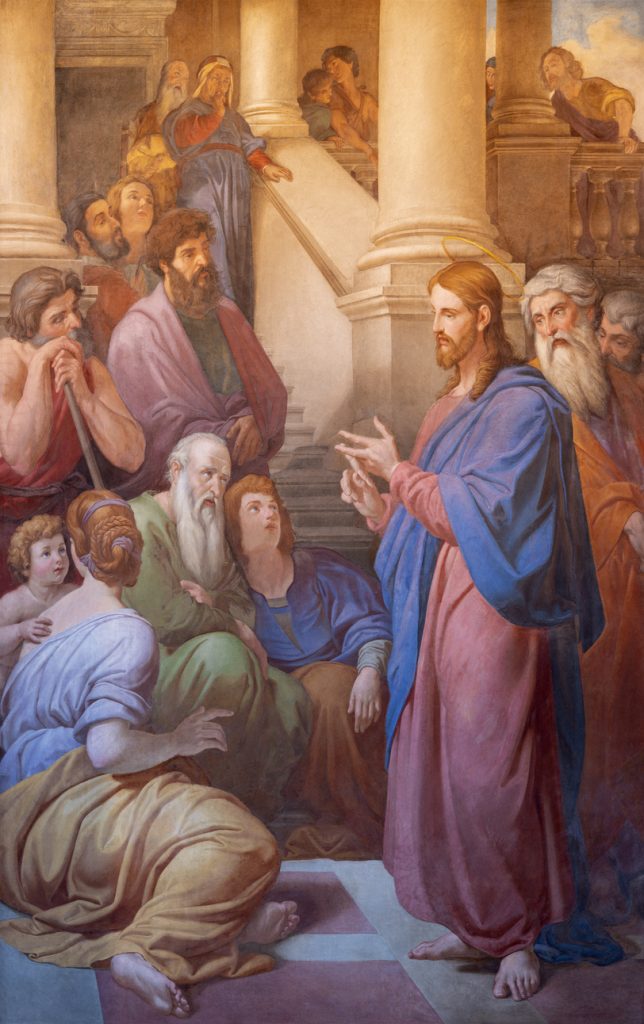
Rome – The fresco of Jesus teaching in the church Santa Maria in Monticelli 

“You call me ‘Teacher’ and ‘Lord,’ and rightly so, for that is what I am.” John 13:13

Jesus is asked many questions in the Gospels; he rarely answers any of them directly. Some may see Jesus as cleverly evading the questioner. Yet I argue that Jesus’s “questioning questioners” is His vital teaching tool to awaken and involve his listeners in spiritual formation. In this context, Jesus typically responds to questions with another question, either through an indirect claim or a specific revelatory aim. Always! Jesus reframes the terms of a pressing topic and sheds light on his interlocutors’ root motives and spiritually compromised perspectives.

In John 13:13, Jesus tells his disciples, “You call me ‘Teacher’ and ‘Lord,’ and rightly so, for that is what I am” (cf. Matt 23:10; 26:18). As a teacher, Jesus adopts different teaching styles for formative reasons. As God anointed, Jesus speaks and embodies the message of God’s reign. He aligns with the prophets of Israel’s past, including John, his immediate predecessor. Jesus seeks to heal and to reveal. Divine revelation aims to open and purify the heart before God. This prepares people to receive God’s Torah written on their hearts (Jer. 31:33). The new covenant transforms the heart from within, and this transformation lies at the center of faithful living.

The Teacher of the Coming Kingdom

To be specific, we must set forth the “givens” of Jesus as a teacher from the context of His ministry and mission. First, Jesus came to proclaim the coming of the Kingdom of God. Second, He is to make disciples, to “seek and save the lost”; “to give His life as a ransom for many”; “to save sinners”; “to save the sick”; and to do all this by summoning His hearers to metanoia, which means calling forth repentance before the coming of the reign of God. To fulfill this goal, Jesus is willing to say to His own disciples what He also said to those who approach, question, and dispute with Him. Therefore, Jesus clearly accepts and even promotes an environment conducive to dialogue, questioning, and discussion.

The Prophet of the Heart

As a theologian, I am quick to point out that Jesus does not have educational exchanges to get the facts. He debates to fulfill God’s will. He exposes and shapes the listener’s core desires, assumptions, and perspectives. Jesus is NOT willing to engage a question directly when the basic question and exchange have already been molded to be anti-kingdom. Jesus’s pedagogy is not aimed at the heart to access commitments, intentions, desires, and core thoughts. Jesus grappled with reason to access the heart for the Kingdom. Jesus is fiercely consistent, whether in response to a question or a straightforward demand. In Luke 12:13–14 (NIV), someone in the crowd said to him, “Teacher, tell my brother to divide the inheritance with me.” Jesus replies, “Man, who appointed me a judge or an arbiter between you?” Rather than simply saying, “No, I won’t do that,” Jesus’s question functions as a claim: why are you trying to use me or manipulate me to resolve your family’s financial dispute? In Luke 12, Jesus confronts greed, worry, and conflict over material security as crucial issues that can obstruct sincere acceptance of proclamation. This is, however, just one instance of Jesus questioning the nature of one’s actions to address a broader, perennial challenge to entering the way of the kingdom. Jesus ultimately seeks to reveal and transform a person’s bedrock desires and intentions so they may see and enter the way of God’s reign. Shalom.

Heavenly Father,

Today, we choose to pay close attention to wisdom and listen intently to understanding. Help us to trust in the Lord with all our heart and lean ONLY on your understanding. In all our ways, may we acknowledge Jesus. And we ask you to direct our paths. We ask you to remove our proud hearts so that we can trust in You. In Jesus’ precious name we pray. Amen

Practicing Resurrection: Answering Christ’s Call to Love, Obey, and Follow

by Dee Ann Loving-Tackitt

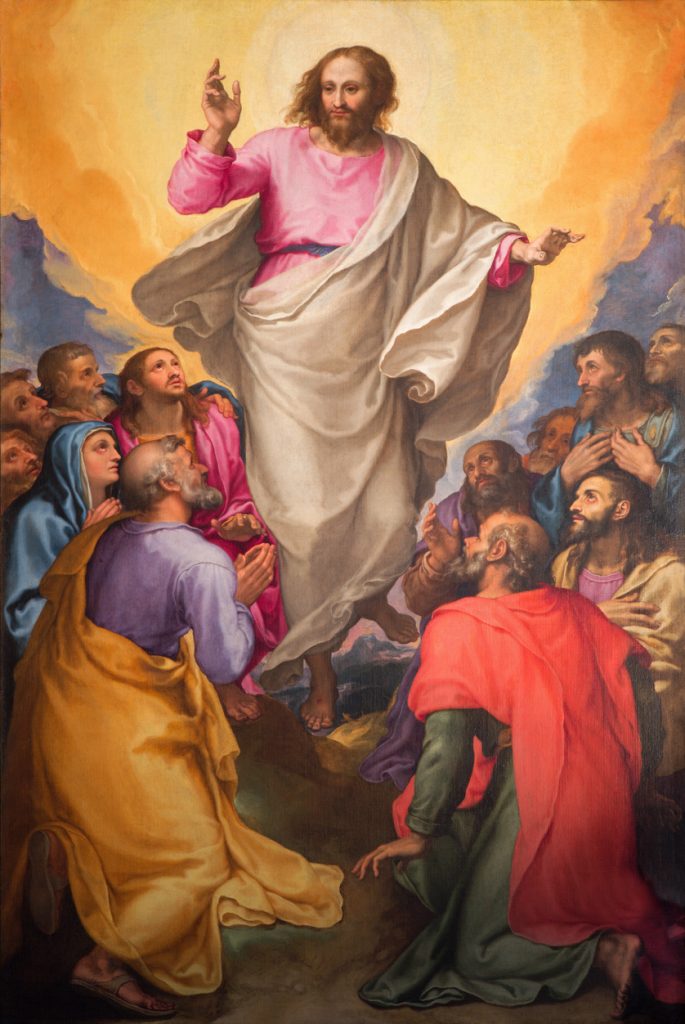
Rome – Ascension of the Lord painting of Chiesa Nuova

“As the Father has loved me, so have I loved you. Now remain in my love. If you keep my commands, you will remain in my love, just as I have kept my Father’s commands and remain in his love. I have told you this so that my joy may be in you and that your joy may be complete.”—John 15:9–11

Writing from a Nazi prison, Dietrich Bonhoeffer wrote, “What keeps gnawing at me is the question, Who is Christ actually for us today?” That question still presses on every serious Christian. Jesus put this issue before his disciples during his farewell supper when he said, “If you love me, you will keep my commandments…You are my friends if you do what I command you” (Jn 15:14 In this sense,  He repeated this challenge in the Sermon on the Mount, “Not everybody who says to me, ‘Lord, Lord,’ will get into the kingdom of heaven. Only those who do the will of my Father who is in heaven will enter” (Matt 7:21).  The risen Christ, while eating breakfast with Peter on the beach, asks him the same question three times, “Simon, do you love me?” Peter replies each time, “Lord, you know I love you.” In light of Peter’s triple denial, Jesus gave him a concrete command: “Feed my sheep.” He concluded with the words, “Follow me” (John 21:15–19).

Jesus was consistent and clear. He was not looking for admirers who would merely nod in agreement with the Sermon on the Mount. He called followers who would put his words into practice. Because God raised Jesus from the dead, we follow the living Christ here and now. To “practice resurrection” is not simply to admire Jesus from a distance, but to let his risen life take shape in our own lives.  

In Christian thought, “practicing resurrection” is a theological concept that means rather than waiting for resurrection only after death, believers “practice resurrection” by embodying qualities associated with resurrection life: hope in the face of despair, forgiveness and reconciliation, justice and compassion, renewal after failure or loss, and participation in God’s work of bringing new life to the world. This phrase is associated with writer and pastor Eugene Peterson, who used it to describe the daily life of discipleship. Fortunately, “practicing resurrection” is something that most of us are already living. We were made in, through, and for Christ (Col 1:16). He has taken our human nature upon himself and joined our lives to his own. Our “life is in Christ, who became for us wisdom from God, and righteousness and sanctification and redemption” (1 Cor 1:30). God created us to know him.  We are given a gracious participation in God’s own goodness. This grace enables us to know God even though apart from him, we are incapable of and unfit for such knowledge.

If we seek knowledge of God by grace through faith, we will walk the way of Jesus, because anyone who seeks to know God will pursue the mind of Christ and the humility and obedience that go with it. We anticipate the life of fellowship we will share with God for eternity. As Paul reflects this kind of mindset, we are to “seek the things that are above, where Christ is seated at the right hand of God.” Irenaeus said it well when he wrote, “The Word of God, Jesus Christ, on account of his great love for mankind, became what we are in order to make us what he is himself.”

Shalom.

When Worship Needs Repentance

by Dee Ann Loving-Tackitt

A blog reflection on hollow religion, true repentance, and the mercy of God

Isaiah 1:10–18 (NIV)

10 Hear the word of the Lord, you rulers of Sodom; listen to the instruction of our God, you people of Gomorrah!
11 “The multitude of your sacrifices— what are they to me?” says the Lord. “I have more than enough of burnt offerings, of rams and the fat of fattened animals; I have no pleasure in the blood of bulls and lambs and goats.
12 When you come to appear before me, who has asked this of you, this trampling of my courts?
13 Stop bringing meaningless offerings! Your incense is detestable to me. New Moons, Sabbaths and convocations— I cannot bear your worthless assemblies.
14 Your New Moon feasts and your appointed festivals I hate with all my being. They have become a burden to me; I am weary of bearing them.
15 When you spread out your hands in prayer, I hide my eyes from you; even when you offer many prayers, I am not listening. Your hands are full of blood!
16 Wash and make yourselves clean. Take your evil deeds out of my sight; stop doing wrong.
17 Learn to do right; seek justice. Defend the oppressed. Take up the cause of the fatherless; plead the case of the widow.
18 “Come now, let us settle the matter,” says the Lord. “Though your sins are like scarlet, they shall be as white as snow; though they are red as crimson, they shall be like wool.”

The Shock of the Opening Address

The passage begins with a jolt: “Hear the word of the LORD, you rulers of Sodom; listen to the instruction of our God, you people of Gomorrah!” Isaiah is not speaking to pagan cities, but to Judah. By using Sodom and Gomorrah, he strips away false security based on covenant identity, temple worship, or religious tradition.

God Rejects Worship That Covers Injustice

The sacrifices were not inherently wrong; God had given Israel a sacrificial system. The problem was that Judah had turned worship into a substitute for repentance. They were bringing offerings while continuing in violence, oppression, and neglect of the vulnerable.

God’s language is intense: “I have more than enough,” “I have no pleasure,” “Stop bringing meaningless offerings,” “Your incense is detestable to me,” and “I hate with all my being” your appointed festivals. This is divine revulsion toward worship that has become a mask for sin.

Verse 15 gives the sharpest image: “When you spread out your hands in prayer, I hide my eyes from you… Your hands are full of blood!” The posture of prayer cannot erase injustice. Hands lifted in worship are unacceptable when those same hands tolerate oppression.

The Call: Wash, Turn, Learn, Seek

Isaiah does not leave the people with condemnation alone. God commands them to wash, become clean, remove evil, stop doing wrong, and learn to do right. Repentance is not merely feeling sorry; it is a reorientation of life.

That reorientation is concrete: “seek justice. Defend the oppressed. Take up the cause of the fatherless; plead the case of the widow.” For Isaiah, authentic worship produces advocacy for those most likely to be ignored.

The Grace of Verse 18

After such a severe indictment, verse 18 is stunning: “Come now, let us settle the matter,” says the Lord. Though their sins are like scarlet, they shall be “as white as snow.” God exposes sin not to destroy the repentant, but to invite them into cleansing.

How the New Testament Echoes Isaiah 1:10–18

The New Testament carries Isaiah’s concern forward. Jesus confronts religious leaders who are careful about outward observance while neglecting “justice and mercy and faithfulness” (Matthew 23:23). He also says, “I desire mercy, and not sacrifice” (Matthew 9:13; 12:7), echoing the prophetic conviction that religious precision cannot compensate for lovelessness.

James makes the connection even more direct: “Religion that is pure and undefiled before God the Father is this: to visit orphans and widows in their affliction” (James 1:27). Isaiah commands Judah to defend the fatherless and plead the widow’s cause; James names care for the same vulnerable groups as a mark of true religion.

What This Passage Says to Us Today

Isaiah 1:10–18 warns modern readers against measuring spiritual health only by visible religious activity. Church attendance, prayer, giving, Bible study, and public ministry matter, but they cannot replace repentance, humility, justice, and mercy. Isaiah asks not only, “Do I worship?” but, “Is my worship shaping me into someone who reflects God’s compassion?”

The passage is also hopeful. God does not simply say,Go away.” He says, “Come now.” He invites stained people into cleansing, guilty people into forgiveness, and hollow worshipers into transformed obedience.

A Closing Prayer

Heavenly Father, search our hearts and reveal where our worship has become outward performance without inward repentance. Wash us from sin, turn us from evil, and teach us to do what is right. Let our prayers lead to justice, our worship lead to mercy, and our faith become visible in compassion for the vulnerable. Thank you that though our sins are like scarlet, you promise to make them white as snow. Amen.

When the Rain Falls: What It Says About God—and About Us

by Dee Ann Loving-Tackitt

“For He makes His sun rise on the evil and on the good, and sends rain on the just and on the unjust.” —Matthew 5:45


A Simple Question That Opens a Deeper Truth

It is a simple image, yet one that carries a profound truth: rain falls without distinction. It does not pause to measure worthiness or separate the deserving from the undeserving. Instead, it nourishes everything it touches, revealing something essential about the heart of God.

The question often arises in reflection: Did it ever rain on Jesus? Scripture does not record a specific moment when raindrops fell on His shoulders, yet the land in which He lived tells its own story. First-century Palestine had cool, wet winters and hot, dry summers. Jesus walked those roads, taught among those fields, and traveled through Galilee, where storms could rise suddenly. The Gospels place Him in violent weather—winds crashing and waves surging—reminding us that the One who calmed the storm first stepped into it (Mark 4:37–39).

Because Jesus fully entered human experience, it is not difficult to imagine Him beneath darkened skies during the rainy season. This deepens Hebrews 4:15, which reminds believers that Christ sympathizes with human weakness because He lived within it. Even ordinary realities, including changing weather, were not foreign to Him.

Rain and the Sovereignty of God

Yet in Scripture, rain is never merely weather. It reveals God’s character and His relationship with His people. Throughout the Old Testament, rain belongs to the Lord alone. While surrounding nations credited fertility gods such as Baal with precipitation, Israel understood that rain came from Yahweh. Jeremiah 14:22 declares that no false god can bring rain, but only the Lord who created the heavens.

Rain as Blessing and Covenant Care

Rain also functions as a sign of covenant blessing. In Leviticus 26:4, God promises “rains in their season,” so the land would yield produce. Israel depended on early rains that softened the soil and later rains that matured crops. Regular rain testified not only to provision but to God’s faithful care, echoing Psalm 65:9–10, where He waters and enriches the earth.

When the Heavens Close: Rain and Judgment

Conversely, the absence of rain carried powerful meaning. Deuteronomy 11:17 warns that disobedience could cause the heavens to be “shut up,” leaving the land dry. Drought became a sign of spiritual fracture and a reminder that life depends on the One who gives it.

Rain as the Word That Brings Life

Scripture deepens the image by comparing rain to God’s Word. Isaiah 55:10–11 describes rain and snow falling from heaven, watering the earth, and causing it to bring forth life. In the same way, God’s Word never returns empty but accomplishes what He intends, nurturing growth that may not be immediately visible but is always purposeful.

Jesus and the Rain of Common Grace

When Jesus speaks of rain in the Sermon on the Mount, He draws on these layers of meaning and expands them. By teaching that God “sends rain on the just and on the unjust,” Jesus reveals common grace—a generosity that flows to all people regardless of merit.

This does not diminish saving grace or erase the call to faith. Instead, it shows that some of God’s gifts are given freely, not as rewards but as expressions of His nature. The rain that falls on every field reminds us that God’s goodness cannot be confined to human measurements of worthiness.

The One Who Sends Rain… Walked Beneath It

In this light, the simple question about rain takes on greater significance. Whether or not a Gospel writer recorded the moment, Jesus lived beneath the same sky that gives sunshine and rain. The One who created the seasons walked within them, and the One who sends rain embodied that generosity in His life and ministry.

For believers, this reframes the experience of rain. At times, rain may feel like blessing, refreshing the soul and bringing renewal. At other times, it may feel like difficulty, a season where clarity is hidden behind heavy clouds. Yet Scripture invites trust: full clouds eventually pour themselves out upon the earth, turning what appears heavy into something life-giving.

Because of Christ, no moment within that experience is empty of meaning. Emmanuel—God with us—has stepped into every condition of human life, both calm and storm. His presence assures us that nothing we encounter is outside His care.

A Closing Reflection: Standing in the Rain

Rain, then, becomes more than a natural occurrence. It becomes a testimony of God’s sovereignty, provision, discipline, Word, and grace, revealing a goodness that extends beyond human expectations.

And within that truth is a quiet invitation: to trust that, whether standing in sunlight or beneath falling rain, one is held within the care of the God who sends it—and the Savior who once walked beneath it.

How Big is Our God?

by Dee Ann Loving-Tackitt

Now to him who is able to do immeasurably more than all we ask or imagine, according to his power that is at work within us. Ephesians 3:20–21

Offer Prayers That Match the Size of Your God

Pastor Burden (Dr. Jason) at First Baptist Lubbock recently said, “Offer prayers that are proportionate to the size of your God.” Those words settled deep in my spirit. In fact, the Holy Spirit just wouldn’t leave me alone about it. I felt convicted. Do I really understand how big God is?

I have learned—maybe because of my age, or maybe because of my deepened relationship with Jesus—that when I do not know an answer, I immediately go in prayer and to His Word. This is what I found in the Bible:

God’s Greatness Is Beyond Measure

God’s magnitude transcends human comprehension entirely. God is great with abundant power, and his understanding extends beyond measure. (Ps 147:5) Even heaven and the highest heaven cannot contain God—how much less a human-built structure. (1 Kings 8:27) This isn’t merely poetic language; it describes God’s fundamental nature.

God Is Everywhere Yet Uncontained

God fills heaven and earth, (Jer 23:24) yet this omnipresence doesn’t confine him to space. Whether one ascends to heaven or descends to Sheol, whether one travels to the uttermost parts of the sea, God is present there. (Ps 139:7–12) The paradox is essential: God operates within creation while remaining entirely unconditioned by spatial or temporal limits.

God’s Wisdom Is Unsearchable

God is the everlasting Creator of the earth’s ends, never fainting or growing weary, with understanding that cannot be searched out. (Isa 40:28) God’s depths cannot be discovered, his limits cannot be found—his measure exceeds heaven, Sheol, earth, and sea. (Job 11:7–9) The riches, wisdom, and knowledge of God are unfathomable; his judgments and ways are inscrutable. (Rom 11:33)

God Is Greater Than Our Understanding

This immensity creates a profound tension: God’s thoughts and ways are as far above human thoughts and ways as the heavens exceed the earth. (Isa 55:8–9) God measures waters in his hand, marks the heavens with a span, and treats nations as drops from a bucket and dust on scales. (Isa 40:12–15) God is able to do far more abundantly than all we ask or think. (Eph 3:20–21)

God Is Infinite—Beyond All Limits

The theological tradition captures this through the concept of infinity: God’s being and activity are in no way bound by limitations of time and space. The question of God’s location is not applicable—he brought space and time into being and existed before space was created. God’s size, ultimately, cannot be measured because measurement itself is a finite concept applied to an infinite reality.

In conclusion, Pastor Burden’s words have become both a challenge and an invitation: if God is truly immeasurable, then my prayers should no longer be limited by fear, doubt, or small expectations. My response is to pray with greater faith, greater boldness, and greater trust—believing that the God who is able to do immeasurably more is still working within us.

References

Francis Pieper, Christian Dogmatics (St. Louis: Concordia Publishing House, 1953), 441.

Millard J. Erickson, Christian Theology (Grand Rapids, MI: Baker Academic, 2013), 243.

Loving Our Enemies and Restraining Evil?

by Dee Ann Loving-Tackitt

Scripture holds together personal holiness, public justice, and divine wisdom.

“Do not be overcome by evil, but overcome evil with good.”
Romans 12:21 (ESV)

This week in Dr. Gary May’s BIBL 830 course, The Bible and the Pastor (or Uses of Scripture in Pastoral Ministry), my homework was to think through how Christians should form a biblical response to a contemporary ministry issue. The course examines how Scripture functions in preaching, teaching, counseling, church administration, and the pastor’s own devotional life, with the goal of helping pastors apply the Bible faithfully in real ministry settings. For this assignment, I reflected on John Stott’s treatment of war and peace in Issues Facing Christians Today. As I worked through the material, I was especially struck by the wisdom of Romans 12 and 13 and how those two chapters help Christians think carefully about both peace and justice. While the original discussion was written for class, I realized the subject reaches far beyond the classroom. In a world marked by violence, political division, and deep moral uncertainty, the question of how Christians should think about war is not merely academic. It is pastoral, personal, and public.

Why Stott’s Approach Matters
“Mercy triumphs over judgment.” — James 2:13


What I appreciate about John Stott’s approach is that he refuses two extremes. On one side is the idea that peace means never resisting evil in any form. On the other side is the assumption that force is easily justified whenever a nation feels threatened or angry. Stott takes neither path. Instead, he argues that because God is both just and peace-loving, Christians must think carefully and biblically about the use of force. War, in his view, is never something to celebrate. At best, it is a tragic possibility in a fallen world. Yet Stott also insists that civil government has a real responsibility before God to restrain evil and protect the innocent. That tension—between peace and justice—is what makes the discussion so difficult and so important.

A Christian Framework for Thinking About War
“Blessed are the peacemakers, for they shall be called sons of God.” — Matthew 5:9


Stott draws heavily from the historic Christian just war tradition. In simple terms, this tradition asks whether war can ever be morally justified, and if so, under what conditions. The answer is not a blank check. According to this framework, a war must have a just cause, be carried out by legitimate authority, and be pursued only after serious alternatives have been exhausted. Even then, the conduct of war must be restrained. Violence cannot be indiscriminate, and every effort must be made to protect those who are not participating in the fighting. Finally, there must be a realistic hope that the use of force will lead to a more just outcome rather than deepen injustice. What makes Stott’s discussion valuable is that he does not treat these ideas as political slogans. He treats them as moral boundaries that place human power under God’s judgment.

Romans 12 and 13 and the Wisdom of God
“Never avenge yourselves, but leave it to the wrath of God…” — Romans 12:19


What I find especially compelling in Stott’s discussion is the way he handles Romans 12 and 13 together. At first glance, those chapters may seem to pull in different directions. Romans 12 calls Christians to reject revenge, love their enemies, and overcome evil with good. Romans 13 teaches that governing authorities have a God-given role in restraining evil and punishing wrongdoing. Yet when those chapters are read together, they display the wisdom of God rather than a contradiction in Scripture. Romans 12 shapes the heart and conduct of the Christian disciple. Romans 13 explains the public responsibility of civil authority. In other words, God does not give the same calling to every person or institution in exactly the same way. That distinction matters. Christians are never permitted to indulge personal vengeance, hatred, or triumphalism. At the same time, Stott argues that government may, under limited and morally serious conditions, use force to protect the innocent and restrain evil. Whether or not one agrees with every part of his conclusion, this reading of Romans 12 and 13 shows how Scripture can hold together personal holiness, public justice, and divine wisdom.

Why This Matters Beyond the Classroom
“Your word is a lamp to my feet and a light to my path.” — Psalm 119:105


What this assignment reminded me of most is that a Christian view of public life cannot be built on emotion alone. It must be shaped by Scripture. That is why questions about the truthfulness and authority of the Bible matter so much. If Scripture is trustworthy and authoritative, then Christians cannot simply adopt whatever moral position feels most compassionate or most practical in the moment. They must wrestle honestly with the whole witness of the Bible, even when that witness includes difficult tensions. For me, that is one of the enduring strengths of Stott’s work. He shows that serious Christian ethics requires more than strong opinions. It requires humble submission to God’s Word, careful theological reasoning, and a willingness to let Scripture challenge our instincts as well as our politics.

Final Thought
“If any of you lacks wisdom, let him ask God, who gives generously to all…” — James 1:5


I started this week’s homework as an academic assignment for Dr. May’s class, but I finished it thinking more deeply about the wisdom of God in Scripture. Romans 12 and 13 do not offer simplistic answers, but they do offer needed guidance. They remind us that Christians are called to humility, enemy-love, and freedom from personal vengeance, while also recognizing that God has given civil authority a role in preserving justice and order. In a time when public arguments about war, justice, and power are often shaped more by outrage than wisdom, that biblical balance matters. Stott’s work offers a helpful reminder that faithful Christian thinking requires both conviction and humility, and that God’s Word remains the surest guide for difficult moral questions.

Prayer
Heavenly Father, give us hearts that are shaped by Your Word and not by fear, anger, or pride. Teach us to love our enemies, to walk in humility, and to trust Your wisdom where difficult questions remain. Grant wisdom to those in authority, protection to the innocent, and peace where there is violence. Above all, help us to submit our minds and lives to the truth of Scripture through Jesus Christ our Lord. Amen.

Resource
Stott, John R. W. Issues Facing Christians Today. 4th ed. Grand Rapids, MI: Zondervan, 2006.

What Boethius, Baseball, and Bread Are Teaching Me About God

Why the Unchanging God is the Anchor of My Faith


A Grandma, Boethius, and Saturday Morning Theology

“For I the Lord do not change.” — Malachi 3:6

I know. I’m a grandma who retired and took up theology. While some people spend Saturday mornings gardening, I spend mine studying Boethius (c.480-524 CE). He was an early Christian philosopher whose writings on God, time, and eternity have deepened my Bible study and helped me think about what it means to say that God does not change.

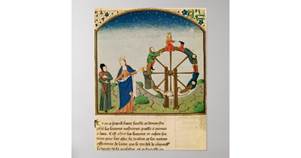
Boethius is often associated with the image of the “Wheel of Fortune.” He pictured life as a spinning wheel—one moment we may feel on top, and the next, everything can shift. Circumstances rise and fall, and very little in this world stays steady for long. (His personal story behind this is powerful, but that’s a story for another blog.) His insight is simple but lasting: if we place our trust in changing circumstances, we will always feel unstable. But if we trust God, who never changes, we can remain steady no matter where we are on the wheel.

That matters to me because everything in my life changes. My thoughts shift, my body ages, and my understanding grows. But God is not like me. God does not grow older, learn something new, or move from one state to another. God simply is.

What I find so helpful is the idea that God is eternal, not just in the sense that He lives forever, but in the sense that He exists beyond time altogether. I live in the past, present, and future. God does not. So when I think about God knowing the future, I do not picture Him waiting for tomorrow to arrive. What is future to me is not future to God. He sees all of time at once. That means God can know everything without changing.

What Does “Timeless” Really Mean?

“From everlasting to everlasting you are God.” — Psalm 90:2

When theologians say God is timeless, they do not mean He has a very long life. They mean He is not stretched out across moments at all. My life is lived in before-and-after. I live after the flood and read about it as something that happened long ago. But God’s life is not before the flood, during the flood, or after the flood. God does not move through events the way I do.

That raises an obvious question: how can a timeless God relate to people like me who live one moment at a time? I experience life as a sequence. One thing happens, then another. From my point of view, events unfold little by little. From God’s point of view, all moments are present. So, the question is whether He can know what happens in time without being bound by time as I am.

What helps me here is realizing that knowledge is more than a list of facts. To know something fully is not just to know true statements about it, but to know the thing itself. So, if God is omniscient, His knowledge cannot be reduced to a giant collection of correct information. He knows reality itself fully and perfectly.

Patrick’s Game Helped Me See It

“O Lord, you have searched me and known me.” — Psalm 139:1

Last weekend I watched my grandson Patrick play baseball, and his team won. I knew that game from my own limited perspective. I saw what happened from the stands, felt the excitement, and remembered certain moments more than others. But God’s knowledge would be different. He would know every player, every motion, and every moment all at once and perfectly. My knowledge is partial and unfolds in time. God’s knowledge is full and perfect.

Do Changes in the World Mean Changes in God?

“…with whom there is no variation or shadow due to change.” — James 1:17

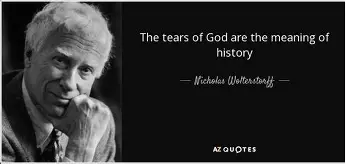
Here comes Nicholas Wolterstorff, another theologian keeping me company on these Saturday mornings, with a fair question: if God knows a changing world, must God change too? I understand the concern because when I learn something new, my knowledge changes. I find out the bread is ready or hear that Patrick’s team won. But there is a difference between coming to know something and simply knowing it. I learn bit by bit. God does not. He does not “find out” what is happening in the world. So, changes in the world do not mean changes in God.

So where does all of this leave me on a Saturday morning with Boethius, Patrick’s baseball game, and bread rising in my kitchen? It leaves me convinced that God can know a changing world without being a changing God. I learn a little at a time. God does not. He knows the world as its Creator, not as a spectator trying to catch up.

“Jesus Christ is the same yesterday and today and forever.” — Hebrews 13:8

And that is why this matters for discipleship. Because God does not change, His love does not waver, His wisdom does not fail, and His promises do not weaken. I can follow Christ even when I do not understand what He is doing in my life. In the end, all my Saturday morning theology brings me here: I can trust the God who sees the whole story when I can barely see the next step.

Prayer:

Heavenly Father,

Thank You that You do not change. When my life feels uncertain and my understanding feels small, help me trust Your steady love, wisdom, and faithfulness. Teach me to follow Christ one step at a time, resting in the truth that You see the whole story and hold me in Your care. In Jesus name we pray. Amen.

Scriptures for Further Reading

  • Malachi 3:6 — “For I the Lord do not change.”
  • Hebrews 13:8 — “Jesus Christ is the same yesterday and today and forever.”
  • James 1:17 — with God there is “no variation or shadow due to change.”
  • Psalm 90:1–2 — God’s eternal nature
  • Isaiah 46:9–10 — God’s knowledge and purposes
  • Psalm 139:1–6 — God’s perfect knowledge of us
  • Lamentations 3:22–23 — God’s faithfulness
  • Numbers 23:19 — God does not change like human beings do

Resource

Brown, Graham. “God’s Unchanging Knowledge of the World.” Sophia 28, no. 2 (1989): 2–12.

Remaining in His Presence: A Woman’s Call to Worship from Psalm 27

Come Close, Stay Near, and Rest in Him


The Presence We Long For

At the heart of Psalm 27 is a tender and anchoring desire—one that speaks deeply to the heart of every woman who longs for peace in the middle of responsibility and spiritual weight. David writes, “One thing have I asked of the Lord… that I may dwell in the house of the Lord all the days of my life” (Psalm 27:4). This is not a request for escape, but for nearness.

So often we believe we need solutions, clarity, or control. Yet Scripture gently redirects us. What we truly need is Him. His presence becomes the place where our hearts are steadied, our identity is restored, and our burdens are quieted. In a world that pulls us in many directions, worship becomes our way of returning—again and again—to the One thing that matters most.


Worship in the Middle of the Battle

Psalm 27 does not ignore hardship. It acknowledges fear, opposition, and real spiritual conflict. But instead of retreating, David engages the battle through worship. He lifts both praise and prayer like a two-edged sword, reminding us that worship is not passive—it is powerful.

For us, this is a beautiful reframe. Worship is not reserved for peaceful seasons; it is essential in difficult ones. When we worship, we are not pretending everything is fine. We are declaring that God is greater than what we face. Our voices, our prayers, and even our quiet surrender become acts of spiritual strength.

As women, we carry love deeply, but we also carry concerns. Psalm 27 shows us that love for God and reverence for God belong together. We draw near with intimacy, yet we honor Him with awe. This balance keeps our hearts grounded and our worship rich with meaning.


His Presence in the Darkness

One of the most comforting truths of this psalm is that God’s presence is not dependent on our circumstances. Even when life feels clouded and unclear, He is near. In fact, Scripture often shows that it is in those very moments of uncertainty that His presence becomes most real.

What feels like darkness to us is never darkness to Him. The “clouds” we walk through can become the place where His goodness quietly surrounds us. Many of us can look back and see that the seasons we least understood were the ones where He held us closest.

Dear sister, if today feels heavy or uncertain, take heart. God has not stepped away. His presence is steady, faithful, and unshaken. Even when you cannot see clearly, you are still being covered by His mercy.


A Faith That Waits

The closing verses of Psalm 27 offer a gentle but powerful instruction: “Wait on the Lord; be of good courage, and He shall strengthen your heart; wait, I say, on the Lord.” (Psalm 27:14).

Waiting is not easy, especially for women who are used to caring, planning, and responding quickly to needs around them. Yet waiting in God’s presence is not inactivity—it is trust at its deepest level. It is choosing to remain with Him when answers feel delayed and outcomes are uncertain.

Waiting becomes an act of worship when we refuse to rush ahead of Him. It is where courage is formed, and where God strengthens our inner life in ways the outside world may never see. He meets us in that stillness and quietly renews our hearts.


An Invitation for Today

Psalm 27 extends a beautiful invitation—to remain in the presence of the Lord through worship. Not just during a set devotional time, but throughout the ordinary rhythms of the day. In your home, in your thoughts, in your quiet moments, He is there.

You do not have to strive to earn His nearness. You are invited to dwell in it. As you turn your heart toward Him, even in small ways, you will find strength rising, peace settling, and courage growing.

Stay close, dear friend. Worship gently. Wait faithfully. And rest in the assurance that His presence is enough for everything you face today.


A Closing Prayer

Heavenly Father,
Teach us to remain in Your presence. Draw our hearts back to You in the middle of all we carry. Let our lives become an offering of worship—steady, sincere, and full of trust. Strengthen our hearts as we wait on You, and remind us again and again that You are near.

In Jesus’ name,
Amen 💛

Amazing Grace

Scripture, Doctrine, and the Church Family


📖 Scripture

“Therefore, there is now no condemnation for those who are in Christ Jesus.”
— Romans 8:1


Living Free in Christ: Baptist Doctrine

Bernie and I recently joined First Baptist Lubbock, and in this season, we have been intentionally studying Baptist doctrine together. As I’ve leaned into that—especially as a doctoral student in Biblical Studies at a Baptist university—I’ve found something that has deeply encouraged my heart… something I am truly thankful for.

As I studied the doctrine, this is what I found:

At its core, Baptist theology carries a beautiful truth for struggling Christians: receiving new mercies is part of the Christian life —the steady rhythm of God’s grace.

This truth is deeply reflected in Baptist doctrine.

  • Salvation by grace reminds us that we are not defined by our past, but justified through Christ.
  • The priesthood of all believers tells us we can come directly to God—boldly and immediately
  • Soul competency reminds us that we stand personally before God, responsible to Him above all.
  • Sanctification reminds us that growth is ongoing… and stumbling is not the end

And I found myself thinking:

This is amazing grace.


📖 What Does Scripture Say?

As a Bible student, I had to ask:

What does Scripture actually say about living in ongoing renewal without shame through the steady rhythm of God’s grace?

From the very beginning, we see that shame entered through sin.

In the Garden, Adam and Eve didn’t just feel guilty—they hid. Shame whispered, “This is who you are now.” It shifted identity.

But the Gospel tells a different story.

Jesus meets people in their shame—and He restores them.

He does not define them by their failure.
He redefines them through His grace.

In John 8, when the woman was brought before Him, Jesus had every right to condemn her… but instead, He extended mercy, called her out of sin, and lifted her from the shame that once held her. And, He told her to go and sin no more.


What We Are Reminded of in Scripture

  • “If we confess our sins, He is faithful and just to forgive us…” (1 John 1:9)
  • “As far as the east is from the west, so far has God removed our transgressions from us.(Psalm 103:12)
  • “Therefore, if anyone is in Christ, the new creation has come: The old has gone, the new is here!” (2 Corinthians 5:17)

Here is the truth:

Shame may enter through sin, but it is broken through the finished work of Christ.

When Jesus said, “It is finished,” He wasn’t just paying for sin—He was breaking the power of sin and removing the guilt that once defined us, restoring our identity in Him.


Doctrine and Scripture Together

When I compare what I found in Baptist doctrine with what I found in Scripture, they align so beautifully:

  • Doctrine says we can come boldly → Scripture says there is no condemnation for those in Christ.
  • Doctrine says we have access to God → Scripture says we are cleansed and made new for those in Christ.
  • Doctrine says growth is ongoing → Scripture says grace is sufficient for those in Christ.

And this is what I am most thankful for:

Being made new is a natural part of the Christian life—the steady, faithful rhythm of God’s grace.


🤍 Why the Church Family Matters

From my heart, I want to say this:

This is why being part of a church family matters so much.

Yes, we can come to God individually—and that is a beautiful truth.
But we were never meant to walk this out alone.

We need a place where:

  • grace is spoken out loud
  • Truth is lived in community
  • restoration is seen
  • And people remind us who we are when we forget

The church becomes living proof that starting again is possible… not just once, but daily.


🌸 Living This Out

In our home, in our church, and through The House of Prayer, this is what Bernie and I are learning to live: Daily priesthood means daily renewal
Daily renewal means we keep walking forward—restored, renewed, and covered in grace.


🙏 Prayer

Father,
Thank You for the gift of grace that continually renews us in Christ.
Thank You that in Christ, we are not defined by our past or our sin, but made new in Christ.

Teach us to come boldly to You—not hiding, not hesitating, but trusting in Your mercy.
Help us receive Your forgiveness fully and walk in the new identity You have given us.

Strengthen us to keep growing, keep turning, and keep trusting You.
And thank You for the gift of the church—for people who speak truth, extend grace, and walk alongside us.

Let our lives reflect the rhythm of Your grace—again and again.

In Jesus’ name,
Amen.

Green Grass in a Desolate Place

Jesus our Shepherd Who Provides

Psalm 23: A Psalm of David. (NIV)

1 The LORD is my shepherd; I shall not want. 2 He makes me lie down in green pastures.3 He leads me beside still waters. He restores my soul. He leads me in paths of righteousness for his name’s sake. 4 Even though I walk through the valley of the shadow of death, I will fear no evil, for you are with me; your rod and your staff, they comfort me. 5 You prepare a table before me in the presence of my enemies; you anoint my head with oil; my cup overflows. 6 Surely goodness and mercy shall follow me all the days of my life, and I shall dwell in the house of the LORD forever.

Mark 6:30-44 (NIV)

30 The apostles returned to Jesus and told him all that they had done and taught. 31 And he said to them, “Come away by yourselves to a desolate place and rest a while.” For many were coming and going, and they had no leisure even to eat. 32 And they went away in the boat to a desolate place by themselves. 33 Now many saw them going and recognized them, and they ran there on foot from all the towns and got there ahead of them. 34 When he went ashore he saw a great crowd, and he had compassion on them, because they were like sheep without a shepherd. And he began to teach them many things. 35 And when it grew late, his disciples came to him and said, “This is a desolate place, and the hour is now late.36 Send them away to go into the surrounding countryside and villages and buy themselves something to eat.” 37 But he answered them, “You give them something to eat.” And they said to him, “Shall we go and buy two hundred denarii worth of bread and give it to them to eat?” 38 And he said to them, “How many loaves do you have? Go and see.” And when they had found out, they said, “Five, and two fish.” 39 Then he commanded them all to sit down in groups on the green grass. 40 So they sat down in groups, by hundreds and by fifties. 41 And taking the five loaves and the two fish, he looked up to heaven and said a blessing and broke the loaves and gave them to the disciples to set before the people. And he divided the two fish among them all. 42 And they all ate and were satisfied. 43 And they took up twelve baskets full of broken pieces and of the fish. 44 And those who ate the loaves were five thousand men.

Jesus, Our Shepherd Who Provides

“The LORD is my shepherd; I shall not want.”
—Psalm 23:1

There are some words Scripture places so deeply in our souls that they surface without effort. Psalm 23 is one of them. We whisper it in hospital rooms and at gravesides. We carry it through uncertain seasons. It is a psalm for those who know what it is to walk through shadows—and still dare to trust.

Another familiar story meets us in Mark 6: the feeding of the five thousand. Five loaves. Two fish. A crowd too large and resources too small. At first glance, these passages may feel separate—one poetic, one narrative. But when we slow down and listen closely, we begin to hear the same voice.

Jesus is the Shepherd of Psalm 23—now standing among His sheep.

Mark is not offering a coincidence. He is revealing fulfillment.

Sheep Without a Shepherd—Until Jesus Appears

When Jesus steps ashore, Mark tells us He sees the great crowd and is moved with compassion, because they were like sheep without a shepherd (Mark 6:34).

That phrase is heavy with meaning. Throughout Israel’s history, God’s people suffered under failed leaders and were repeatedly described as scattered sheep. Psalm 23 answers that ache with a promise: The LORD is my shepherd.

In Mark 6, that promise takes flesh.

Jesus does not distance Himself from the language of shepherding—He embodies it.He stays with the crowd. He teaches them. He takes responsibility for their hunger and their formation. Before bread is broken, lives are gathered.

The Shepherd has come.

Green Grass in the Wilderness

Then Mark tells us something surprisingly specific. Jesus commands the people to sit down on the green grass.

Green grass—in a desolate place.

Psalm 23 says, “He makes me lie down in green pastures.” Sheep only lie down when they feel safe, when fear loosens its grip, when trust settles deep.

Here, in the wilderness, Jesus creates that same safety. Where the Shepherd stands, the wilderness begins to resemble pasture. Scarcity no longer gets the final word. The kingdom of God often comes quietly—placing rest beneath weary bodies and life where barrenness once ruled.

A Table Prepared by the Shepherd

The disciples see the math and panic. Jesus sees a table.

Psalm 23 declares, “You prepare a table before me…”
Mark tells us, “They all ate and were satisfied.”

Not barely enough.
Not rationed.
Satisfied.

This is shepherd abundance. When the true Shepherd provides, there is not only enough—there is overflow. Twelve baskets remain, a sign that nothing placed in the Shepherd’s hands is ever wasted.

Just before this story, Mark records another meal—Herod’s feast. That feast is shaped by power, ego, and fear, and it ends in death. Jesus’ feast is marked by compassion, simplicity, and trust, and it ends in life.

Two tables.
Two kingdoms.
One Shepherd who gives Himself for His sheep.

Still Waters and a Fearless Walk

Immediately after the meal, Mark leads us onto troubled waters. The disciples struggle. The wind resists them. Then Jesus comes—walking on the sea.

Psalm 23 rises again:
“He leads me beside still waters… Even though I walk through the valley of the shadow of death, I will fear no evil.”

The Shepherd who feeds is the Shepherd who protects. The Shepherd who gathers on the hillside is the Shepherd who stands between His people and chaos. Mark tells us the disciples did not yet understand about the loaves. In other words, they were still learning who Jesus truly is.

He is the Shepherd.

The Shepherd Still Walks With Us

Revelation gathers Psalm 23 once more and carries it forward: the Lamb who is also the Shepherd, no more hunger, no more thirst, God wiping away every tear.

What Jesus does in Mark 6 is not only history—it is promise. Psalm 23 is no longer only poetry. It is prophecy fulfilled in Christ.

So if today feels desolate,
if you come weary,
if you arrive hungry—body or soul—

Jesus, your Shepherd, sees you.

The table is set.
The grass is green—even here.
And the new creation has already begun.

A Prayer for the Path

Heavenly Father,
We thank You for giving us Jesus, our Good Shepherd. In places of weariness or uncertainty, help us recognize His presence and trust His care. Teach us to rest where He leads, to receive what He provides, and to walk without fear, knowing He is with us.
May Your goodness and mercy follow us all the days of our lives, as we dwell in Your presence.
In Jesus’ name, Amen.

Continuing on the Prayer Path

Five Scriptures for Prayer and Reflection

John 10:11 — “I am the good shepherd. The good shepherd lays down his life for the sheep.”
→ Sit with the truth that Jesus does not just guide you—He gives Himself fully for your care and salvation.

Ezekiel 34:15–16 — “I myself will be the shepherd of my sheep… I will seek the lost.”
→ Pray with gratitude that God personally comes after His people, especially in places of weakness or wandering.

Matthew 11:28 — “Come to me, all who labor and are heavy laden, and I will give you rest.”
→ Bring your weariness honestly to Jesus and receive the rest only the Shepherd can give.

John 6:35“I am the bread of life; whoever comes to me shall not hunger.”
→ Reflect on where you seek satisfaction and ask Jesus to nourish the deeper hungers of your soul.

Revelation 7:16–17 — “The Lamb in the midst of the throne will be their shepherd.”
→ Rest in hope, knowing the Shepherd who feeds you now will one day wipe away every tear forever.