
Category Archives: Scripture Reflections

The Moment Good News Broke In

The House of Prayer Bible Commentary

Bernie and I are so excited to begin a new journey together—we are writing a Bible commentary for The House of Prayer. We’re starting where our hearts always seem to go first: the Gospels, and especially the fast-moving, powerful account of Mark. What you’re reading here is a “commentary on the commentary,” a glimpse into our very first entry, Mark 1:1. Our prayer is that these reflections will not only inform but draw others closer to Jesus as His Word comes alive line by line.

The beginning of the gospel of Jesus Christ, the Son of God.

Mark 1:1

Some beginnings simply introduce a story, but others announce that everything is about to change. Mark wastes no time easing his readers in. With striking clarity and urgency, he opens: “The beginning of the gospel of Jesus Christ, the Son of God” (Mark 1:1). In a single line, he sets the tone, declares his purpose, and invites us to step into something far greater than a narrative—a divine revelation unfolding in real time.

From the earliest words of Scripture, we see how powerful a beginning can be. Genesis 1:1 tells us who God is and what He has done with sweeping authority. Likewise, Mark follows this pattern of clarity, but with remarkable brevity. He answers the essential questions immediately. The “who” is Jesus Christ. The “what” is the gospel—the good news. Yet, even in this simplicity, there is depth that cannot be contained in one sentence. Mark does not aim to say everything at once; instead, he opens a doorway into a story that will reveal its fullness as it unfolds.

The phrase “the Son of God” carries both theological weight and a sense of mystery. Some early manuscripts omit it, yet the Gospel itself resounds with its truth. From the voice of the Father at Jesus’ baptism to the confession at the cross, Mark consistently reveals Jesus’ divine identity. Even when Jesus does not frequently speak the title Himself, His actions, authority, and obedience testify to it. He is not merely a teacher or prophet—He is the One through whom God’s power is made known, the obedient Son who walks the path of suffering and surrender for the sake of the world.

What is especially striking is Mark’s use of the phrase “the beginning.” This is not just a starting point in time; it is the launch of something eternal. It reaches back into the promises spoken by the prophets, now coming into fulfillment. It stands firmly in the present moment, where God’s redemptive plan is actively unfolding. And it stretches into the future, where the full impact of this good news will be realized. Mark’s beginning is not confined to a moment—it is the inauguration of a kingdom.

And then there is the word “gospel.” Mark introduces it without explanation, allowing its meaning to emerge through the life, ministry, death, and resurrection of Jesus. The good news is not delivered as a definition, but as a living reality. It is seen in healing, heard in teaching, and ultimately revealed in sacrifice and victory. Mark invites us not just to understand the gospel, but to encounter it.

As readers, we are not positioned as distant observers. From the very first verse, we are drawn in. We are invited to recognize who Jesus is, to receive the good news He brings, and to follow where this beginning leads. Mark’s Gospel reminds us that when God begins something, it is never small. It carries the weight of eternity and the power to transform every life it touches.

This is where the good news begins—and it is where our salvation begins as well.

Prayer
Heavenly Father,

thank You for the power and clarity of Your Word. Thank You for sending Jesus, the Son of God, as the good news our hearts long for. Help us to see beyond the surface and recognize the depth of what You have begun. Draw us into Your story, and give us faith to follow where You lead. Let Your truth shape us, and let Your gospel come alive in our lives each day. In Jesus’ name, amen.

Resources:

Broadman Bible Commentary, vol. 8. Nashville, TN: Broadman Press, 1969.

Rydelnik, Michael, and Michael Vanlaningham, eds. The Moody Bible Commentary. Chicago, IL: Moody Publishers, 2014.

Further Reading

  • Genesis 1:1 – “In the beginning, God created the heavens and the earth.”
  • Isaiah 40:3 – “A voice of one calling: ‘In the wilderness prepare the way for the Lord…’”
  • Malachi 3:1 – “I will send my messenger, who will prepare the way before me…”
  • Mark 1:11 – “And a voice came from heaven: ‘You are my Son, whom I love; with you I am well pleased.’”


Cast It Anyway: Trusting God in the Unknown

by Dee Tackitt

Most mornings, I grind wheat berries and begin making homemade bread. It is a long process. The grain has been planted, grown, harvested, ground, mixed, and kneaded—long before it ever reaches my kitchen table. And even then, I still have to trust the process. I place the dough aside, not rushing it, not forcing it… just waiting.

There is a letting go in breadmaking.
You do your part—and then you trust what you cannot see.

Ecclesiastes 11 speaks to that same kind of faith.


Ecclesiastes 11:1-6

Ship your grain across the sea;
    after many days you may receive a return.
Invest in seven ventures, yes, in eight;
    you do not know what disaster may come upon the land.

If clouds are full of water,
    they pour rain on the earth.
Whether a tree falls to the south or to the north,
    in the place where it falls, there it will lie.
Whoever watches the wind will not plant.
    Whoever looks at the clouds will not reap.

As you do not know the path of the wind,
    or how the body is formed[a] in a mother’s womb,
so you cannot understand the work of God,
    the Maker of all things.

Sow your seed in the morning,
    and at evening let your hands not be idle,
for you do not know which will succeed,
    whether this or that,
    or whether both will do equally well.


🌊 Cast Your Bread (vs. 1)

“Cast your bread upon the waters…”

At first, it sounds like a loss. Like letting go of something valuable without a guarantee of return.

But this is not waste—it is trust.

The bread we cast is the Word of God.
The waters are the movement of the Holy Spirit.

And here is the quiet promise:
When the Word is released into the current of the Spirit, God carries it where it needs to go.

You may not see the result today.
You may not even recognize it when it returns.

But it will not be wasted.


🌱 Don’t Hold Back (vs. 2)

“Invest in seven ventures, yes, in eight…”

Live open-handed.

Love more than feels safe.
Serve in more places than feel comfortable.
Speak truth even when you don’t know how it will be received.

Seven reminds us of God’s perfect work.
Eight reminds us of resurrection—new life where none seemed possible.

When we sow into the gospel—Jesus Christ and Him crucified—we are sowing into eternal life.

And you don’t know which seed will take root…
or if God will cause many to flourish at once.


🌧️ Trust Where It Lands (vs. 3)

“If clouds are full of water, they pour rain…
If a tree falls… there it will lie.”

Some outcomes are simply not yours to control.

Life does not always unfold neatly.
Ministry does not always land where you hoped.
People do not always respond the way you prayed they would.

And yet—God is not hindered by where things fall.

Wherever the seed lands,
wherever the rain pours,
God is still able to bring life.


🌬️ Don’t Wait for Perfect Conditions (vs. 4)

“Whoever watches the wind will not plant…”

If we wait until everything feels certain, we will never begin.

There will always be:

  • One more reason to hesitate
  • one more unknown
  • one more “what if”

But faith does not wait for perfect weather.

Faith plants anyway.
Faith sows anyway.
Faith trusts anyway.


👶 Rest in the Mystery (vs. 5)

“As you do not know… how the body is formed in a mother’s womb…”

There are sacred things only God understands.

A baby growing in secret.
The movement of the wind.
The quiet work of God beneath the surface of your obedience.

You may not see it forming.
You may not feel progress.

But something holy is happening.

God is working—deep, unseen, and sure.


🌅 Keep Sowing (vs. 6)

“Sow your seed in the morning, and at evening let your hands not be idle…”

This is steady faith.

Not rushed.
Not anxious.
Just faithful.

Morning—sow.
Evening—sow again.

Pray.
Encourage.
Speak truth.
Show up.

Because you do not know which effort will bear fruit…

“…or whether both will do equally well.”

And sometimes—
in the kindness of God—
Both do.

A Prayer for the Path

Heavenly Father,

We come to You with open hands.
So much of what we do feels like casting—releasing what we love into places we cannot control.

Teach us to trust You in the letting go.

When we sow Your Word, remind us that it is never wasted.
When we feel uncertain, steady our hearts in Your promises.
When we are tempted to wait for perfect conditions, give us courage to act in faith.

Lord, we confess—we like to understand everything.
But You are the Maker of all things, and Your ways are higher than ours.

So help us rest in the mystery of Your work.

As a child is formed in the womb, unseen but full of life,
let Your purposes grow in ways we cannot yet see.

Give us diligence to sow in the morning and in the evening.
Keep our hands from becoming idle and our hearts from growing weary.

And when the harvest comes—whether soon or after many days—
remind us that every good thing has come from You.

We trust You with the seed.
We trust You with the outcome.
We trust You with the waiting.

In Jesus’ name,
Amen.

Resources:

Beetham, Christopher A., and Nancy L. Erickson, eds. The NIV Application Commentary on the Bible. NIV Application Commentary. Grand Rapids, MI: Zondervan Academic, 2024.

Everett, Gary H. The Book of Ecclesiastes. Study Notes on the Holy Scriptures. 2011.

Hale, Thomas. The Applied Old Testament Commentary. Colorado Springs, CO; Ontario, Canada; East Sussex, England: David C. Cook, 2007.

Scripture for Further Reflection

  • Proverbs 11:24–25 – The principle of generous sowing and return
  • Isaiah 55:10–11 – God’s Word accomplishing His purpose
  • Hosea 10:12 – Sowing righteousness and reaping steadfast love
  • Matthew 13:3–9, 18–23 – The parable of the sower
  • Luke 16:10 – Faithfulness in small things
  • 1 Corinthians 3:6–7 – God gives the increase
  • 2 Corinthians 9:6–8 – Sowing generously
  • Galatians 6:7–9 – Reaping in due season
  • James 1:5 – Trusting God’s wisdom
  • Hebrews 11:1 – Faith in what we do not see

When Foxes Find a Home and Jesus Does Not

Two foxes have made their home right here on 93rd Street in the middle of Lubbock, Texas. City streets, traffic, porch lights, barking dogs — none of it has discouraged them. They trot across our yards with confidence, slipping between fences as if they’ve lived here forever. And honestly, they probably have. (picture by Ricardo Martinez)

Foxes are astonishingly adaptable creatures. The red fox — the most widespread fox species in the world — thrives in environments ranging from Arctic tundra to deserts, and even in major cities and suburbs. They are small, swift, clever mammals with pointed ears, narrow snouts, and long bushy tails that help them balance and stay warm.

Watching Foxes in the Middle of the City

Watching them here, in the middle of a city, stirred something deep in me. Because Jesus once said something about foxes — and it wasn’t about their cleverness or beauty. It was about home.

“Foxes have dens and birds of the air have nests, but the Son of Man has nowhere to lay his head.” — Matthew 8:20

Jesus and the Cost of Following

This statement wasn’t poetic sadness. It was a challenge — a response to a scribe who boldly declared, “I will follow you wherever you go.” Jesus didn’t applaud his enthusiasm. Instead, He warned him: You don’t know what you’re asking.

Scholars note that Jesus wasn’t merely talking about physical homelessness. He was revealing the deeper reality of His mission — rejection by the very people who should have welcomed Him as Messiah-King. His lack of a place to lay His head was part of His humiliation as the Son of Man, the Lord of creation who walked the earth as a wanderer. Following Him meant embracing that same dispossession, that same reversal of worldly priorities.

Feeling Unmoored When Jesus Calls

And that’s where this touched my heart. Because when Jesus called my name, I didn’t feel homeless — but I did feel unmoored. The things that once felt important no longer held me. The places where I used to “lay my head” — emotionally, spiritually, socially — didn’t fit anymore. My heart started following Jesus in a way that loosened my grip on everything else.

So here I am, watching two foxes who have found a home in the middle of Lubbock, while the One I follow had none. And somehow, that makes sense to me.

What Home Really Is

Because the more I follow Him, the more I realize: Home isn’t where I live. Home is who I follow.

And like those foxes slipping through the fences on 93rd Street, I’m learning to move lightly through this world — not rootless, but free.

A Moment of Invitation

Maybe as you read this, something in your own heart stirred — the same way those foxes stirred mine. Maybe you’ve felt that gentle pull, that holy disconnection from what used to define you. Maybe you’ve sensed Jesus calling your name, inviting you into a life where “home” is no longer a place you build but a Person you follow.

If so, hear this clearly: Jesus still calls disciples the same way He always has — personally, directly, lovingly, and with purpose. He doesn’t ask you to clean yourself up first. He doesn’t ask you to prove anything. He simply says, “Follow Me.”

And following Him will change you. It will loosen your grip on what once felt important. It will reorient your priorities. It will give you a new kind of belonging — not rooted in geography or status, but in grace.

If you sense that call today, don’t ignore it. Open your heart. Say yes. Let Him lead you into the kind of life where even if you have “nowhere to lay your head,” you are never without a home.


Closing Prayer

Heavenly Father,

We love you, Jesus. You are the One who calls us out of what is familiar and into what is eternal. You are the One who walked this world without a place to lay Your head, so that we could find our true home in You.

Today, I lift up every heart reading these words — the searching heart, the restless heart, the weary heart, the heart that feels the tug of Your voice. Draw them close. Speak their name. Give them courage to follow wherever You lead.

Loosen our grip on what cannot save us, and anchor us in the love that never lets go. Make us disciples who walk lightly in this world, but deeply in Your presence.

In Jesus holy name we pray,

Amen.

Related Scriptures

These verses echo the themes of discipleship, surrender, following Jesus, and the cost of leaving behind what once felt like “home.”

• Matthew 8:19–20 — Then a teacher of the law came to him and said, “Teacher, I will follow you wherever you go.” Jesus replied, “Foxes have dens and birds have nests, but the Son of Man has no place to lay his head.”

• Luke 9:57–62 — Jesus calls His followers to radical, immediate obedience.

• Matthew 16:24–25 —Then Jesus said to his disciples, “Whoever wants to be my disciple must deny themselves and take up their cross and follow me. For whoever wants to save their life will lose it, but whoever loses their life for me will find it.”

• Philippians 3:7–8 — Paul counts all things as loss compared to knowing Christ.

• Hebrews 13:14 — “For here we have no lasting city, but we seek the city that is to come.”

• 1 Peter 2:11 — Believers are “sojourners and exiles” in this world.

• John 10:27–28 — “My sheep listen to my voice; I know them, and they follow me. I give them eternal life, and they shall never perish; no one will snatch them out of my hand.”

• Psalm 84:1–4 — Blessed are those who dwell in God’s presence; He is our true home.

• Psalm 90:1 — “Lord, You have been our dwelling place in all generations.”

• Revelation 21:3 — God will dwell with His people; home is ultimately with Him.


Resources

Bruce, F. F. Hard Sayings of Jesus: The Hard Sayings Series. Downers Grove, IL: IVP Academic, 2025.

Chamblin, J. Knox. Matthew: A Mentor Commentary. Ross-shire, Great Britain: Mentor, 2010. Boring, M. Eugene.

“The Gospel of Matthew.” In New Interpreter’s Bible, edited by Leander E. Keck, Vol. 8. Nashville: Abingdon Press, 1994–2004.

Could It Be?

But you, Bethlehem Ephrathah,
though you are small among the clans of Judah,
out of you will come for me
one who will be ruler over Israel,
whose origins are from of old,
from ancient times.”

Micah 5:2 (NIV)

Three Who Followed the Promise Before the Star Appeared

Long before a star split the night sky over Bethlehem, long before wise men packed gifts and set their faces toward a small Judean town, there were others who traveled toward the same King. They did not journey by camel or by compass. They traveled by promise, by prophecy, and by faith. Their roads were marked by scrolls and songs, visions and covenant. Yet, like the three Kings who would one day kneel at the manger, they too asked the question that stirs the heart of every seeker:

Could it be?

David: The King Who Looked Beyond His Throne

David knew what it meant to be king. He wore the crown. He sat on the throne. Yet even in his reign, David sensed that another King was coming—One greater than himself. God’s covenant with David spoke of a son whose kingdom would never end. David listened, wondered, waited.

In his psalms, David gave voice to what he could not yet see. “The Lord said to my Lord: ‘Sit at my right hand…’” Who was this Lord greater than David? Who was this descendant worthy of eternal worship? David’s faith journey moved him forward—from shepherd to king to prophet—as he followed the promise of a coming ruler who would reign not by sword, but by righteousness.

David never saw a manger, but he found Jesus in hope. And like the wise men who bowed before a Child-King, David laid his crown down in advance.

Could it be… my Lord?

Isaiah: The Watchman Who Saw the Child

If David sang of the coming King, Isaiah saw Him. In a world trembling with war and exile, Isaiah spoke words that defied logic: a child would be born, a son would be given, and the government would rest on His shoulders. Isaiah proclaimed what seemed impossible—a virgin with child, a suffering servant, a Prince of Peace.

Isaiah’s journey was costly. His message was often rejected. Yet he kept walking the long road of obedience, eyes lifted toward a future filled with light. Like a watchman on the wall scanning the horizon, Isaiah held the promise steady for generations who would come after him.

The wise men followed a star. Isaiah followed the Spirit. Both arrived at the same truth: God would come near, not in power alone, but in human flesh.

Could it be… God with us?

Micah: The Prophet Who Named the Place

Micah’s path was quieter, shorter, yet no less sure. While kings rose and fell, Micah set his gaze on a small village—Bethlehem. Insignificant. Overlooked. Unlikely. Still, Micah declared that from this humble place would come a ruler whose origins were from ancient days.

Micah reminds us that God’s ways are rarely loud. The King would not be born in a palace but in a town too small to matter. Micah trusted what others dismissed. He followed no star, only the whisper of God’s truth guiding him to a place no one expected to look.

The wise men asked, “Where is the one born King of the Jews?” Micah had already answered.

Could it be… here?

Travelers Toward the Same King

David, Isaiah, and Micah never walked side by side, yet their journeys converged at Christ. Each traveled with what they were given—music, vision, words—and each found Jesus by faith. Like the three Kings, they recognized that when God announces a King, the only right response is worship.

They did not arrive on the same night as Mary and Joseph. Yet heaven counts them among those who found Him. Their lives remind us that faith is a journey across time, that prophecy is a road that leads to Christ, and that every generation is invited to ask:

Could it be… the One we’ve been waiting for?

And the answer—written in Scripture, sung in psalm, spoken by prophets, and held in a manger—is yes.

Closing Prayer

Lord God,
Before there was a manger, You planted hope in the hearts of Your servants.
Through songs, visions, and whispered prophecies, You taught them to watch, to wait, and to wonder.

Thank You for David, Isaiah, and Micah—
for faith that traveled centuries ahead of sight
and trusted that You would keep every promise.

Help us to be people who look for Jesus with the same holy expectancy.
Give us eyes to recognize Him in humble places
and hearts ready to bow when the answer is finally clear.

May our lives, like theirs, quietly proclaim:
Could it be?
Yes—He has come, and He is with us still.

Amen.

The King and His Cross

by Pastor Dee

Good Friday is not merely the day we remember Jesus’ suffering—it is the day we behold the King enthroned in self-giving love. The cross is the doorway into God’s acknowledged reign on earth, and prayer is how we walk through that doorway with repentance, faith, and renewed allegiance.

Mark 15:33–39 — As Jesus breathes his last, the curtain is torn and a centurion confesses, “Truly this man was the Son of God.” Good Friday reveals a paradox: the King conquers not by taking life, but by giving his life to open access to God.

Philippians 2:5–11 — Jesus’ obedience descends “to the point of death—even death on a cross.” This is the shape of his kingship: humility, surrender, and trust in the Father’s will, followed by God’s vindication and exaltation.

Colossians 2:13–15 — At the cross God cancels the record of debt and disarms hostile powers. Good Friday is not defeat; it is the decisive rescue and the public unveiling of God’s victory over sin and all usurping rule.

The Cross and the Kingdom

In covenantal terms, a kingdom (the basileia—God’s rule or reign) is constituted by relationship: a king and a citizenry bound together in loyalty, protection, and shared life. One without the other is not a “kingdom” in that covenant sense. That is why the coming of God’s kingdom is never just a change of circumstances; it is the restoration of rightful relationship under rightful rule.

On Good Friday we see how Jesus brings about God’s acknowledged reign on earth by simultaneously fulfilling, in his own person, God’s requirements of a perfect King and a perfect citizen. He does not merely announce the kingdom; he embodies it—holding together what our sin has torn apart: faithful rule and faithful obedience.

Christ becomes the God-approved King by proving his love for his subjects to the fullest extent—by self-sacrifice for their rescue and restoration. His authority is not asserted by domination, but revealed in mercy. At the cross, the King does what only the true King would do: he bears the cost of reconciliation himself.

And he proves his God-approved citizenship by becoming obedient to his Sovereign to the fullest extent—submitting completely to the Father’s authority and demonstrating loyalty in the face of creaturely (satanic and human) usurpation, rebellion, and compromise. Where Adam grasped, Jesus yielded; where we resist, Jesus trusted.

Jesus accomplishes this supremely on the cross because it is by the kind of death he suffered that both the love (for fallen creation) and obedience (to his sovereign Lord) he consistently demonstrated throughout his life reach their climactic result. Good Friday is the convergence point: perfect love meeting perfect obedience, in public, for us.

Therefore, by fulfilling both requirements of perfect King and perfect citizen in his own person—on the cross, to God’s fullest satisfaction—Jesus inaugurates God’s redemptive rule on earth. He recapitulates and reconstitutes a new covenant community around his own mediatory personhood. And he invites repentant sinners to enter this new sphere of communion with the Triune God for their restoration—and for the redemption of all creation.

Today, the Prayer Path is simple: behold the King, bow as citizens, and belong to the covenant community he purchased.

Prayer

Heavenly Father,

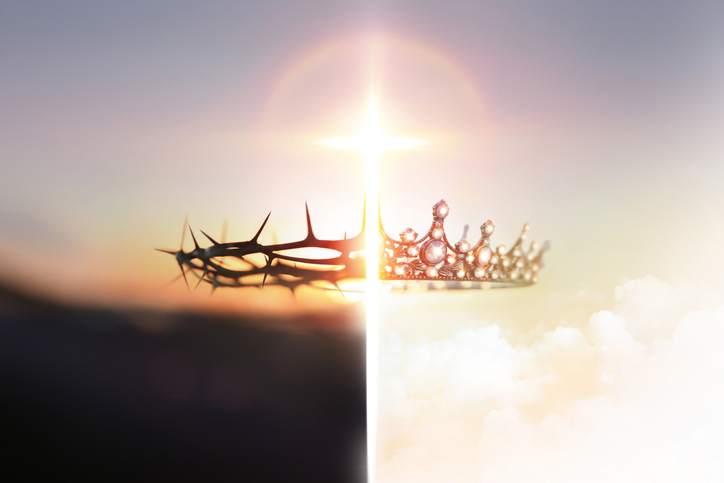
You are the rightful Sovereign—holy, just, and faithful. Jesus, you are the God-approved King whose throne is a cross and whose crown is thorns.

Spirit of God, open my eyes to the glory of this love that does not let me go.

Lord, I confess my divided allegiance. I have wanted the benefits of your kingdom without surrendering my citizenship. I have compromised with rebellion—my own and the world’s—and I have trusted my will over yours. Forgive me through the blood of Christ, and wash me clean. Thank you that at the cross, your love and Jesus’ obedience reached their climactic result for my rescue and restoration. Thank you for canceling my debt, for disarming the powers, and for opening the way into communion with you.

On this Good Friday, I bow to your reign. Teach me to live as a loyal citizen of your kingdom—quick to repent, glad to obey, and courageous in the face of compromise. Form in me the mind of Christ: humility, trust, and steadfast love. Extend your redemptive rule in my home, my church, and my community. Gather a renewed covenant people around Jesus—restored worshipers who reflect the King’s self-giving love. Bring repentance where there is rebellion, healing where there is brokenness, and hope where there is despair, until all creation is made new in Him.

In Jesus name we pray, Amen.

The Glory of King Jesus Revealed in Service

Power through Love on Maundy Thursday

John 13:1–17 NIV

13 It was just before the Passover Festival. Jesus knew that the hour had come for him to leave this world and go to the Father. Having loved his own who were in the world, he loved them to the end.

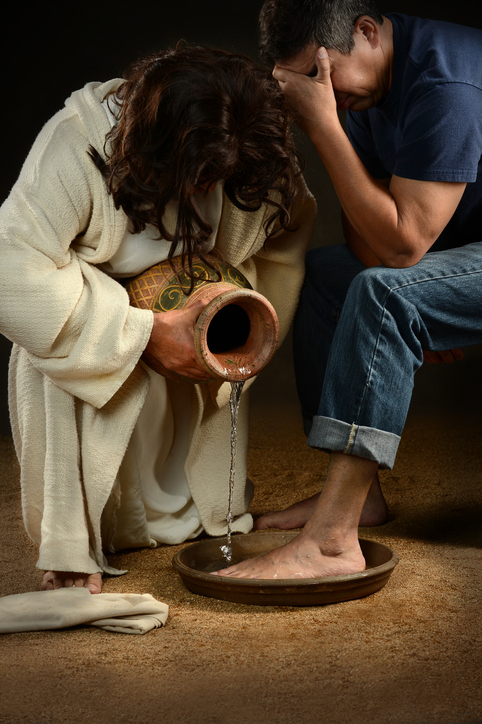
The evening meal was in progress, and the devil had already prompted Judas, the son of Simon Iscariot, to betray Jesus. Jesus knew that the Father had put all things under his power, and that he had come from God and was returning to God; so he got up from the meal, took off his outer clothing, and wrapped a towel around his waist. After that, he poured water into a basin and began to wash his disciples’ feet, drying them with the towel that was wrapped around him.

He came to Simon Peter, who said to him, “Lord, are you going to wash my feet?”

Jesus replied, “You do not realize now what I am doing, but later you will understand.”

“No,” said Peter, “you shall never wash my feet.”

Jesus answered, “Unless I wash you, you have no part with me.”

“Then, Lord,” Simon Peter replied, “not just my feet but my hands and my head as well!”

10 Jesus answered, “Those who have had a bath need only to wash their feet; their whole body is clean. And you are clean, though not every one of you.” 11 For he knew who was going to betray him, and that was why he said not every one was clean.

12 When he had finished washing their feet, he put on his clothes and returned to his place. “Do you understand what I have done for you?” he asked them. 13 “You call me ‘Teacher’ and ‘Lord,’ and rightly so, for that is what I am. 14 Now that I, your Lord and Teacher, have washed your feet, you also should wash one another’s feet. 15 I have set you an example that you should do as I have done for you. 16 Very truly I tell you, no servant is greater than his master, nor is a messenger greater than the one who sent him. 17 Now that you know these things, you will be blessed if you do them.

John 13:31-35 NIV

Jesus Predicts Peter’s Denial

31 When he was gone, Jesus said, “Now the Son of Man is glorified and God is glorified in him. 32 If God is glorified in him,[a] God will glorify the Son in himself, and will glorify him at once.

33 “My children, I will be with you only a little longer. You will look for me, and just as I told the Jews, so I tell you now: Where I am going, you cannot come.

34 “A new command I give you: Love one another. As I have loved you, so you must love one another. 35 By this everyone will know that you are my disciples, if you love one another.”

Imagine the scene.

Jesus knows exactly what is coming. His arrest is hours away. Betrayal is already unfolding. If there were ever a moment for a final sermon, a rallying cry, or a call to resistance, this would have been it.

Instead, John tells us something astonishing: “Having loved His own who were in the world, He loved them to the end.” Knowing that the Father had placed all things into His hands, knowing He had come from God and was returning to God, Jesus does something utterly unexpected.

He rises from the table.
He removes His outer robe.
He wraps a towel around His waist.
And He kneels.

King Jesus begins to wash feet.


Love That Takes the Lowest Place

John 13 does not describe this act as symbolic or ceremonial. It is physical, intimate, and unsettling. In the world of the disciples, foot washing was the task of the lowest servant in the household. It was never the role of the teacher, much less the Lord.

Peter’s resistance reveals how upside‑down this moment feels. “You will never wash my feet,” he says. But Jesus answers with words that cut to the heart of discipleship: “Unless I wash you, you have no share with me.” Maundy Thursday reminds us that participation in the life of Christ begins not with what we offer Him, but with what we are willing to receive.

Before we serve, we must be served. Before we love, we must be loved. Before we kneel for others, we must allow King Jesus to kneel for us and cleanse the places we would rather hide.


“You Also Ought to Wash One Another’s Feet”

When Jesus finishes, He does not leave the moment open to personal interpretation. He explains it plainly. “You call me Teacher and Lord, and you are right,” He says. “If I, your Lord and Teacher, have washed your feet, you also ought to wash one another’s feet.”

This is where Maundy Thursday becomes a command rather than a memory. The call to love is not abstract. Jesus does not redefine love with sentiment or theory. He defines it with posture. Love bends low. Love serves without demanding return. Love takes the place no one else wants.

The command Jesus gives is not simply to admire His humility, but to embody it. His love becomes the pattern by which all Christian love is measured.


Glory Revealed Through Sacrifice

After Judas leaves the room and the shadow of betrayal becomes unmistakable, Jesus speaks again. “Now is the Son of Man glorified.” In John’s Gospel, glory is not found in escape from suffering, but in faithful obedience through it. What the world calls shame, Jesus calls glory. What looks like loss will soon be revealed as victory.

Maundy Thursday stands at the edge of the cross. The towel anticipates the nails. The basin points forward to the blood poured out. The humility of the upper room prepares us for the self‑giving love of Calvary.

King Jesus reveals that true authority is never grasped. It is given. And it is given for the sake of love.


A New Commandment for the Church

Jesus concludes the evening with words that echo into the life of the church. “A new commandment I give to you, that you love one another. Just as I have loved you, you also are to love one another.” The standard is no longer reciprocity or convenience, but Christ Himself.

By this love, Jesus says, the world will recognize His disciples. Not by power. Not by position. Not by persuasion alone. But by a love that kneels, serves, and remains faithful to the end.


From Then to Now

Maundy Thursday refuses to remain safely in the past. It presses into our present lives and asks difficult, necessary questions. Where is Jesus calling us to take the lower place? Who needs to be loved with a love that costs something? In what ways are we being invited to lay aside status, comfort, or control in order to serve?

The night King Jesus took off His robe still speaks. His towel still hangs before us. And His command still stands.

May we be a people who receive His love deeply and live it faithfully.
May we follow King Jesus, even when the way leads us to our knees.

Heavenly Father,
on this holy night, we pause at the basin and the towel.
We remember that You loved Your own to the very end—
not with words alone, but with hands that served
and a heart that poured itself out.

We confess that we often resist this way of love.
We cling to comfort, protect our position,
and hesitate to kneel where You freely knelt.
Forgive us for the times we have preferred power over humility
and distance over devotion.

Wash us again, Lord.
Cleanse the places we try to hide.
Teach us to receive Your love
before we attempt to give it away.

Shape us into a people marked by Your commandment—
a people who love as You have loved us.
Give us eyes to see those we are called to serve,
courage to take the lowest place,
and hearts willing to remain faithful even when love is costly.

As we leave this moment, keep us near Your heart
and prepare us to follow You to the cross,
trusting that Your self‑giving love
will lead us all the way to life.

We pray in the name of King Jesus,
the Servant Lord,
Amen.

Eight Days Later: When Jesus Comes Back for the One Who Missed It

Thomas, Covenant Mercy, and the New Creation Rhythm of God

I’m writing this from Richardson, Texas, in the middle of Your Time to Shine 2026 with Sweet Adelines Region 25. It’s a weekend filled with harmony, community, and the joy of voices rising together. And maybe that’s why this passage from John 20 has been stirring in my heart — because it’s a story about a missing voice, a broken chord, and the God who refuses to let the song resolve without restoring the one who was not in the room. There’s a detail in this story we often overlook: Jesus appears to Thomas eight days later. Not immediately. Not the next morning. Eight days. And in Scripture, eight is never incidental. It carries the weight of covenant, new creation, and God’s unwavering commitment to finish what He begins.

Jesus Appears to Thomas

Scripture — John 20:24–29 (NLT)

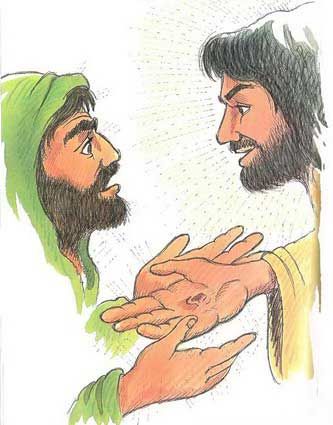
24 One of the twelve disciples, Thomas (nicknamed the Twin),[a] was not with the others when Jesus came. 25 They told him, “We have seen the Lord!” But he replied, “I won’t believe it unless I see the nail wounds in his hands, put my fingers into them, and place my hand into the wound in his side.” 26 Eight days later the disciples were together again, and this time Thomas was with them. The doors were locked; but suddenly, as before, Jesus was standing among them. “Peace be with you,” he said. 27 Then he said to Thomas, “Put your finger here, and look at my hands. Put your hand into the wound in my side. Don’t be faithless any longer. Believe!” 28 “My Lord and my God!” Thomas exclaimed. 29 Then Jesus told him, “You believe because you have seen me. Blessed are those who believe without seeing me.” “One of the twelve disciples, Thomas (nicknamed the Twin), was not with the others when Jesus came. They told him, ‘We have seen the Lord!’ But he replied, ‘I won’t believe it unless I see the nail wounds in his hands, put my fingers into them, and place my hand into the wound in his side.’ Eight days later the disciples were together again, and this time Thomas was with them. The doors were locked; but suddenly, as before, Jesus was standing among them. ‘Peace be with you,’ he said. Then he said to Thomas, ‘Put your finger here, and look at my hands. Put your hand into the wound in my side. Don’t be faithless any longer. Believe!’ ‘My Lord and my God!’ Thomas exclaimed. Then Jesus told him, ‘You believe because you have seen me. Blessed are those who believe without seeing me.’”

Reflection

Thomas missed the first gathering. Scripture doesn’t tell us why. Maybe grief isolated him. Maybe fear kept him away. Maybe he simply couldn’t bear to hope again. But here is the beauty of covenant: God’s faithfulness is not dependent on our flawless presence. Jesus doesn’t shame him. He doesn’t scold him. He doesn’t say, “Thomas, you should’ve been there.” Instead, Jesus returns. And John makes sure we know when He returns: eight days later. In Scripture, the eighth day is the day of new beginnings — the day beyond the completed cycle of seven. It’s the day of covenant identity (circumcision on the eighth day), new creation (eight people stepping out of the ark), and consecration (priests beginning ministry on the eighth day). The early church even called Sunday — the day of resurrection — the Eighth Day, the dawn of God’s new world. So when Jesus appears to Thomas on the eighth day, He is doing more than accommodating a doubter. He is performing a covenant act. He is ushering Thomas into resurrection reality. He is giving Thomas his own “new creation” moment. Thomas’s doubt is not the center of the story. Jesus’s covenant faithfulness is. Thomas sets conditions: “I won’t believe unless…” But covenant doesn’t begin with our belief. It begins with God’s promise. Jesus meets Thomas exactly where his unbelief lives — in the wounds. And Thomas responds with the clearest confession in the Gospel: “My Lord and my God!” The eighth day turns doubt into worship. It turns absence into belonging. It turns unfinished faith into resurrected faith.

Biblical Principle

God completes what He begins — even when we falter, delay, or miss the moment. The eighth day reveals a covenant God who returns for the one who wasn’t in the room, restores the one who struggled to believe, and brings His people into the fullness of new creation. Maybe you feel like Thomas. Maybe you missed a moment. Maybe you feel late to faith, late to healing, late to hope. Maybe you’re watching others rejoice while you’re still trying to breathe. The eighth day tells you this: Jesus comes back for you. He steps into locked rooms. He speaks peace into anxious hearts. He meets you in the very place you’re afraid to look. And He invites you — gently, firmly — into belief, into restoration, into new creation life. The eighth day is not just a date on the disciples’ calendar. It is the rhythm of God’s covenant love. And it is still happening.

Prayer

Heavenly Father, Thank You for being the God who returns for us. Thank You for covenant faithfulness that does not depend on our strength, our timing, or our perfect presence. Meet us in our doubts, our fears, and our locked‑room moments. Breathe Your peace over us. Lead us into the eighth‑day life — the life of new creation, restored faith, and renewed hope. Make us people who believe, not because we see everything clearly, but because You have shown Yourself faithful again and again. Amen.