Category Archives: Community

How God Restores What Trauma Breaks

by Dee Ann Loving-Tackitt

“He heals the brokenhearted and binds up their wounds.” — Psalm 147:3

Trauma has a way of breaking life open. It can shatter our sense of safety, silence our voice, and fracture our identity. Neuroscience shows that when people relive traumatic memories, the brain’s language centers go quiet while emotional centers flare with activity. This is why survivors often say, “I don’t have words for what happened.” Trauma steals language.

But God has always been in the business of restoring what was broken—especially the parts of us that feel too shattered to name. And Scripture gives us a powerful pattern: healing often begins when people reclaim their story.

Interestingly, modern research on expressive writing echoes this same truth. When trauma survivors write about their experiences, they re-engage the parts of the brain responsible for language, narrative, and meaning-making. Over time, expressive writing has been shown to reduce anxiety, improve mood, strengthen working memory, and support post-traumatic growth.

Science and Scripture meet in a beautiful place: healing begins when we bring our story into the light.

David’s Psalms: When Pain Finds Its Voice

The Psalms are filled with raw, unfiltered emotion. David writes through fear, betrayal, grief, and despair. He names what feels unspeakable. He puts chaos into language.

This mirrors what expressive writing does today—helping the brain integrate overwhelming experiences and restore emotional balance. David’s writing becomes both prayer and processing, a sacred act of survival.

Joseph’s Redemption: Rewriting a Wounded Story

Joseph endured betrayal, abandonment, false accusation, and imprisonment. Years later, he reframes his story with God’s help:

“You meant evil against me, but God meant it for good.” — Genesis 50:20

This is meaning-making—the same cognitive shift expressive writing often produces. Joseph doesn’t erase the trauma; he integrates it. His identity is rebuilt not by forgetting the pain but by understanding it through God’s lens.

Job’s Lament: Wrestling Toward Understanding

Job’s suffering is overwhelming—loss of family, livelihood, health, and dignity. Much of the book is Job trying to make sense of his pain. He speaks, questions, laments, and reflects. He narrates his trauma in real time.

This mirrors the therapeutic process: naming the pain, exploring its meaning, and slowly reconstructing identity after devastation. Job’s restoration is not only physical; it is deeply narrative.

Israel’s Exile: Remembering, Rebuilding, and Returning

The exile is a national trauma. Israel loses home, identity, and stability. In response, the prophets call the people to remember, write, and tell their story. Lamentations records communal grief. Ezra and Nehemiah describe rebuilding both the city and the people’s identity.

God leads them through a process of naming the loss, narrating the experience, and rebuilding life with new meaning—just as expressive writing helps trauma survivors do today.

The Risen Christ: Scars That Tell a Story

After the resurrection, Jesus appears with His scars still visible. The wounds remain, but they no longer signify defeat—they signify victory, identity, and purpose.

This is the heart of trauma recovery: the wound becomes part of the story, not the end of it.

Where Scripture and Science Meet: Healing Through Story

Modern research shows that expressive writing helps trauma survivors:

  • Re-engage language centers
  • Integrate fragmented memories
  • Reduce distress
  • Improve mood and functioning
  • Rebuild meaning
  • Experience post-traumatic growth

Scripture shows God leading people through the same arc:

  • Naming the trauma (Psalms, Lamentations)
  • Narrating the experience (Job, Joseph)
  • Rebuilding identity (Exile and Return)
  • Finding meaning in suffering (Paul)
  • Transforming wounds into testimony (Jesus)

Both tell the same truth: healing often begins when we reclaim our story.

Trauma may silence us, but God invites us to speak—to write, to remember, to narrate, to rebuild. Expressive writing becomes not just a therapeutic tool but a spiritual practice, a way of joining the long biblical tradition of people who found healing by putting their pain into words.

And in doing so, we discover what Scripture has always promised: our wounds can become part of a redeemed story.

A Prayer for Healing and Restoration

Father, You see every wound, every memory, every moment that felt too heavy to carry. You know the places where trauma has stolen our words and fractured our sense of self. Today, we ask You to gently restore what has been broken. Give us courage to name our pain, strength to write our story, and grace to see Your hand in every chapter. Bind up the wounds that still ache. Bring light to the places that feel dark. And transform our scars into testimonies of Your faithfulness. Amen.


Around the Table: Our First Stonecroft Bible Study

By Dee Ann Loving-Tackitt

“For thus says the Lord… who formed the earth and made it… He established it; He did not create it empty, He formed it to be inhabited: ‘I am the Lord, and there is no other.’” — Isaiah 45:18

There are moments when heaven feels close enough to touch—and this week, we experienced one of them.

God, who formed the earth with purpose and intention, also formed this gathering. It was not случай or convenience, but a quiet, divine invitation. He created the space, filled the room, and drew each heart to the table.

We gathered in the podcast room at in my home, five women in all—one joining us faithfully by Zoom—drawn together by a shared hunger for the Word and a deep love for the presence of God. We sat around the podcast table, not as strangers or spectators, but as sisters. The room felt cozy, wrapped in quiet anticipation, as if the Holy Spirit had already gone ahead of us and was waiting there.

We Began in Prayer

Before a page was turned or a word was spoken, we bowed our hearts in prayer.

And it wasn’t hurried.
It wasn’t formal.

It was like lowering a bucket into a deep, living well.

Our voices rose gently—gratitude, surrender, expectancy. Scripture seemed to echo in the silence between our words. We were not just opening a Bible study—we were opening our hearts to be taught, shaped, and softened.

There is something sacred about the first prayer of a gathering. It sets the table. It aligns the room. It reminds us that this is not about information—it is about transformation.

And in that moment, we knew: God was with us.

A Wise Leader and a Beautiful Beginning

We were so blessed to have Doris Haney, a wise and godly woman, lead our study. With a gentle strength and a heart anchored in truth, she guided us into the first chapter with grace and clarity.

We are working through a Stonecroft Bible study written by MeLissa Houdmann—designed to invite questions, encourage conversation, and gently lead hearts toward Jesus Christ.

Chapter 1: A Beginning of Faith

The first chapter opens with foundational questions many carry quietly in their hearts:

  • Does God exist?
  • Can we trust the Bible?
  • Is faith reasonable in a skeptical world?

Rather than overwhelming, the study invites. It draws us into thoughtful reflection, offering both biblical truth and a steady assurance that faith is not blind—but grounded, living, and deeply personal.

Around the table, we didn’t rush. We listened. We leaned in. We made space for each woman to speak, to wonder, to share.

And that is where the beauty began.

The Heart of Stonecroft

Stonecroft Ministries carries a beautiful mission—to bring women together in meaningful relationships where the Gospel is shared naturally and lovingly.

Women gathering, just as we did, asking real questions and discovering that God is not distant—but near, personal, and calling each one into relationship with Him.

How blessed we are in Lubbock to have our own Stonecroft connection (Lubbock Christian Women’s Connection) —women willing to open their homes, extend their tables, and say, “Come sit with us.” Please join us for our monthly Luncheon.

A Room Full of Love

Each woman in that room carried something special. Love for other women. Love for Jesus.

There is a shared heartbeat among them—a desire not just to grow personally, but to reach outward, to bring the Word of God to other women who are searching, hurting, or simply wondering if there is more.

And we know there is more.

There is a Savior who calls.
There is grace that meets us.
There is truth that sets us free.

We Ended in Prayer… and Began Again

As our time came to a close, we gathered once more in prayer.

But this prayer felt different.

It carried:

  • Gratitude for what God had already done
  • Joy for the connections forming
  • And a quiet excitement for what was ahead

We didn’t leave the room the same way we entered.

There was a lightness… a warmth… an anticipation.

Because something had begun.

And as we stepped out into the late afternoon, each woman carried a spark of expectation—already looking forward to next week, when we will gather again around the table, open the Word, and once more lower our hearts into the deep well of God’s presence.


Closing Prayer

Heavenly Father,
You are the One who forms and fills every space with purpose. Thank You for drawing us together, for the sweetness of Your presence, and for the work You have already begun in each heart around this table. Root us in Your truth, deepen our faith, and use us as vessels of Your love to reach others. Let Your Word take living root within us, and may it overflow into every life we touch.

When the Song Follows Us Home: Paul’s Vision of a Living Offering

A Greek Reading of Romans 12 and the Shape of Worship

by Dee Ann Loving-Tackitt

“I appeal to you therefore, brothers and sisters, by the mercies of God, to present your bodies as a living sacrifice, holy and acceptable to God, which is your spiritual worship” (Romans 12:1).

The Rhythm of Worship in Everyday Life

We often assume worship ends when the singing stops. But Paul suggests something far more searching—and far more beautiful. We do not leave our worship behind when we walk out of the sanctuary. It lingers with us, like a melody still echoing after the final note has faded. It follows us into the quiet of our homes, into conversations at the table, into moments of weariness, and into the unseen spaces where faith becomes real. What was lifted in song begins to take shape in service. What was spoken in prayer becomes a posture of the heart throughout the day.

Somewhere between Sunday morning and the ordinary rhythm of the week, we begin to sense that worship was never meant to be something we merely attend, but something we carry—something that continues in how we think, how we love, and how we offer ourselves back to God in the smallest and most sacred ways. It meets us in the hard conversation, in the hidden prayer, in the choice to serve when no one notices. Worship, it seems, refuses to stay contained within walls or schedules—it breathes, it moves, it lives.

It is in this movement—from gathered worship into lived worship—that Romans 12 begins to open with new clarity. What can first feel like a series of separate instructions is, in truth, a deeply connected vision of the Christian life. Paul is not handing us a scattered collection of commands; he is showing us how the mercies of God reshape the whole person. Worship becomes the thread that holds everything together—our minds, our relationships, our service, and our love—until faith is no longer confined to a moment, but expressed through the offering of an entire life.

The Priesthood of Every Believer

Paul begins with the language of offering: to “present your bodies as a living sacrifice” is unmistakably priestly language. It reaches back into the Old Testament, where priests brought offerings before God, yet in Christ that holy calling is no longer limited to a few. Scripture now names the whole church as “a chosen race, a royal priesthood” (1 Peter 2:9), a vision that helps illuminate why Romans 12 speaks of worship in such embodied and daily terms.

Worship, then, is not merely something we attend; it is something we become.

Our lives—our thoughts, actions, relationships, and service—are now the offering. This transforms the ordinary into the sacred. Nothing is outside the reach of worship when it is given back to God.

Transformation Before Expression

Yet Paul does not move from offering straight into outward action. Before he speaks of gifts, relationships, or service, he turns to the inner work that makes true worship possible: “Do not be conformed to this world, but be transformed by the renewing of your mind” (Romans 12:2).

This renewal matters because worship always flows from what shapes our vision. If our minds are formed primarily by the world, our devotion can become shallow, distracted, or distorted. But when truth renews the way we think, we begin to discern the will of God—what is good, acceptable, and perfect—and our lives start to align with what we behold.

True worship begins inwardly before it is ever expressed outwardly.

A Humble and Connected Body

A renewed mind does not remain private for long. It begins to shape the way we see ourselves and the people around us. That is why Paul moves naturally from inward transformation to shared life, calling believers to humility: “not to think of himself more highly than he ought to think” (Romans 12:3).

This is not a call to diminish ourselves, but to see clearly. Each of us belongs to something greater—“we, though many, are one body in Christ, and individually members one of another” (Romans 12:5). Worship dismantles pride because it reorients our identity. Life is no longer about personal prominence; it is about participating in the life of Christ’s body.

Gifts as Acts of Worship

Once Paul has reminded us that we belong to one body, he turns to the grace at work within that body. God has distributed gifts—graciously and intentionally—and each one is meant to serve the life of the whole. Whether we serve, teach, exhort, give, lead, or show mercy, these gifts are not platforms for recognition but expressions of worship.

When we use what God has given us for the good of others, we are offering something holy. Ministry itself becomes an act of devotion. Teaching becomes worship. Serving becomes worship. Giving becomes worship. Every gift, rightly exercised, becomes a living sacrifice before God.

The Heart of It All: Genuine Love

And yet Paul does not allow the chapter to rest in giftedness alone. Beneath every act of service lies a deeper foundation, and at the center of everything he writes is this anchoring truth:
“Let love be genuine” (Romans 12:9).

This is not just one instruction among many—it is the heartbeat of the entire passage. Love is what gives meaning to every gift and every act of service. Without it, even the most impressive expressions of ministry become empty. As Paul teaches elsewhere, “If I… have not love, I gain nothing” (1 Corinthians 13:3).

Genuine love is not surface-level kindness. It is rooted in truth. It “abhors what is evil” and “holds fast to what is good” (Romans 12:9). It is both discerning and devoted.

A Life Overflowing With Worship

Once love takes root, it does not remain an idea for long—it becomes visible in everyday life. It is expressed in devotion to others, in honoring them above ourselves, in diligence, in spiritual fervor, and in faithful service to the Lord. It rejoices in hope, endures through trials, and perseveres in prayer. It sees needs and responds with generosity. It opens doors in hospitality, welcoming others into grace-filled spaces. It is present when we choose patience instead of sharpness, forgiveness instead of resentment, or quiet faithfulness in work that feels unseen.

What emerges here is not a checklist, but a portrait—a lived-out theology. These are not isolated commands meant to weigh us down, but living expressions of what it looks like when worship fills a life.

Not a Checklist, but an Invitation

That is why Romans 12 is best received not as a ledger of spiritual performance, but as an invitation into a way of life. When we read it only as a list of requirements, it can feel overwhelming, and we may quietly think, “I don’t measure up.” But Paul’s intention is not to crush us under impossible standards; it is to draw us more deeply into the life made possible by God’s mercy.

Instead of asking, “Am I doing all of this perfectly?” we begin to ask, “How is God inviting me to worship today?” Perhaps it is through encouraging a weary heart, persevering in unseen prayer, opening our home even when it feels inconvenient, or choosing humility in a moment that tempts us toward self-protection.

Seen this way, Romans 12 gently but powerfully expands our understanding of worship far beyond gathered moments. It reminds us that worship happens in quiet places, in difficult seasons, in ordinary conversations, and in faithful obedience—in the hospital room, in the classroom, in the kitchen, and in the stillness of prayer. It is found wherever a life is surrendered to God.

A Living Offering

In the end, this passage is not about striving harder but about surrendering more fully. Because of God’s mercy, our lives become the altar, and upon that altar we offer ourselves—not once, but continually. The song of worship does not end when the service closes; it follows us into the world as a living offering.

Living. Breathing. Serving. Loving.

And in that offering, God is pleased.

Prayer
Heavenly Father, teach us to worship You not only with our songs, but with our lives. Renew our minds, humble our hearts, and make us faithful in the ordinary places where devotion is quietly formed. Let love be genuine in us. Shape our service, our words, our work, and our rest into a living offering that is pleasing to You. And when the music fades and the week unfolds before us, may the song of Your mercy continue in us—living, breathing, serving, and loving for Your glory. In Jesus name we pray.  Amen.

Culy, Martin M. “Romans 12:9-13: Greek Grammar and How to Worship God.” Journal of the Evangelical Theological Society 65, no. 4 (2022): 719–32.

Follow Jesus: The True Direction of the Law

by Dee Ann Loving-Tackitt

Opening Scripture
“For I desire mercy, not sacrifice, and acknowledgment of God rather than burnt offerings.” (Hosea 6:6; cf. Matthew 9:13)

The Tension Between Legalism and Mercy

Legalism has always been uncomfortable with mercy. It clings tightly to rules, even when God Himself shows that mercy is the deeper law. Yet the New Testament does not erase the Law—it reveals its heart. Jesus does not come to dismantle what God established; He fulfills it (Matthew 5:17), uncovering what the Law was always pointing toward: the mercy of God extended to His people through relationship, not mere regulation. Mercy Woven Throughout the Old Testament

All throughout Scripture, we see that mercy was never an afterthought—it was always central. David, fleeing for his life, ate the consecrated bread reserved for priests, and God did not condemn him (1 Samuel 21:1–6). The Hebrew midwives disobeyed Pharaoh’s command to kill the male infants, preserving life instead of submitting to wicked authority, and Scripture says God blessed them (Exodus 1:17–21). Rahab hid the spies, defying her king and risking her life, and rather than being judged, she was redeemed and woven into the very lineage of Christ (Joshua 2; Matthew 1:5). Again and again, mercy did not break God’s will—it fulfilled it.

Jesus Reveals the Fullness of the Law

Jesus brings this truth into full light. When He walks among the people, He heals on the Sabbath (Mark 3:1–5). He reaches for those labeled “unclean” and restores them (Mark 1:40–42). He sits with sinners and calls them into new life (Luke 5:30–32). And He declares plainly, “I desire mercy, not sacrifice” (Matthew 9:13). In every act, Jesus shows us that the Law was never meant to burden or crush—it was meant to guide hearts toward God, to open the way for redemption, and to reflect His compassion.

The Law Points to Christ

So here is the truth we must hold onto: if a law does not point us to Christ, if it does not reflect His mercy, if it does not move people toward redemption, then it is no longer functioning as God intended. The Law is a signpost—and every signpost must point to Jesus. When we cling to rules without mercy, we miss the destination. But when we walk in mercy, we step into the very heart of God.

Closing Prayer
Heavenly Father, thank You for revealing the true heart of Your Law through Jesus. Forgive us for the times we have clung to rules without reflecting Your mercy. Teach us to see people the way You see them—with compassion, grace, and a desire for their redemption. Help us to walk in truth without losing love, and to uphold Your Word in a way that points others to Christ. Let our lives be signposts that lead others to You as we share mercy and Your Truth.

In Jesus’ name, Amen.

A Symphony in Words: An Evening with the Lubbock Symphony and Maestro Cho

by Dee Ann Loving-Tackitt

The Expectation Before the First Note

Beginning with the vision cast by Maestro David Cho in his program notes, Bernie and I found ourselves leaning forward before a single note was played. He had so beautifully prepared the journey that by the time we looked up, it felt as if the entire concert hall had quietly shifted—like someone had tilted the room just enough that we were all perched on the edge of expectation, waiting for the downbeat. This concert, celebrating the 250th birthday of the United States, gathered together a rich tapestry of American sound—music filled with spirit, remembrance, and heartfelt meaning

A Journey Through American Sound

The opening half carried us through familiar melodies and historic voices. Folk tunes like “Johnny Comes Marching Home” stirred something deep and collective, while Charles Ives’ unmistakable American voice added texture and originality. And then came Scott Joplin’s “The Entertainer,” which for me was not just a performance—it was a return home. I could hear it as I once did in my mother’s piano studio, where Bach, Beethoven, Mozart, and Schumann were the steady companions of my childhood. She taught the classics faithfully—but every now and then, she allowed this lively piece to slip in. Perhaps it was because of my dad. When he sat down at that same piano, those well-trained classical keys suddenly found themselves swept into something freer. He played jazz by ear, and when he “tickled the ivories,” the music came alive in a completely different way. It felt like a parade bursting through our living room—I would almost expect to see Macy’s balloons floating overhead. That same spark flickered again as the orchestra brought Joplin to life. Gershwin’s An American in Paris followed, and somehow the sounds of Paris traveled all the way to Lubbock. The taxi horns, the carefree motion, the blending of American energy with European charm—it was all there, alive and vibrant.

Wide-Open Spaces and a Patriotic Finale

The second half opened wide with Aaron Copland, whose music seemed to stretch across vast American landscapes. You could almost see the open plains, feel the dust, and hear the joyful energy of a hoedown that resonates so naturally with West Texas. From there, the program moved into beloved works by Tchaikovsky, Lowden, and Sousa, building toward a celebratory close—complete with triumphant chimes, thunderous cannon blasts, sparkling piccolo lines, and a heartfelt recognition of our veterans. When the audience joined together in “Stars and Stripes Forever,” it wasn’t just a performance—it became a shared voice, honoring 250 years of history.

The Music Comes Alive

And yet, as magnificent as the program was, it was the movement of the music—the life within it—that took my breath away. The bows did not simply move; they caressed the strings, drawing the sound out gently, as if awakening something already alive within the instrument. The violins seemed to breathe under their touch, their voices rising like soft sighs, coaxed into the light. The flutes shimmered, catching the glow of the stage lights like tiny prisms. Their tones danced in the air, as if sunlight itself had been scattered into sound—flickering, sparkling, alive. Behind them, the percussionists waited—not idly, but attentively—as though the music itself were calling to them. You could feel the pull, like a tide rising, until at just the right moment, they stepped in, answering with precision and power. The brass and woodwinds stood like pillars, framing the stage in sound—rich, resonant, and steady. They created a kind of living architecture, surrounding the orchestra with depth and strength. And then there was the harp… It did not simply play; it whispered. Each note fell like a drop of water, like light slipping through something sacred. Time itself seemed to pause and listen.

The Maestro as Artist

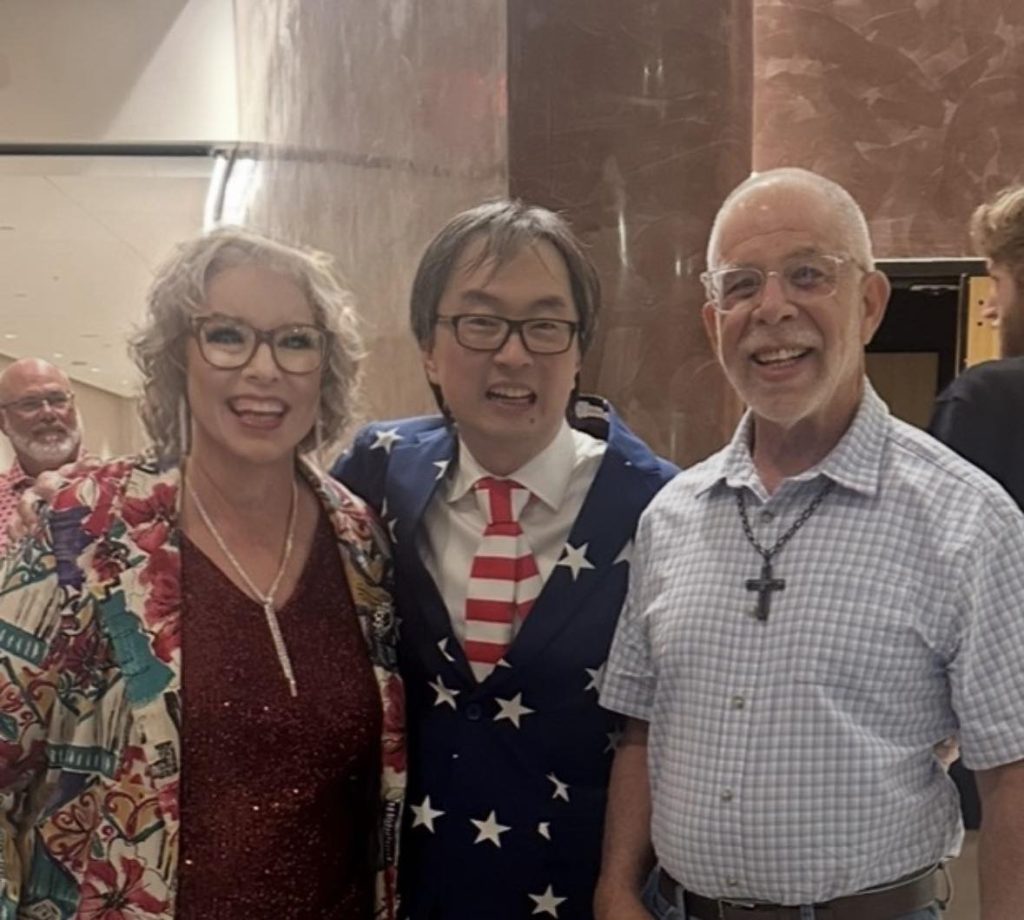
At the center stood Maestro Cho—not merely conducting, but painting. In the first half, dressed in bold red, he moved like an artist before a canvas. His hands became brushstrokes, sweeping color into the air. In the second half, with red still grounding him, he appeared in a blue coat adorned with stars and a striped tie. The music itself became a living flag—unfurling, waving, dancing. His movements rippled through the orchestra like wind through fabric, lifting the sound into something you could almost see.

A Sweet Gift for Two Musicians

For Bernie and me, there was an added sweetness to the evening. These were not unfamiliar works—we had taught many of them to our UIL Music Memory students and even performed some with the Plainview Symphony. To sit side by side without a score, without rehearsal notes, simply listening—it was a gift. We could hear the passion of the musicians not as performers preparing, but as listeners receiving. And what a joy that was.

A Divine Encounter in the Lobby

And as if the evening itself were not already a gift, there was one more moment waiting for us. In the lobby, we didn’t just cross paths—we collided in rhythm with Maestro David Cho, as if our steps had been quietly orchestrated. We congratulated him on a beautiful evening, and then I shared that I will be joining the Teaching Artist program this fall. His face didn’t just smile—it lit with delight. There was a genuine joy, a spark that revealed how deeply he loves children and believes in this work. He immediately began asking about the schools, the students, the possibilities. It felt like one of those meetings heaven arranges—unexpected, perfectly timed, and deeply encouraging. And I walked away even more excited, more inspired, and more grateful to be part of what the Lubbock Symphony is doing in our community.

Looking Ahead

As the final notes faded, we found ourselves already looking forward. The next concert—perhaps right around Bernie’s birthday on September 3—will open the Lubbock Symphony Orchestra’s 80th season, featuring Cliburn Laureate pianist Clayton Stephenson. And we will be there…ready once again, should the room tilt ever so slightly, drawing us to the edge of our seats.