What I Learned in My First Two Weeks as a Teaching Artist for Young Audiences with the Lubbock Symphony

By Dee Ann Loving-Tackitt

One of the most remarkable aspects of the Lubbock Symphony’s Teaching Artist program is its commitment to bringing music directly into children’s lives. While many students may not yet have the opportunity to attend a symphony concert, the program lets them encounter great music, composers, instruments, and musical ideas in the familiar setting of their own classrooms. Through songs, stories, movement, listening activities, and historical connections, students discover that music is not something distant or reserved for experts. Rather, it is a living language that belongs to them. As I begin my first year as a Teaching Artist, I have already learned an important lesson: music education is not simply about teaching children facts about music. It is about helping them discover wonder.

On my way to Bean Elementary one morning, I was listening to the Symphony Hall channel on SiriusXM. Lately, I have been paying close attention to the introductions the hosts give because I am developing program notes and planning future broadcasts for the Ruach Symphony Witness. One particular introduction caught my attention. The host spoke about Bartolomeo Cristofori (1655-1731). Cristofori was an Italian musician, craftsman, and instrument builder who lived during the late seventeenth and early eighteenth centuries. At the time, keyboard players primarily performed on harpsichords. Although beautiful, harpsichords could not respond dynamically to the player’s touch. Whether a key was struck gently or forcefully, the sound remained essentially the same. Cristofori envisioned something different. Because he understood music so deeply, he understood what musicians needed. Through years of experimentation and craftsmanship, he developed a new mechanism that let players control volume and expression with their touch. In doing so, he invented and built the first pianos. What struck me was that Cristofori’s achievement was not merely technical. He did not build a piano because he loved wood, strings, and hammers. He built a piano because he loved music. His musical knowledge let him imagine an instrument that did not yet exist.

As I thought about that story while driving to school, I realized that this is the kind of teacher I want to become. I may never build a musical instrument, but I hope to know music so thoroughly and love it so deeply that I can help shape something even more important: a child’s heart. If Cristofori could create an instrument that inspired generations of musicians, perhaps a Teaching Artist can help create a lifelong love of music in a young person. That thought stayed with me throughout these first two weeks.

During our first week, the students met the Lubbock Symphony Orchestra. They watched videos of our own Maestro Cho and learned about the conductor’s role. They listened to a performance. The students were wonderfully attentive, curious, and eager to learn.

One little girl raised her hand and informed me that Maestro Cho was a conductor, but not a train conductor. I laughed and told her, “That’s true. But knowing Maestro Cho, if someone invited him to conduct a train, he would probably do a wonderful job!” The class erupted in laughter, and from that moment on, the students seemed to feel a personal connection with our orchestra. They understood that musicians are real people and that the symphony belongs to them as much as anyone else.

https://www.facebook.com/share/r/1DCGTZ9W4N/

In several classrooms, we integrated music into literacy instruction. Students practiced long and short vowel sounds by singing them. Rhythm sticks became learning tools that helped reinforce language skills while keeping students actively engaged. Watching children discover that learning can happen through music reminded me of the incredible versatility of our art form.

Other classrooms were studying Abigail Adams and Sojourner Truth, which allowed us to explore history through music. The students learned that Abigail Adams frequently wrote letters to her husband, John Adams, when they were separated. As a folk music researcher, I became fascinated with finding a musical connection to her life. After considerable research, I discovered references in her letters to a Scottish tune that she and John apparently cherished. The children listened carefully as I explained how a simple melody could help people remember loved ones over great distances. They thought it was a very special idea.

When we studied Sojourner Truth, the students learned about her courageous travels and her tireless advocacy for freedom. They discovered that she was also known for her beautiful singing voice. Historical accounts describe how she often adapted familiar tunes and inserted her own messages, allowing her audience to engage with her ideas through song. The students were fascinated by the idea that music could be used not only for entertainment but also to inspire social change. When they heard about Sojourner’s version of “The Battle Hymn of the Republic,” they began to see how music and history are often woven together.

All three of my schools also studied Wolfgang Amadeus Mozart. Students learned about his extraordinary talent and passion for learning. We discussed how great musicians are often great listeners. Mozart paid attention to everything around him, constantly learning from the music he heard.

This activity was by far the favorite with all ten of my classes.

The students enjoyed discovering historical connections between Mozart and Abigail Adams. Although Mozart was a celebrated composer during her lifetime, Abigail’s personal musical preferences seem to have leaned toward the Scottish music she knew and loved. Such connections helped students realize that the people they study in history books were real individuals with personal tastes, interests, and experiences.

As rewarding as the lessons themselves have been, the greatest joy has come from the students. I love their smiles and laughter. And every day, as I prepare to leave, several children run up to make sure I know they love me. I always tell them that I love them too.

Those moments remind me why the arts matter. Long after the students forget the dates, names, and facts we discuss, I hope they remember how music made them feel. I hope they remember that someone shared music with them, believed in their creativity, and invited them into a world filled with beauty. My first two weeks as a Teaching Artist have taught me that teaching music is not merely transferring knowledge. It is building relationships, cultivating curiosity, and nurturing wonder. Bartolomeo Cristofori used his understanding of music to build an instrument. As Teaching Artists, we use our understanding of music to build something even more enduring: a lifelong love of music in children’s hearts. And that may be the most beautiful instrument of all.

From Holy Saturday to New Creation: A Biblical Theology of Posttraumatic Growth

The Theological Foundation of a thesis project for the candidacy of The Doctorate of Ministry in Biblical Studies by Dee Ann Loving-Tackitt

With arms spread wide between heaven and earth, Christ died on the cross (Matt 27:32–50). Standing between death and life, despair and hope—the disciples failed to perceive what God is accomplishing in this rich silence (Matt 27:57-66; 28:1-10). Holy Saturday is a harrowing day, full of profound mystery. Scripture repeatedly portrays this “middle space” in the Easter Triduum as a place of divine activity, the antechamber to the other side of death and the threshold of resurrection. What appears to be an ending becomes transformation for God’s redemptive work. The disciples who wait in confusion and grief soon become witnesses to the risen Christ. Their transformation reflects the broader biblical pattern of God bringing renewal out of suffering and despair. Creation bursts forward into renewed faith, purpose, and mission. This regrowth from renewal provides a theological framework for understanding posttraumatic growth as more than recovery from suffering. Through the death and resurrection of Jesus Christ, wounded believers are invited into restoration, spiritual formation, and discipleship.

Scripture portrays humanity living in the tension between God’s intended flourishing and the reality of a fallen world. Humanity’s rebellion fractures its relationship with God and introduces death, alienation, and suffering into creation.[1] In the garden, man was tempted to bypass God’s blessings and transcend human limitations to claim divine prerogatives.[2] God acknowledges that humanity “has become like one of us in knowing good and evil” (Gen 3:22, English Standard Version). The serpent essentially offers a counterfeit path to divine likeness—one achieved through deception and disobedience rather than obedience and grace. The fall is humanity’s first seduction by false divination—accepting the serpent’s whispered knowledge over God’s explicit command. A profound theological symmetry links Holy Saturday and the fall. God’s patient waiting and suffering of human rebellion begin with the fall and continue through human history. Humanity’s choice of Satan’s divinization mirrors this pattern in reverse—a rebellion that God permits to absorb and ultimately redeem.[3] Humanity’s brokenness becomes, in God’s economy, a kind of Holy Saturday—a space of abandonment and silence where God’s redemptive work operates beneath the surface. The parallel deepens when we consider God’s response. Through His death and resurrection, Christ opens the way into the eternal Sabbath rest promised to the people of God (Heb 4:9-11).

[4] Just as Holy Saturday is theologically understood as the period Christ descends into the underworld to bring salvation to the dead, so too does God’s patience with human rebellion become redemptive.[5] Yet God consistently moves toward humanity in the midst of its woundedness. The Exodus narrative reveals God’s redemptive response to a people living under oppression and despair. When God reveals Himself as “I AM” (אֶהְיֶה) and proclaims His covenant name Yahweh (יהוה), He identifies Himself as the God who is present with His people and committed to their deliverance (Exod 3:14-15). Israel’s deliverance from bondage demonstrates that God does not abandon those who suffer but acts to bring them from captivity into freedom. Throughout Israel’s history, patterns of failure, exile, loss, and restoration continue to reveal both the depth of human brokenness and the persistence of God’s covenant faithfulness. Again and again, God transforms situations marked by despair into opportunities for renewal and renewed participation in His purposes.[6]

The pattern seen throughout Scripture, from humanity’s fall and Israel’s deliverance to the death and resurrection of Christ, is embodied in the disciples themselves as they move from fear and grief to faith, community, and witness. The cross represents the deepest encounter with human suffering and brokenness, while the resurrection reveals God’s power to bring new life out of death.[7] During Holy Saturday, the disciples could not perceive what God was accomplishing through the silence of the tomb. Yet the risen Christ appeared to those same disciples, meeting them in their fear, uncertainty, and grief. Their wounds, doubts, and failures did not exclude them from His purposes. Instead, Christ gathered them into a community of faith and commissioned them to bear witness to His resurrection. Consequently, Christian discipleship rests upon the conviction that woundedness is not the end of the story. Through union with Christ and participation in His body, believers are formed into faithful disciples who bear witness to God’s redeeming work in the world.

The restoration experience began after the disciples encountered the risen Christ. As in Psalm 77, the disciples’ lamentations turns to praise as Christ leads them through the love and power of God’s deliverance. Their doubts turn to comfort. Christ commands them to follow His example and use their suffering to help others.[8] Throughout Scripture, spiritual formation deepens through remembering, reflecting on, and recounting God’s faithfulness. The ultimate result is that God is glorified when his people are delivered from suffering.[9] God’s people are called to preserve His works for future generations through written remembrance and are formed through remembrance and recounting of His faithfulness. Preserving testimony enables future generations to grow in faith as they learn from God’s past redemptive work. Consequently, modern practices of theological reflection and written remembrance are means of discipleship and spiritual formation.[10]

Habakkuk’s wrestling with God is what we might call posttraumatic growth. It shows how suffering becomes redemptive when channeled through obedience and testimony.[11] Habakkuk was not angry with his people’s corruption but with God’s silence. This prompted him to demand divine action. Yet, as God usually does, he answers with  imperatives—commanding him to “write the vision.”[12] God is doing something remarkable: converting personal anguish into a communal resource. The writing isn’t merely to preserve the vision from being forgotten, but to enable others to read it and act upon it.[13] This transformation is posttraumatic growth: suffering becomes meaningful when it is integrated into a larger narrative and shared with others.[14] God’s message is clear: it is intended for all people everywhere and must be passed on. Habakkuk’s personal crisis becomes everyone’s spiritual resource.

The New Testament connection emerges through this same pattern. Throughout the Old Testament, a vision denotes God-given revelation about the spiritual significance of present or future events, and God gives greater insight into the spiritual meaning of forthcoming events.[15] This principle—suffering producing clarity and testimony— extends into the New Testament through apostolic witness: persecution producing proclamation and pain producing purpose. The pattern is true for both Testaments and today. When we bring our struggles to God and then articulate them clearly for others, they become invitations rather than isolating experiences. The imperative to “write”—whether literally or metaphorically—transforms private crisis into public witness.

Just as Habakkuk discovered that his cry for justice became an invitation to deeper discipleship through God’s imperative to write, wounded believers today find in Christ’s death and resurrection the same transformative call—to move through suffering into restoration and become witnesses of redemptive hope to others. The new creation has begun. Peter tells believers, “You must worship Christ as Lord of your life. And if someone asks about your hope as a believer, always be ready to explain it” (1 Pet 3:15).  The ministry intervention proposed in Royal Beginnings seeks to participate in this biblical pattern by helping women move from brokenness to restoration, from restoration to discipleship, and from discipleship to witness.


[1] Ian M. Duguid, Ronald L. Bergey, Jay R. Sklar, and Christine Palmer, eds., ESV Expository Commentary, vol. 1, Genesis-Numbers (Wheaton, IL: Crossway, 2025), 70.

[2] C. Amos, Birthpangs and Blessings: A Commentary on the Book of Genesis, 1st ed. (York, UK: Sacristy Press, 2022), 48.

[3] J. Paul Tanner, Daniel, Evangelical Exegetical Commentary (Bellingham, WA: Lexham Press, 2020), 769.

[4] Tanner, Daniel, Evangelical Exegetical Commentary, 769.

[5]  Clinton E. Arnold, ed., Zondervan Illustrated Bible Backgrounds Commentary: Hebrews to Revelation (Grand Rapids, MI: Zondervan, 2002), 27.

[6] Duguid, Bergey, Sklar, and Palmer, eds., ESV Expository Commentary, 667-69.

[7] R. Alan Culpepper, Matthew: A Commentary (Louisville, KY: Westminster John Knox Press, 2021), 706-07.

[8] Allen P. Ross, A Commentary on the Psalms, vol. 2, Psalms 42–89 (Grand Rapids, MI: Kregel Academic, 2013), 639–40.

[9]  Allen P. Ross, A Commentary on the Psalms, vol. 3, Psalms 90–150 (Grand Rapids, MI: Kregel Academic, 2016), 220–21.

[10] Dennis Prager, The Rational Bible: Deuteronomy (Washington, DC: Regnery Faith, 2022), 110–11.

[11] Michelle Panchuk, “What Doesn’t Kill Me Makes Me Stronger?: Post-Traumatic Growth and the Problem of Suffering,” Religious Studies 60, no. 3 (2024): 429.

[12] Booth. Habakkuk: The Christian Standard Commentary. Nashville: B&H Publishing Group, 2024.

[13] Panchuk, “What Doesn’t Kill Me Makes Me Stronger?, 429.

[14] Steven J. Duby, Habakkuk, ed. Michael Allen and Scott R. Swain, The International Theological Commentary on the Holy Scripture of the Old and New Testaments (London: T&T Clark, 2025), 85.

[15] Duby, Habakkuk, 85.

Questioning the Questioners

Jesus’s Prophetic Pedagogy of the Heart

by Dee Ann Loving-Tackitt

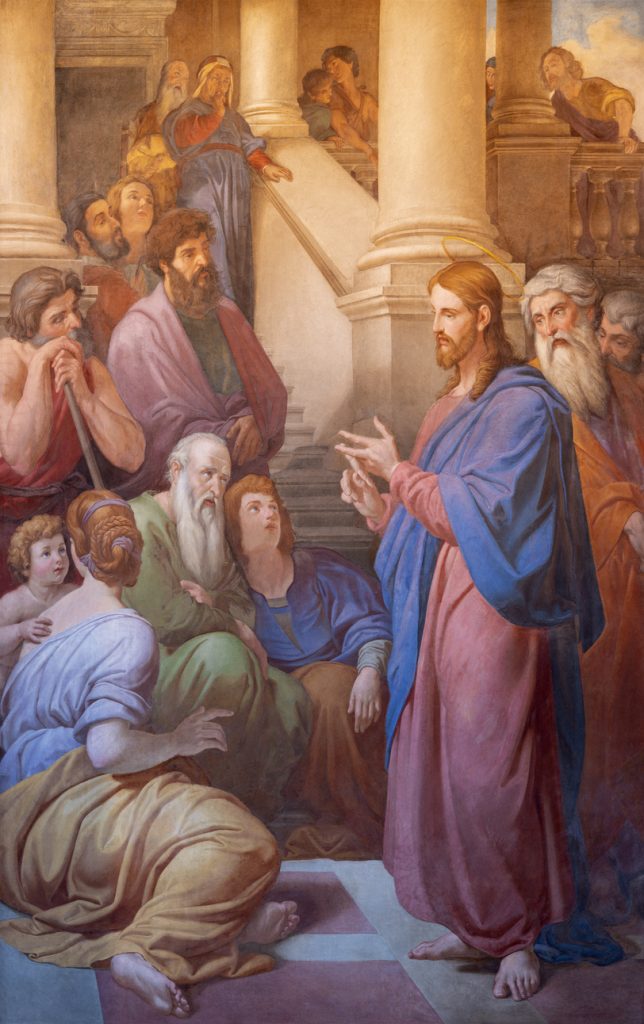
Rome – The fresco of Jesus teaching in the church Santa Maria in Monticelli 

“You call me ‘Teacher’ and ‘Lord,’ and rightly so, for that is what I am.” John 13:13

Jesus is asked many questions in the Gospels; he rarely answers any of them directly. Some may see Jesus as cleverly evading the questioner. Yet I argue that Jesus’s “questioning questioners” is His vital teaching tool to awaken and involve his listeners in spiritual formation. In this context, Jesus typically responds to questions with another question, either through an indirect claim or a specific revelatory aim. Always! Jesus reframes the terms of a pressing topic and sheds light on his interlocutors’ root motives and spiritually compromised perspectives.

In John 13:13, Jesus tells his disciples, “You call me ‘Teacher’ and ‘Lord,’ and rightly so, for that is what I am” (cf. Matt 23:10; 26:18). As a teacher, Jesus adopts different teaching styles for formative reasons. As God anointed, Jesus speaks and embodies the message of God’s reign. He aligns with the prophets of Israel’s past, including John, his immediate predecessor. Jesus seeks to heal and to reveal. Divine revelation aims to open and purify the heart before God. This prepares people to receive God’s Torah written on their hearts (Jer. 31:33). The new covenant transforms the heart from within, and this transformation lies at the center of faithful living.

The Teacher of the Coming Kingdom

To be specific, we must set forth the “givens” of Jesus as a teacher from the context of His ministry and mission. First, Jesus came to proclaim the coming of the Kingdom of God. Second, He is to make disciples, to “seek and save the lost”; “to give His life as a ransom for many”; “to save sinners”; “to save the sick”; and to do all this by summoning His hearers to metanoia, which means calling forth repentance before the coming of the reign of God. To fulfill this goal, Jesus is willing to say to His own disciples what He also said to those who approach, question, and dispute with Him. Therefore, Jesus clearly accepts and even promotes an environment conducive to dialogue, questioning, and discussion.

The Prophet of the Heart

As a theologian, I am quick to point out that Jesus does not have educational exchanges to get the facts. He debates to fulfill God’s will. He exposes and shapes the listener’s core desires, assumptions, and perspectives. Jesus is NOT willing to engage a question directly when the basic question and exchange have already been molded to be anti-kingdom. Jesus’s pedagogy is not aimed at the heart to access commitments, intentions, desires, and core thoughts. Jesus grappled with reason to access the heart for the Kingdom. Jesus is fiercely consistent, whether in response to a question or a straightforward demand. In Luke 12:13–14 (NIV), someone in the crowd said to him, “Teacher, tell my brother to divide the inheritance with me.” Jesus replies, “Man, who appointed me a judge or an arbiter between you?” Rather than simply saying, “No, I won’t do that,” Jesus’s question functions as a claim: why are you trying to use me or manipulate me to resolve your family’s financial dispute? In Luke 12, Jesus confronts greed, worry, and conflict over material security as crucial issues that can obstruct sincere acceptance of proclamation. This is, however, just one instance of Jesus questioning the nature of one’s actions to address a broader, perennial challenge to entering the way of the kingdom. Jesus ultimately seeks to reveal and transform a person’s bedrock desires and intentions so they may see and enter the way of God’s reign. Shalom.

Heavenly Father,

Today, we choose to pay close attention to wisdom and listen intently to understanding. Help us to trust in the Lord with all our heart and lean ONLY on your understanding. In all our ways, may we acknowledge Jesus. And we ask you to direct our paths. We ask you to remove our proud hearts so that we can trust in You. In Jesus’ precious name we pray. Amen