
Category Archives: Mark at the Writing Center

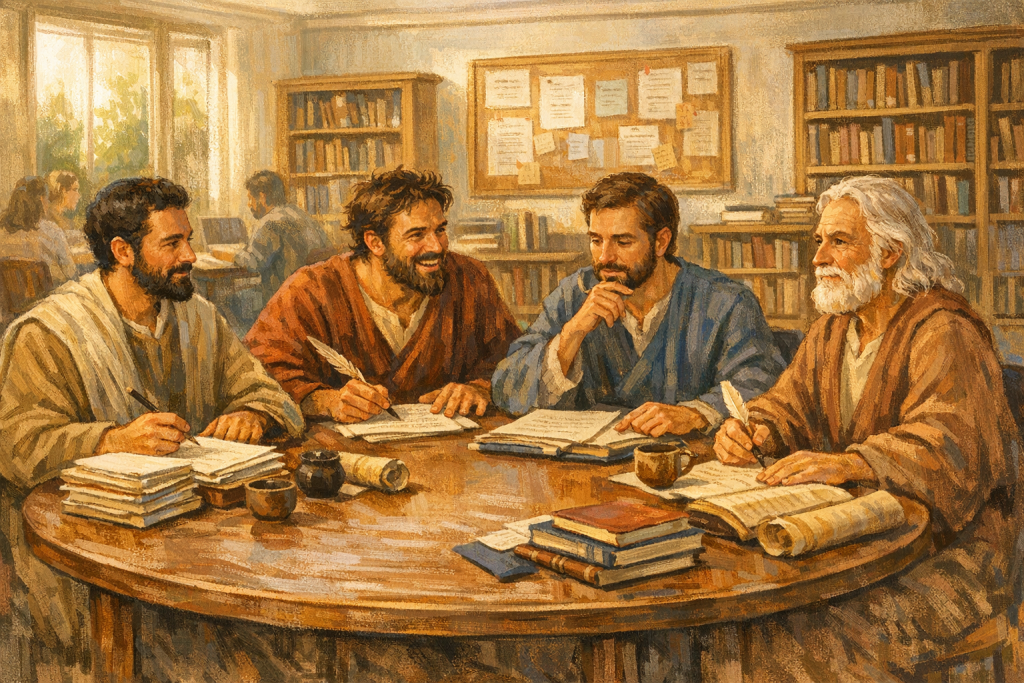
Matthew, Mark, Luke,& John Visit the Writing Center

by Dee Ann Loving-Tackitt
“Let the word of Christ dwell in you richly in all wisdom; teaching and admonishing one another…” — Colossians 3:16 (KJV)

Beginning the Journey

One of the most interesting things I’m learning as I attend Writing training sessions for my job at Liberty University is that not every writer thinks about writing in the same way. Some writers want clear rules and the “right” answer. Others are more comfortable with multiple perspectives. Still others see writing as a process of reflection, revision, and discovery. In other words, here are the three types of writers I may be assisting: dualist, relativist, and reflective writers. Each one has strengths, and each one needs a slightly different kind of support.

Calling in Four Famous Writers

Now for the fun part. Matthew, Mark, Luke, and John have different styles, let’s have some fun and imagine them visiting the Writing Lab.

Matthew: The Structured Writer

Matthew came in first, sat down neatly, and said, “I like structure. I like organization. I like showing how everything connects and fulfills what has already been said.” I nodded and thought, Okay, Matthew definitely wants the assignment sheet, the rubric, and probably a sample paper too. If I were using my Writing Lab categories creatively, I might say Matthew sounds the most like a dualist writer. He values order, clarity, and clear teaching, and he seems very concerned with presenting truth in a direct, purposeful way.

Mark: The Urgent Writer

Then Mark came in, and before I could even offer him a chair, he was already halfway through his explanation. “Immediately,” he seemed to say, “we need to get to the point.” Mark’s style felt urgent, energetic, and fast-moving. He didn’t seem interested in long introductions or unnecessary details. He wanted action. He wanted momentum. Mark was the hardest to classify, but I could imagine him leaning toward a writer who values strong direction and clarity while still pushing forward with intensity, a dualist! He did not seem interested in overthinking the process. He wanted the message on the page.

Luke: The Thoughtful Writer

Luke arrived next with the calm confidence of someone who had actually prepared for the appointment. He opened his notes and explained that he preferred to write in an orderly way, carefully considering details and making sure the account was thorough and understandable. Luke sounded like the kind of writer who understands that ideas need context, explanation, and thoughtful arrangement. He felt much more like a reflective writer to me—careful, balanced, and interested in developing writing with purpose and precision.

John: The Deeply Reflective Writer

Then John walked in, and the entire room changed. John did not seem rushed at all. Instead, he spoke in a way that made me feel like every sentence had layers beneath it. He seemed less interested in simply giving information and more interested in helping the reader see meaning, depth, and truth from a deeper angle. If Matthew brought structure and Mark brought urgency, John brought reflection. He definitely struck me as a reflective writer—the kind of writer who is comfortable with complexity and willing to let ideas unfold thoughtfully.

Back to Studying!

Now that was a fun break, but now it’s back to studying. And if I smile a little longer at my students, it will probably be because I’m thinking of Matthew, Mark, Luke, and John.
When Mark Returns AGAIN to the Writing Center

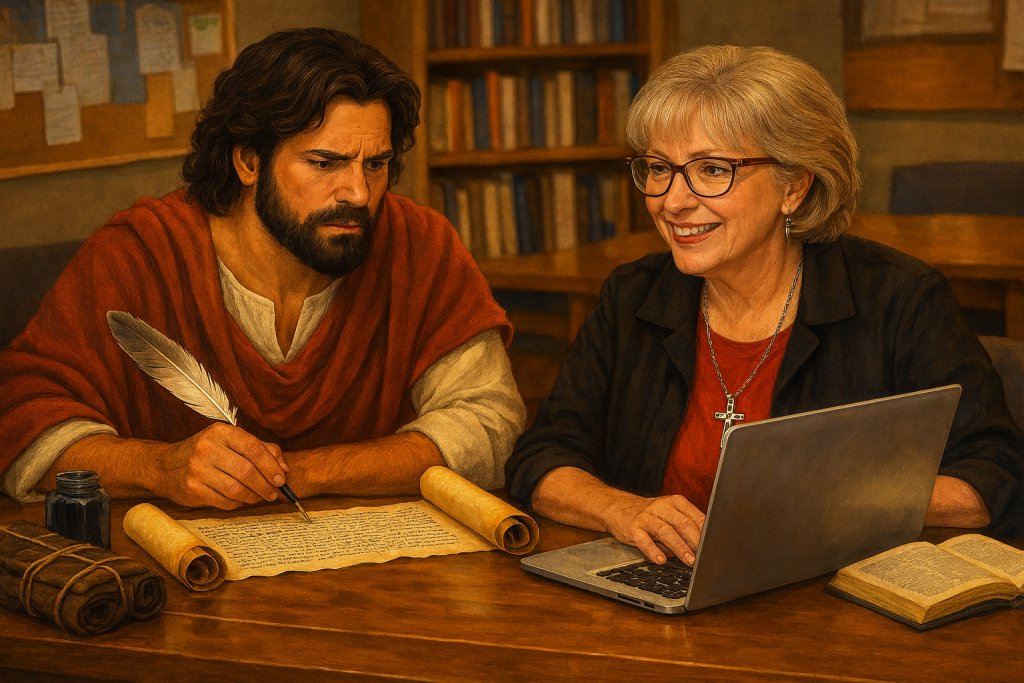
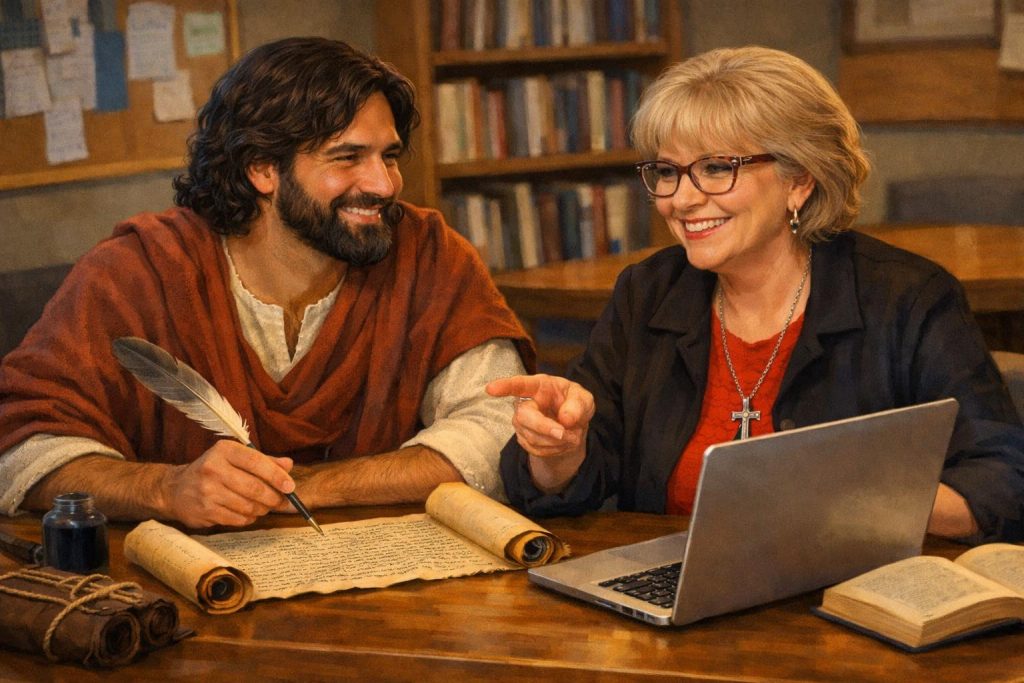
I’ve been scribing the Gospels lately—just twenty verses into Mark chapter 1—and I finally decided it was time. I needed to call Mark into the Writing Center. Yes, that Mark. The one who wrote the shortest, fastest, most breathless Gospel in the New Testament. The one who can’t seem to write a paragraph without sprinting.

So I sat him down, slid the manuscript across the table, and said, “Mark, we need to talk about your grammar.”

He blinked at me, probably wondering how he got here and why a woman from the 21st century was holding a red pen over his sacred text. But I pressed on.


“Mark, About These Sentences…”

“Listen,” I told him, “I know this is translated from your original language. I know Koine Greek doesn’t follow modern English rules. I know your Gospel was meant to be read aloud, fast-paced, urgent, breathless. But let’s not make excuses here.”

I tapped the page.

“You have sentences that run on for half a mile. You start half your paragraphs with ‘And.’ You leave out verbs. You splice commas like you’re trying to knit with punctuation. And honestly, Mark… I love it.”

He looked relieved.

Because the truth is, Mark’s grammar may be chaotic, but his message is not. His Gospel moves like a wildfire—quick, bright, unstoppable. It reads like someone who cannot wait another second to tell you about Jesus. And maybe that’s why his grammar feels like it’s sprinting. His heart is sprinting.


The Gospel That Changed Lives

I leaned back in my chair and said, “Mark, your grammar may give English teachers heart palpitations, but your Gospel has changed the world.”

He nodded, because he knows.

His Gospel has:

  • called sinners to repentance
  • revealed Jesus as the Son of God
  • shown demons fleeing at His voice
  • displayed the heavens torn open
  • carried the cross to the center of history
  • proclaimed resurrection with trembling joy

Mark didn’t write to impress scholars. He wrote to save souls. He wrote so the church—then and now—could hear the good news with urgency and clarity.

And maybe that’s why his grammar feels like a man running out of breath. He wasn’t polishing sentences. He was proclaiming salvation.


Why I Love Mark’s “Bad Grammar”

So I told him, “Mark, your grammar may be questionable, but your theology is flawless.”

He grinned.

Because the Gospel of Mark is not a literary masterpiece—it is a spiritual earthquake. It shakes the ground under our feet. It tears open the heavens. It drives Jesus into the wilderness and drives demons out of people. It calls fishermen from their boats and calls us from our old lives.

Mark writes like a man who has seen the kingdom of God break in and cannot slow down long enough to breathe, much less diagram a sentence.

And honestly? I love it!

Father,
Thank You for the gift of Your Word—perfect in truth even when our grammar isn’t. Thank You for inspiring Mark to write with urgency, passion, and Holy Spirit fire, reminding us that the Gospel is not about polished sentences but about a Savior who changes lives. As we read, study, and even laugh our way through these verses, let Your Spirit open our eyes to see Jesus more clearly. Give us hearts that respond as quickly as Mark writes—immediately, joyfully, and obediently. May Your Word run swiftly through our lives, accomplishing everything You send it to do.
In Jesus’ name, Amen.

A Second Visit to the Writing Center

Mark 1:2–3

Mark Returns

I imagine Mark showing up at the Writing Center again this week—scroll tucked under his arm, sandals dusty, eyes bright with that same urgency he had last time. He sits down across from me, unrolls his parchment, and says, “I’ve added the next part. Can you look at it?”

Of course I can.

So I read:

“As it is written in Isaiah the prophet,
‘Behold, I send my messenger before your face,
who will prepare your way,
the voice of one crying in the wilderness:
Prepare the way of the Lord,
make His paths straight.’”
(Mark 1:2–3)

Back at the Writing Center

And once again, I slip right into tutor mode.

“Mark,” I say, “we talked about this last time. You wrote ἐν τῷ Ἠσαΐᾳ τῷ προφήτῃ—‘in Isaiah the prophet’—but your first line is from Malachi. I know why you did it. In your world, you name the major prophet even when you blend texts. That’s normal. That’s expected. That’s how your people cite Scripture.”

He nods, as if to say, Of course. Everyone knows that.

“But modern readers don’t,” I continue. “They’ll think you made a mistake. So if you were turning this in for an English class, I’d suggest something like:
‘As the Scriptures say—first in Malachi, then in Isaiah…’

He raises an eyebrow.
I shrug.
“Different century. Different expectations.”

The Voice in the Wilderness

Then we move on to verse 3.

“Now this part,” I say, tapping the line with my finger, “this is where your heart shows. φωνὴ βοῶντος ἐν τῇ ἐρήμῳ—‘a voice crying in the wilderness.’ You didn’t soften it. You didn’t polish it. You didn’t modernize it. You let Isaiah thunder straight through your pen.”

Mark grins.
He knows exactly what he’s doing.

What Mark Emphasizes

“And look at what you emphasize,” I continue. “Not the wilderness. Not the voice. Not even the messenger. You emphasize the Lord.

Prepare the way of the Lord.
Make His paths straight.”

I lean back in my chair.

Not Just a Story—An Announcement

“Mark, you’re not just writing a biography. You’re announcing an arrival. You’re telling your readers that the God who spoke through the prophets is stepping onto the stage of history. No wonder your Greek feels urgent. No wonder your sentences run like they’re out of breath. You’re not trying to impress us—you’re trying to wake us up.”

He smiles again, and I realize something:

Mark doesn’t need my help with grammar.
He needs my help with translation—not of words, but of worlds.

The Gospel Doesn’t Whisper

Because Mark writes like a man standing on tiptoe, shouting across centuries, “He’s here! The Lord is here!”

And sometimes, in our careful, polished, modern world, we forget that the gospel didn’t arrive quietly. It arrived like a voice in the wilderness—loud, raw, unignorable.

Walking the Prayer Path

Maybe that’s the deeper lesson for us on this prayer path. We don’t prepare the way of the Lord by perfecting our sentences.
We prepare it by opening our hearts.
By clearing the clutter.
By making straight the paths where He wants to walk.

What a Beginning

Mark reminds us that the gospel is not a literary exercise.
It is an announcement.
A summons.
A beginning.

And what a beginning it is.

A Prayer

Heavenly Father,
You are the One we prepare for—and yet You are the One who prepares us.

Clear the paths of our hearts where they have become cluttered and crooked. Remove the fear, the pride, and the distractions that keep us from seeing You clearly. Teach us to listen for Your voice, even when it comes like a whisper—or like a cry in the wilderness.

Help us not to polish our lives for appearance, but to open them fully to Your presence. Make us ready—not just in word, but in spirit—to receive You and to follow where You lead.

And when You call, give us courage to respond quickly, just as Mark wrote—with urgency, with joy, and with the certainty that the Lord has come.

We love You, Jesus.
Prepare us for Your work.

Amen.

A Resource for Going Deeper

If you find yourself curious about Mark’s urgency, his use of Scripture, or even the texture of his Greek, here are a few trusted resources that open up his Gospel in meaningful ways:

For understanding Mark as a whole:

  • James R. Edwards, The Gospel According to Mark (Pillar Commentary)
    This is a wonderful, readable commentary that explains the flow of Mark’s story and highlights his urgency and theological focus. It helps you see exactly what Mark is emphasizing—and why it matters for us today.
  • R.T. France, The Gospel of Mark (New International Greek Testament Commentary)
    This one goes deeper, especially into how Mark uses Scripture (like Isaiah and Malachi in Mark 1:2–3). It’s especially helpful for understanding why Mark blends passages and how his original audience would have heard it.

Suggested Scripture Readings

To understand the fuller story behind Mark’s opening, these passages connect beautifully:

  • Isaiah 40:3–5 — The original “voice in the wilderness”
  • Malachi 3:1 — The promise of the messenger
  • Luke 3:1–6 — Another account of John preparing the way
  • John 1:19–23 — John the Baptist’s own testimony
  • Psalm 24:7–10 — Welcoming the King of Glory

When Mark Came to the Writing Center

 The beginning of the gospel of Jesus Christ, the Son of God. As it is written in Isaiah the prophet, “Behold, I send my messenger before your face,
 who will prepare your way, Mark 1:1-2

Today, I found myself smiling at a funny little thought while working on my commentary on Mark’s Gospel. I imagined Mark himself sitting across from me at the Writing Center—scroll unrolled, ink still fresh—sliding his opening lines in front of me and asking, “Does this sound right?”

So I read his words slowly:

“The beginning of the gospel of Jesus Christ, the Son of God.
As it is written in Isaiah the prophet…”

And I couldn’t help it—I slipped right into tutor mode.

“Mark,” I would say gently, “your ideas are beautiful. Truly. But you’re writing like a first-century Jewish author… and my job is to help modern English readers understand you.”

First, I’d point to that opening sentence. “Friend,” I’d smile, “you don’t have a verb here. Now, in Greek, that works just fine. It’s powerful, almost like a bold title carved into stone. But in English, it reads like a fragment. If this were a paper, I’d just ask you to add one simple word: is.

And suddenly the line breathes a little differently:

“This is the beginning of the good news about Jesus Christ, the Son of God.”

Clear. Direct. Complete.

Then we’d move on to the second line. “Mark,” I’d continue, “you’ve written ‘as it is written in Isaiah,’ but your first quotation actually comes from Malachi. Now, I know why you did that. In your world, you name the major prophet even when you blend passages. That’s a perfectly acceptable practice in your time. But modern readers might get confused.”

So I’d suggest something like:

“As the Scriptures say—first in Malachi, and then in Isaiah…”

And then I’d lean back, smile, and say, “You didn’t do anything wrong. You’re just writing from your own time, your own tradition, your own rhythm. And it works—it really does.”

Because the truth is, Mark’s Gospel doesn’t begin with careful, polished explanations. It bursts onto the page. It feels like someone who can’t wait another second to tell the story of Jesus. There is urgency in his voice. There is movement. There is life.

And maybe that’s the deeper lesson for all of us walking this prayer path.

Sometimes we worry so much about getting every word right, every detail perfect, every sentence polished… that we forget the joy of simply telling the good news. Mark reminds us that the gospel is not primarily about flawless grammar—it is about a living Savior.

He doesn’t linger long in introductions. He doesn’t slow down for perfection. He simply begins:

“This is the beginning of the good news…”

And what a beginning it is.


Prayer

Heavenly Father,
Thank You for the writers of Scripture, who spoke Your truth with passion, urgency, and faith. Thank You for Mark, whose words remind us that the gospel is living and powerful, not confined to perfect sentences but alive in every heart that receives it.

Help us not to hold back out of fear of saying things imperfectly. Give us courage to share the good news boldly, joyfully, and faithfully. Teach us to love Your Word deeply, to understand it responsibly, and to speak it with grace.

And Lord, let our lives themselves become part of that unfolding story—evidence that the good news is still being written today.

In Jesus’ name,
Amen.