Category Archives: Writing as Witness

The Author Who Enters His Own Story

by Dee Ann Loving-Tackitt

Then God said,“Let us make mankind in our image, in our likeness, so that they may rule over the fish in the sea and the birds in the sky, over the livestock and all the wild animals, and over all the creatures that move along the ground.” So, God created mankind in his own image,
in the image of God he created them; male and female he created them.                               
Genesis 1: 26–27

Yes, we address God our Father with many names. YHWH, Elohim, El Shaddai, Jehovah Rapha. Another way I understand God’s relationship with all of us is as the Author of all creation, His living story. Many of us, through J.R.R Tolkien, read how he shaped Middle-earth with language, imagination, and design. God is THE Creator. The difference between Tolkien and THE Creator is infinite: Tolkien made a fictional world, while God authors reality itself.

The theologian Kevin Vanhoozer discusses God as the Author of His own story, naming it Theodramatic Theology.

What is Authorial Analogy?

A human author writes. God creates.

An author creates with words, while God creates when He speaks.

An author shapes the plot. God creates the plot as He writes our story.

An author writes the story from beginning to end, but God knows the end before our beginning.

God does not need ink; He creates with His Power.

In Genesis, when God speaks, light appears. When He speaks, life begins. Psalm 33 says, “By the word of the Lord were the heavens made.”

Three Types of Divine Authorship

Authorial Analogy can be explained in three ways.

  1. God as our divine author creates with order, beauty, meaning, and life. Authors have that goal as well.
  2. God shapes history by just creating and stepping back. Yet He chooses to join the story. In the Bible, God spoke to Abraham, sent prophets, became Christ, and took part in the story He writes.
  3. By speaking and working through human writers, God has given us Scripture. In this way His voice is heard in many times, places, and styles.

What About Human Freedom?

How can we be free if God is our Creator? This question is often asked. Are we merely puppets? I don’t think so. God does not do all the talking, keeping us silent. He wants to have a conversation. God speaks, and we should respond! Right away! I have experienced this: God calls, convicts, persuades, reveals, and teaches. This is how He heals us. God waits for us to respond. When we choose to listen and talk to God, our hearts soften. But the opposite is true as well: when we choose to resist, our hearts harden. God does not force this conversation; He waits for us to choose to join His story. He holds the whole story in His hands.

  • We are responsible to God and others within the story God writes.
  • God can stand outside His creation, just as an author is physically outside His story.
  • Yet, God IS present within creation. Therefore, he can be compared to the author who steps into His own story.

The Bible

Where can we read God’s story? Open the Bible. We can read how He creates, makes covenants, and gives us shalom (peace) through His Word. Not only does God speak in the Bible, but He is present in the Bible because He is speaking directly to you. That is why I call Him the Author of all Creation. We live God’s story because He speaks, sustains, and guides.

“As Author, God is not limited by his created work … one authorial day is like a character’s thousand years (2 Pet. 3:8). The Author can open the text to any page, flip back and forth at will, and write himself into the drama of human history: God’s Word and Spirit are in created time but not of it.” Kevin Vanhoozer

Shall we pray?

Heavenly Father,

We weave fictions of our lives with words. We create myths without Your authorship. We welcome Your Words that build a holy place in our hearts while turning love into beautiful music. We still do not fully understand Your way. In Christ, the language You put in our hearts illuminates this dim world. May Your love always cleanse our minds and replenish us with joy. In Jesus’ precious name we pray. Amen.

Resources

Freeman, Austin M. “The Author of the Epic: Tolkien, Evolution, and God’s Story.” Zygon 56, no. 2 (2021): 500–516. EBSCOhost.

Hronich, Andrew. 2025. “God and Indiana Jones.” Liberty Theological Review 9, (1). 

Settecase, Parker. “Don’t Write off the Absentee Author: Why the Problems of Divine Hiddenness and Neglect Don’t Destroy Vanhoozer’s Authorial Analogy.” Perichoresis 21, no. 4 (2023): 34–51. https://doi.org/10.2478/perc-2023-0030.


How God Restores What Trauma Breaks

by Dee Ann Loving-Tackitt

“He heals the brokenhearted and binds up their wounds.” — Psalm 147:3

Trauma has a way of breaking life open. It can shatter our sense of safety, silence our voice, and fracture our identity. Neuroscience shows that when people relive traumatic memories, the brain’s language centers go quiet while emotional centers flare with activity. This is why survivors often say, “I don’t have words for what happened.” Trauma steals language.

But God has always been in the business of restoring what was broken—especially the parts of us that feel too shattered to name. And Scripture gives us a powerful pattern: healing often begins when people reclaim their story.

Interestingly, modern research on expressive writing echoes this same truth. When trauma survivors write about their experiences, they re-engage the parts of the brain responsible for language, narrative, and meaning-making. Over time, expressive writing has been shown to reduce anxiety, improve mood, strengthen working memory, and support post-traumatic growth.

Science and Scripture meet in a beautiful place: healing begins when we bring our story into the light.

David’s Psalms: When Pain Finds Its Voice

The Psalms are filled with raw, unfiltered emotion. David writes through fear, betrayal, grief, and despair. He names what feels unspeakable. He puts chaos into language.

This mirrors what expressive writing does today—helping the brain integrate overwhelming experiences and restore emotional balance. David’s writing becomes both prayer and processing, a sacred act of survival.

Joseph’s Redemption: Rewriting a Wounded Story

Joseph endured betrayal, abandonment, false accusation, and imprisonment. Years later, he reframes his story with God’s help:

“You meant evil against me, but God meant it for good.” — Genesis 50:20

This is meaning-making—the same cognitive shift expressive writing often produces. Joseph doesn’t erase the trauma; he integrates it. His identity is rebuilt not by forgetting the pain but by understanding it through God’s lens.

Job’s Lament: Wrestling Toward Understanding

Job’s suffering is overwhelming—loss of family, livelihood, health, and dignity. Much of the book is Job trying to make sense of his pain. He speaks, questions, laments, and reflects. He narrates his trauma in real time.

This mirrors the therapeutic process: naming the pain, exploring its meaning, and slowly reconstructing identity after devastation. Job’s restoration is not only physical; it is deeply narrative.

Israel’s Exile: Remembering, Rebuilding, and Returning

The exile is a national trauma. Israel loses home, identity, and stability. In response, the prophets call the people to remember, write, and tell their story. Lamentations records communal grief. Ezra and Nehemiah describe rebuilding both the city and the people’s identity.

God leads them through a process of naming the loss, narrating the experience, and rebuilding life with new meaning—just as expressive writing helps trauma survivors do today.

The Risen Christ: Scars That Tell a Story

After the resurrection, Jesus appears with His scars still visible. The wounds remain, but they no longer signify defeat—they signify victory, identity, and purpose.

This is the heart of trauma recovery: the wound becomes part of the story, not the end of it.

Where Scripture and Science Meet: Healing Through Story

Modern research shows that expressive writing helps trauma survivors:

  • Re-engage language centers
  • Integrate fragmented memories
  • Reduce distress
  • Improve mood and functioning
  • Rebuild meaning
  • Experience post-traumatic growth

Scripture shows God leading people through the same arc:

  • Naming the trauma (Psalms, Lamentations)
  • Narrating the experience (Job, Joseph)
  • Rebuilding identity (Exile and Return)
  • Finding meaning in suffering (Paul)
  • Transforming wounds into testimony (Jesus)

Both tell the same truth: healing often begins when we reclaim our story.

Trauma may silence us, but God invites us to speak—to write, to remember, to narrate, to rebuild. Expressive writing becomes not just a therapeutic tool but a spiritual practice, a way of joining the long biblical tradition of people who found healing by putting their pain into words.

And in doing so, we discover what Scripture has always promised: our wounds can become part of a redeemed story.

A Prayer for Healing and Restoration

Father, You see every wound, every memory, every moment that felt too heavy to carry. You know the places where trauma has stolen our words and fractured our sense of self. Today, we ask You to gently restore what has been broken. Give us courage to name our pain, strength to write our story, and grace to see Your hand in every chapter. Bind up the wounds that still ache. Bring light to the places that feel dark. And transform our scars into testimonies of Your faithfulness. Amen.

The Kindness of God: When Words Point Beyond Themselves

by Dee Ann Loving-Tackitt

“The Lord is good to all; he has compassion on all he has made.”
Psalm 145:9 (NIV)

Have you ever wondered whether our words about God are big enough?

The longer we walk with Christ, the more we realize that human language struggles to describe divine reality. We speak of God as Father, Shepherd, King, Redeemer, and Friend. Scripture provides us with these images, yet none of them fully captures the mystery of who God is.

This is not a weakness of faith. It is a reminder of God’s greatness.

Why We Need Metaphors

Much of our language about God is metaphorical. We call God our Rock, yet we do not mean that He is a literal stone. We describe Him as our Shepherd, though He does not walk behind flocks carrying a staff.

These images help us understand aspects of God’s character. They are gifts that enable finite people to speak about an infinite God.

Metaphors do more than decorate language. They help us see truth. They create bridges between what we know from everyday life and what we are trying to understand about God’s nature.

The Importance of Careful Language

The words we use matter because language shapes perception.

If we reduce God to a single image or description, we risk creating a picture that is too small. Scripture itself employs a rich variety of images and descriptions because no single metaphor can contain the fullness of God.

Good theology is not merely about choosing the correct words. It is about recognizing both the power and limitations of those words.

God’s Kindness Revealed

One of the most beautiful truths in the Christian faith is that God is not distant from humanity. The biblical story reveals a God who creates, calls, redeems, forgives, and restores.

When we speak of the kindness of God, we are speaking of His gracious movement toward His creation. We see this kindness in the Incarnation, in the Cross, and in the daily mercies that sustain us.

God’s kindness is not sentimental. It is active. It reaches into broken lives and offers hope, healing, and renewal.

Humility in Theology

There is a certain humility required when talking about God.

We must speak because God has revealed Himself. Yet we must also remember that our words can never exhaust the mystery of the One we worship.

Theologians, pastors, and everyday believers share the same responsibility: to use language faithfully while remaining open to wonder.

A Final Reflection

Perhaps the goal of theological language is not to place God neatly inside our definitions but to draw us deeper into relationship with Him.

Every biblical image, every metaphor, and every doctrine ultimately points beyond itself to the living God.

And when our words fall short, His kindness remains greater than our ability to describe it.

“Now we see only a reflection as in a mirror; then we shall see face to face” (1 Corinthians 13:12).

Resource

Soskice, Janet Martin. The Kindness of God : Metaphor, Gender, and Religious Language. Oxford ; Oxford University Press, 2007.

Joining the Conversation

From Theology to Thesis

by Dee Ann Loving-Tackitt

“Come now, let us reason together, says the Lord.”
—Isaiah 1:18 (ESV)

An Unexpected Writing Lesson

One of the unexpected blessings of my work reviewing student papers at Liberty University is that I get to step into conversations I might never have joined otherwise. In a single week, I may read papers on theology, Shakespeare, police reporting, leadership, education, ministry, history, and any number of subjects in between. Whatever the topic, I find myself discussing the same three things with students: their thesis, the structure of the paper, and the clarity of their writing.

A good paper has a clear destination. A reader should be able to identify the argument, follow the organization, and understand where the writer is leading them. Because of that, I am always looking for the thesis.

So imagine my surprise as I sat working on my own doctoral homework this week. I found myself stopping in the middle of a reading assignment—not because I disagreed with the author, but because the writing was so skillfully constructed that I had to analyze it. The introduction was engaging. The conclusion was memorable. The structure was excellent. Yet something unusual was happening.

The thesis was not in the introduction. That almost never happens. As I tell my students, every paper needs a thesis. I often use what I call the Hamburger Thesis. A purpose statement simply announces a topic: “This paper will discuss hamburgers and their ingredients.” That statement tells the reader the topic, but it does not make a claim. A thesis, however, makes a claim: “Hamburgers are a popular meal because they are convenient, affordable, and customizable.” In that sentence, hamburgers are the topic, and the claim is that they are popular for their convenience, affordability, and customization. The supporting reasons become the body of the paper. In other words, a strong thesis tells readers not only what the writer is discussing, but what the writer believes about it.

That is why this week’s reading stopped me in my tracks. As someone who spends a great deal of time helping students identify thesis statements, I expected to find the author’s central claim near the beginning. Instead, he carefully led his readers through history, challenges, and observations before finally revealing the heart of his argument near the conclusion.

Pulling Up a Chair

And the metaphor was beautiful. The author described theological research as entering an ongoing conversation. I often think about what a privilege it is to sit down and join the conversation.

What conversation? The conversation that began long before us. When we open our Bibles, we enter a conversation that stretches across centuries:

Moses speaks. David sings.

Isaiah proclaims. Matthew testifies.

Paul reasons. John worships.

Then the church fathers join in.

Augustine wrestles with grace.

Luther raises difficult questions.

Calvin examines Scripture.

Countless pastors, missionaries, scholars, and faithful believers add their voices, each attempting to understand and proclaim the Word of God more clearly.

And then, somehow, by God’s grace, we are invited to pull up a chair! What an astonishing thought!

More than Information

Too often, we approach theological study as a task to complete, a class to pass, or a paper to write. We rush toward the assignment and miss the invitation. Theology is not merely collecting information. It is learning to listen carefully to those who have wrestled with Scripture before us while simultaneously listening to the voice of God through His Word.

The Apostle Paul told Timothy:

“What you have heard from me in the presence of many witnesses entrust to faithful men, who will be able to teach others also.”
—2 Timothy 2:2

Notice the pattern. One believer speaks. Another listens. Then that believer teaches the next generation. The conversation continues.

This is discipleship.

It is also scholarship at its best.

Every meaningful theological contribution begins with humility. We do not arrive at the table as experts who have discovered something no one has ever seen. We arrive as learners. We listen. We ask questions. We read. We pray. We wrestle with the text. Then, perhaps, God allows us to offer something useful to the discussion.

A Conversation Across the Centuries

The conversation is bigger than any one denomination, professor, pastor, or student. It spans continents and centuries. It includes believers whose first language was Hebrew, Greek, Latin, German, English, Spanish, and countless others. Some of the voices are brilliant. Some are ordinary. Yet together they testify to the greatness of God.

That is why I love theological study.

Not because I expect to master every subject. Not because I have enough years left to read every book. Certainly not because I think I have all the answers.

The Hidden Thesis

By delaying his central claim until the conclusion, the author invited readers into the conversation before explaining it. Only near the end did he reveal what had been true all along: theological research is not merely about gathering information—it is about joining a discussion that began before we were born and will continue long after we are gone.

So the next time someone wonders why you spend hours reading theology, studying Scripture, writing papers, or researching a difficult biblical question, perhaps the simplest answer is this:

You are joining the conversation.

And what a blessing it is to have a seat at the table.

Prayer

Heavenly Father,

Thank You for inviting us into the great conversation of faith. Thank You for Your Word, for the generations of believers who have faithfully studied it, and for the privilege of learning from them. Give us humble hearts eager to listen, disciplined minds seeking truth, and faithful voices honoring You. Help us not to pursue knowledge for its own sake, but to know You more deeply and to serve others more faithfully. May every book we read, every paper we write, and every discussion we enter draw us closer to Jesus Christ.

May we never take for granted the opportunity to sit at the table with Your people—past and present—and learn together under the authority of Your Word. Teach us to listen well, think deeply, speak graciously, and walk humbly before You. In the name of Jesus, our Teacher, Savior, and Lord,

Amen.

Resource: Kibbe, Michael. From Topic to Thesis : A Guide to Theological Research. Downers Grove, Illinois: InterVarsity Press, 2016.

When Language Becomes Offering

by Dee Ann Loving-Tackitt

📖 Scripture

“Let the words of my mouth and the meditation of my heart be acceptable in Your sight,
O Lord, my rock and my redeemer.”

—Psalm 19:14

Can good writing be taught? I believe it can, though not in a simple or mechanical way. A teacher can show students how sentences work, how ideas are shaped, and how language becomes clear and powerful. What cannot be handed over so easily is the inward spark behind the work. No one can give another person a true love of words, or the deep urge to say something that matters. That must grow from within.

Even so, writing is not beyond teaching. It can be guided, practiced, strengthened, and refined, even if part of it always remains mysterious. There is both gift and discipline in it—something formed through instruction and something awakened from within.


🌿 Reading Like a Writer

People who want to write often read differently from those who read only for pleasure. Of course, they still care about whether a book is meaningful, moving, or enjoyable, but they also notice something more. They pay attention to how the writing works. They listen for rhythm. They watch how scenes are built, how details are placed, and how a writer creates feeling without explaining too much.

Reading, for a writer, becomes both admiration and study. It is not only a matter of loving a book, but of wondering how such a book was made.


🌿 More Than Correctness

Good writing asks for more than correct grammar, although correctness still matters. Clear and careful language is a form of respect for the reader. When a writer is careless, the reader must work harder than necessary, and the thought itself can lose its strength.

At the same time, correctness alone does not create beauty. A sentence may be proper in every way and still feel flat. Good writing needs life as well as order. It needs grace, energy, and a voice that feels real.


🌿 The Tradition of Teaching Writing

For centuries, people have tried to teach others how to write well. Manuals, essays, and books on style exist because writers have always wanted to pass on what they have learned. That long tradition suggests that writing can, indeed, be taught—at least in meaningful ways.

We may not be able to teach genius, but we can teach attention, patience, form, and discipline. These are not small things. They are the very practices that help a writer grow.


🌿 Writing and the Word: The Moment It Was Written

I am reminded of the moment in Scripture when God chose not only to speak, but to write. On Mount Sinai, the Lord gave Moses the commandments, not merely as spoken instruction, but as words inscribed by His own hand on tablets of stone. There is something profoundly significant in that act. God, who could have left His truth in the air as sound, instead fixed it in written form—making His word visible, lasting, and able to be returned to again and again.

Writing, in this sense, becomes more than communication; it becomes preservation, clarity, and testimony. What was written could be read, remembered, taught, and carried forward from one generation to another. It did not depend on memory alone, but on faithful inscription.


🌿 A Tutor’s Calling: Guiding the Voice of Another

My own experience as a reader and my training as a host for the Online Writing Center have convinced me that style matters deeply and that writing can be taught in meaningful ways. In this work, I have the opportunity to encourage other writers, to help them listen more closely to their own sentences, and to show them that clearer, stronger writing often begins with attention.

I cannot give anyone a voice that is not theirs, but I can help them discover it with greater confidence. I have seen that when people feel supported, their writing becomes bolder and more alive. That matters deeply.

I have read Gone With the Wind eleven times, and I know I did not return to it so often by accident. What drew me back was not only the story, but the way Margaret Mitchell told it. Her writing is full, vivid, and alive. She creates a world so rich that it rises off the page. There is drama in her language, but also intimacy. She makes history feel personal and emotion feel expansive.

Because of this, I believe good writing can be taught—even if not every part of it can be explained. Teachers may not be able to create longing, imagination, or style from nothing, but they can help shape them. They can help a writer learn how to carry feeling into language.

In the end, perhaps that is what good writing is: not merely correctness, but a voice strong enough to live in the mind of another person.


🙏 Prayer

Lord, You are the Author of all truth, beauty, and meaning.
Teach us to steward our words with care, humility, and purpose.

Give us minds that think clearly, hearts that feel deeply,
and voices that reflect Your grace.

Help us, as writers and teachers,
to guide others with patience and encouragement,
never shaping their voice into our own,
but helping them discover the one You have given them.

May our words be honest, our style thoughtful,
and our work pleasing in Your sight.

And in all we write,
may Your truth be seen and Your love be heard.

Amen.

Writing as Witness: Why Words Matter in Discipleship

by Dee Ann Loving-Tackitt, Liberty University Online Writing Center Tutor (Host)

House of Prayer Ministry

My mission:
To teach with clear purpose and light,
Through grammar and structure done right,
With witness through art,
And Christ at the heart,
Helping students grow as Champions for Christ.

When Writing Becomes Part of Discipleship

We often think of writing as something reserved for teachers, authors, or students, but it can also be a faithful part of the Christian life. The words we write can encourage, teach, comfort, and point people toward truth. Whether we are tutoring a student, sending a note of encouragement, or reflecting on what God is teaching us, writing can become one more way we serve Him. Scripture connects writing and teaching. Habakkuk 2:2 says to “write the vision” and make it plain, and 2 Timothy 2:2 emphasizes passing truth on so that others can teach it as well. Writing can be part of discipleship because it teaches us to reflect prayerfully, speak truthfully, and serve patiently.

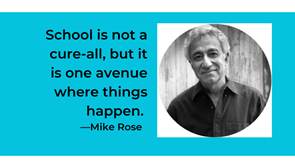
What Mike Rose Helped Me See About Teaching Writing

This reflection grows out of my preparation to tutor university students. As I step into that work, I want to do so with humility, wisdom, and a real desire to serve. One article that has helped me think more carefully about that calling is Mike Rose’s Remedial Writing Courses: A Critique and a Proposal. His ideas challenge some common assumptions about teaching writing, and they also remind me that students need more than correction. They need guidance, dignity, and room to grow.

Rose argues that remedial writing courses often fail students because they are too disconnected from actual university writing. Rather than preparing students for college-level work, these courses may rely on simple, personal assignments that do not reflect the kind of reading, analysis, and argument students will eventually be expected to do. As a result, students may complete remedial courses without developing the skills they need for authentic academic writing.

More Than Simple Topics and Grammar Fixes

Rose also criticizes the common use of simple topics and the heavy emphasis on error correction. He argues that easier topics do not necessarily motivate students, nor do they prepare them for more demanding writing tasks. In the same way, an overemphasis on grammar can cause students to think writing is only about avoiding mistakes rather than developing ideas, communicating clearly, and engaging thoughtfully with an audience.

Writing, Reading, and Thinking Belong Together

Another important point in the article is that writing should not be separated from reading and thinking. Academic writing depends on all three. Students must interact with texts, process ideas, and organize their thoughts in meaningful ways. Rose suggests that remedial instruction is most effective when it treats writing as an integrated process rather than as a collection of isolated skills.

Structure Can Support Growth

Finally, Rose argues that academic writing should not be seen as restrictive or lifeless. Students need to learn structures such as analysis, comparison, and argument, but those structures are not meant to limit thought. Instead, they can help students think more clearly and communicate more effectively. For Rose, remedial writers are not deficient; they are capable learners who need meaningful practice, thoughtful guidance, and gradual exposure to authentic academic work.

What This Means for Serving Students Well

This matters to me as I prepare to tutor university students. Rose’s article reminds me that tutoring should involve more than correcting errors. It should help students grow in confidence, think more clearly, and approach academic writing as a meaningful form of communication. Good tutoring should treat students with dignity, patience, and hope, helping them grow rather than simply fixing sentences.

Why This Matters for Christian Service

In that sense, tutoring writing can also be an act of discipleship. It is a way of helping others grow through truth, patience, and instruction. Discipleship involves learning, teaching, and building others up, and writing can participate in that holy work. As Matthew 28:19–20 shows, disciples are called to teach, and Psalm 102:18 reminds us that what is written can serve future generations. Writing, tutoring, and discipleship come together when words are used with care to guide, strengthen, and bless others.

Ways Christians Can Use Writing as Witness

Writing can be a form of witness because it helps us teach, encourage, and preserve truth. It gives us a way to slow down, pay attention, and put into words what God may be teaching us. It can also bless the people around us. Some research suggests that writing can support reflection, well-being, and emotional processing, and studies on expressive writing have found that practices such as gratitude writing and reflective writing may support positive affect and personal growth. That does not make writing a cure-all, but it does remind us that thoughtful writing can do real good.

That is one reason writing can be such a meaningful part of discipleship. I recently joined a group that has pledged to write out the Bible from Genesis to Revelation, and even that simple act feels like a way of lingering over God’s Word with greater attention. Others blog, write letters to shut-ins, help those who are ill record memories for loved ones, create children’s books, write devotionals, or compose hymns. The opportunities are endless, and each one can become a quiet offering of service.

The encouraging part is that getting started is easier than ever. Writing methods, prompts, and guides are widely available online and in bookstores, and self-publishing has become far more accessible through print-on-demand and e-book platforms. Writing is no longer only for professional authors. It is something ordinary believers can use in extraordinary ways. If God has given you something to say, writing may be one of the ways He invites you to serve. A few faithful words, offered to the Lord, can become a source of witness, comfort, and encouragement to someone else.

For Adults Who Want to Improve Writing

Zinsser, William. On Writing Well: The Classic Guide to Writing Nonfiction. New York: HarperCollins, 2016.

Lamott, Anne. Bird by Bird: Some Instructions on Writing and Life. New York: Anchor Books, 1995.

Strunk, William Jr., and E. B. White. The Elements of Style. 4th ed. New York: Longman, 1999.

Pink, Daniel H. A Whole New Mind: Why Right-Brainers Will Rule the Future. New York: Riverhead Books, 2006.

Clark, Roy Peter. Writing Tools: 55 Essential Strategies for Every Writer. New York: Little, Brown, 2006.

Graff, Gerald, and Cathy Birkenstein. They Say / I Say: The Moves That Matter in Academic Writing. 4th ed. New York: W. W. Norton, 2018.


For Children & Young Writers

Cleary, Beverly. Dear Mr. Henshaw. New York: HarperCollins, 1990.

Cummings, Troy. The Notebook of Doom Series. New York: Scholastic, 2013–.

Gutman, Dan. My Weird School Series. New York: HarperCollins, 2004–.

Scieszka, Jon. The Stinky Cheese Man and Other Fairly Stupid Tales. New York: Viking, 1992.

Arnold, Tedd. Fly Guy Series. New York: Cartwheel Books, 2005–.

DiCamillo, Kate. Because of Winn-Dixie. Cambridge, MA: Candlewick Press, 2000.

These resources encourage writers at every stage—from early readers to adult learners—to grow in clarity, confidence, and voice. Whether writing devotionals, testimonies, or academic reflections, the goal is the same: to communicate truth with grace, purpose, and understanding so that others may hear and respond.

Resource

Rose, Mike. “Remedial Writing Courses: A Critique and a Proposal.” College English 45, no. 2 (February 1983): 109–128.