
by Dee Ann Loving-Tackitt
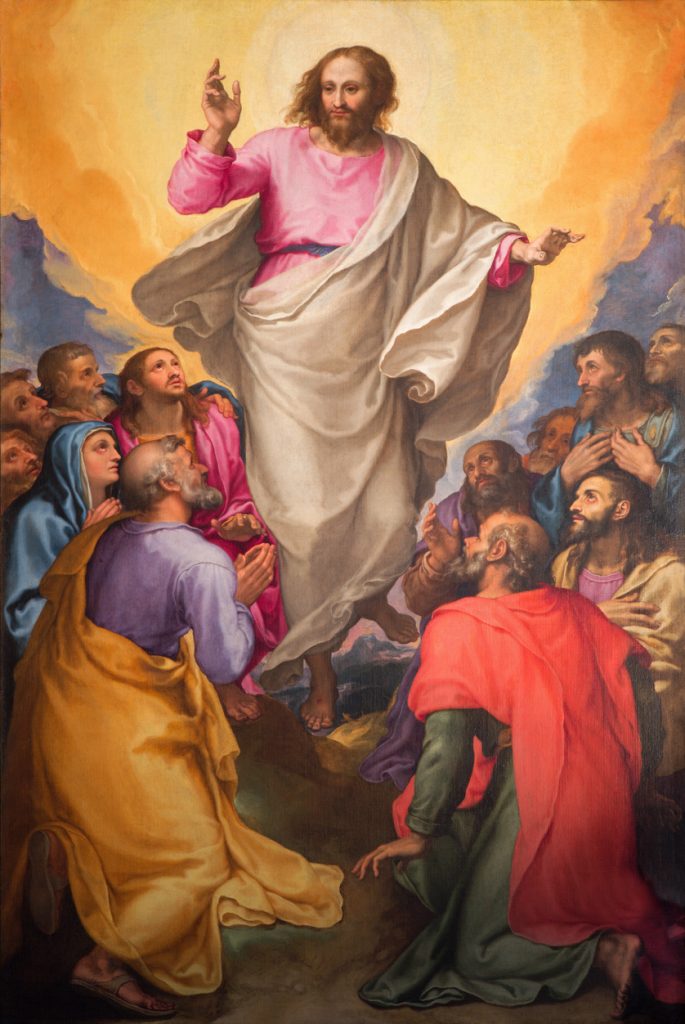
Rome – Ascension of the Lord painting of Chiesa Nuova
“As the Father has loved me, so have I loved you. Now remain in my love. If you keep my commands, you will remain in my love, just as I have kept my Father’s commands and remain in his love. I have told you this so that my joy may be in you and that your joy may be complete.”—John 15:9–11
Writing from a Nazi prison, Dietrich Bonhoeffer wrote, “What keeps gnawing at me is the question, Who is Christ actually for us today?” That question still presses on every serious Christian. Jesus put this issue before his disciples during his farewell supper when he said, “If you love me, you will keep my commandments…You are my friends if you do what I command you” (Jn 15:14 In this sense, He repeated this challenge in the Sermon on the Mount, “Not everybody who says to me, ‘Lord, Lord,’ will get into the kingdom of heaven. Only those who do the will of my Father who is in heaven will enter” (Matt 7:21). The risen Christ, while eating breakfast with Peter on the beach, asks him the same question three times, “Simon, do you love me?” Peter replies each time, “Lord, you know I love you.” In light of Peter’s triple denial, Jesus gave him a concrete command: “Feed my sheep.” He concluded with the words, “Follow me” (John 21:15–19).
Jesus was consistent and clear. He was not looking for admirers who would merely nod in agreement with the Sermon on the Mount. He called followers who would put his words into practice. Because God raised Jesus from the dead, we follow the living Christ here and now. To “practice resurrection” is not simply to admire Jesus from a distance, but to let his risen life take shape in our own lives.
In Christian thought, “practicing resurrection” is a theological concept that means rather than waiting for resurrection only after death, believers “practice resurrection” by embodying qualities associated with resurrection life: hope in the face of despair, forgiveness and reconciliation, justice and compassion, renewal after failure or loss, and participation in God’s work of bringing new life to the world. This phrase is associated with writer and pastor Eugene Peterson, who used it to describe the daily life of discipleship. Fortunately, “practicing resurrection” is something that most of us are already living. We were made in, through, and for Christ (Col 1:16). He has taken our human nature upon himself and joined our lives to his own. Our “life is in Christ, who became for us wisdom from God, and righteousness and sanctification and redemption” (1 Cor 1:30). God created us to know him. We are given a gracious participation in God’s own goodness. This grace enables us to know God even though apart from him, we are incapable of and unfit for such knowledge.
If we seek knowledge of God by grace through faith, we will walk the way of Jesus, because anyone who seeks to know God will pursue the mind of Christ and the humility and obedience that go with it. We anticipate the life of fellowship we will share with God for eternity. As Paul reflects this kind of mindset, we are to “seek the things that are above, where Christ is seated at the right hand of God.” Irenaeus said it well when he wrote, “The Word of God, Jesus Christ, on account of his great love for mankind, became what we are in order to make us what he is himself.”
Shalom.