
Power through Love on Maundy Thursday
John 13:1–17 NIV
13 It was just before the Passover Festival. Jesus knew that the hour had come for him to leave this world and go to the Father. Having loved his own who were in the world, he loved them to the end.
2 The evening meal was in progress, and the devil had already prompted Judas, the son of Simon Iscariot, to betray Jesus. 3 Jesus knew that the Father had put all things under his power, and that he had come from God and was returning to God; 4 so he got up from the meal, took off his outer clothing, and wrapped a towel around his waist. 5 After that, he poured water into a basin and began to wash his disciples’ feet, drying them with the towel that was wrapped around him.
6 He came to Simon Peter, who said to him, “Lord, are you going to wash my feet?”
7 Jesus replied, “You do not realize now what I am doing, but later you will understand.”
8 “No,” said Peter, “you shall never wash my feet.”
Jesus answered, “Unless I wash you, you have no part with me.”
9 “Then, Lord,” Simon Peter replied, “not just my feet but my hands and my head as well!”
10 Jesus answered, “Those who have had a bath need only to wash their feet; their whole body is clean. And you are clean, though not every one of you.” 11 For he knew who was going to betray him, and that was why he said not every one was clean.
12 When he had finished washing their feet, he put on his clothes and returned to his place. “Do you understand what I have done for you?” he asked them. 13 “You call me ‘Teacher’ and ‘Lord,’ and rightly so, for that is what I am. 14 Now that I, your Lord and Teacher, have washed your feet, you also should wash one another’s feet. 15 I have set you an example that you should do as I have done for you. 16 Very truly I tell you, no servant is greater than his master, nor is a messenger greater than the one who sent him. 17 Now that you know these things, you will be blessed if you do them.
John 13:31-35 NIV
Jesus Predicts Peter’s Denial
31 When he was gone, Jesus said, “Now the Son of Man is glorified and God is glorified in him. 32 If God is glorified in him,[a] God will glorify the Son in himself, and will glorify him at once.
33 “My children, I will be with you only a little longer. You will look for me, and just as I told the Jews, so I tell you now: Where I am going, you cannot come.
34 “A new command I give you: Love one another. As I have loved you, so you must love one another. 35 By this everyone will know that you are my disciples, if you love one another.”
Imagine the scene.
Jesus knows exactly what is coming. His arrest is hours away. Betrayal is already unfolding. If there were ever a moment for a final sermon, a rallying cry, or a call to resistance, this would have been it.
Instead, John tells us something astonishing: “Having loved His own who were in the world, He loved them to the end.” Knowing that the Father had placed all things into His hands, knowing He had come from God and was returning to God, Jesus does something utterly unexpected.
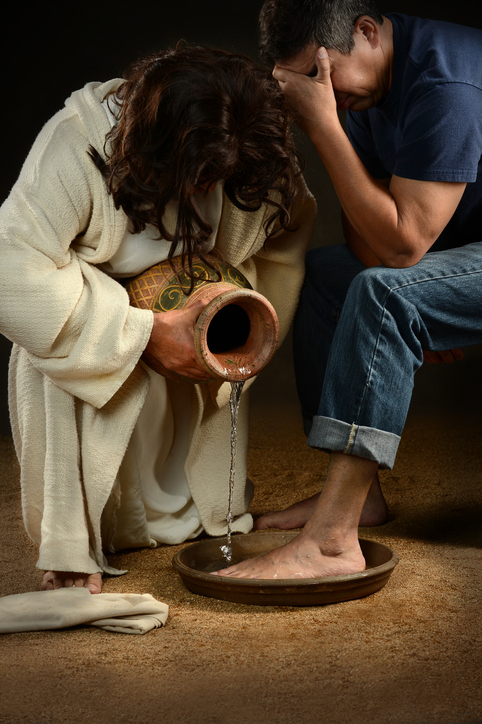
He rises from the table.
He removes His outer robe.
He wraps a towel around His waist.
And He kneels.
King Jesus begins to wash feet.
Love That Takes the Lowest Place
John 13 does not describe this act as symbolic or ceremonial. It is physical, intimate, and unsettling. In the world of the disciples, foot washing was the task of the lowest servant in the household. It was never the role of the teacher, much less the Lord.
Peter’s resistance reveals how upside‑down this moment feels. “You will never wash my feet,” he says. But Jesus answers with words that cut to the heart of discipleship: “Unless I wash you, you have no share with me.” Maundy Thursday reminds us that participation in the life of Christ begins not with what we offer Him, but with what we are willing to receive.
Before we serve, we must be served. Before we love, we must be loved. Before we kneel for others, we must allow King Jesus to kneel for us and cleanse the places we would rather hide.
“You Also Ought to Wash One Another’s Feet”
When Jesus finishes, He does not leave the moment open to personal interpretation. He explains it plainly. “You call me Teacher and Lord, and you are right,” He says. “If I, your Lord and Teacher, have washed your feet, you also ought to wash one another’s feet.”
This is where Maundy Thursday becomes a command rather than a memory. The call to love is not abstract. Jesus does not redefine love with sentiment or theory. He defines it with posture. Love bends low. Love serves without demanding return. Love takes the place no one else wants.
The command Jesus gives is not simply to admire His humility, but to embody it. His love becomes the pattern by which all Christian love is measured.
Glory Revealed Through Sacrifice
After Judas leaves the room and the shadow of betrayal becomes unmistakable, Jesus speaks again. “Now is the Son of Man glorified.” In John’s Gospel, glory is not found in escape from suffering, but in faithful obedience through it. What the world calls shame, Jesus calls glory. What looks like loss will soon be revealed as victory.
Maundy Thursday stands at the edge of the cross. The towel anticipates the nails. The basin points forward to the blood poured out. The humility of the upper room prepares us for the self‑giving love of Calvary.
King Jesus reveals that true authority is never grasped. It is given. And it is given for the sake of love.
A New Commandment for the Church
Jesus concludes the evening with words that echo into the life of the church. “A new commandment I give to you, that you love one another. Just as I have loved you, you also are to love one another.” The standard is no longer reciprocity or convenience, but Christ Himself.
By this love, Jesus says, the world will recognize His disciples. Not by power. Not by position. Not by persuasion alone. But by a love that kneels, serves, and remains faithful to the end.
From Then to Now
Maundy Thursday refuses to remain safely in the past. It presses into our present lives and asks difficult, necessary questions. Where is Jesus calling us to take the lower place? Who needs to be loved with a love that costs something? In what ways are we being invited to lay aside status, comfort, or control in order to serve?
The night King Jesus took off His robe still speaks. His towel still hangs before us. And His command still stands.
May we be a people who receive His love deeply and live it faithfully.
May we follow King Jesus, even when the way leads us to our knees.
Heavenly Father,
on this holy night, we pause at the basin and the towel.
We remember that You loved Your own to the very end—
not with words alone, but with hands that served
and a heart that poured itself out.
We confess that we often resist this way of love.
We cling to comfort, protect our position,
and hesitate to kneel where You freely knelt.
Forgive us for the times we have preferred power over humility
and distance over devotion.
Wash us again, Lord.
Cleanse the places we try to hide.
Teach us to receive Your love
before we attempt to give it away.
Shape us into a people marked by Your commandment—
a people who love as You have loved us.
Give us eyes to see those we are called to serve,
courage to take the lowest place,
and hearts willing to remain faithful even when love is costly.
As we leave this moment, keep us near Your heart
and prepare us to follow You to the cross,
trusting that Your self‑giving love
will lead us all the way to life.
We pray in the name of King Jesus,
the Servant Lord,
Amen.