Why the Unchanging God is the Anchor of My Faith
A Grandma, Boethius, and Saturday Morning Theology
“For I the Lord do not change.” — Malachi 3:6
I know. I’m a grandma who retired and took up theology. While some people spend Saturday mornings gardening, I spend mine studying Boethius (c.480-524 CE). He was an early Christian philosopher whose writings on God, time, and eternity have deepened my Bible study and helped me think about what it means to say that God does not change.
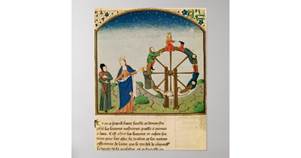
Boethius is often associated with the image of the “Wheel of Fortune.” He pictured life as a spinning wheel—one moment we may feel on top, and the next, everything can shift. Circumstances rise and fall, and very little in this world stays steady for long. (His personal story behind this is powerful, but that’s a story for another blog.) His insight is simple but lasting: if we place our trust in changing circumstances, we will always feel unstable. But if we trust God, who never changes, we can remain steady no matter where we are on the wheel.
That matters to me because everything in my life changes. My thoughts shift, my body ages, and my understanding grows. But God is not like me. God does not grow older, learn something new, or move from one state to another. God simply is.
What I find so helpful is the idea that God is eternal, not just in the sense that He lives forever, but in the sense that He exists beyond time altogether. I live in the past, present, and future. God does not. So when I think about God knowing the future, I do not picture Him waiting for tomorrow to arrive. What is future to me is not future to God. He sees all of time at once. That means God can know everything without changing.
What Does “Timeless” Really Mean?
“From everlasting to everlasting you are God.” — Psalm 90:2
When theologians say God is timeless, they do not mean He has a very long life. They mean He is not stretched out across moments at all. My life is lived in before-and-after. I live after the flood and read about it as something that happened long ago. But God’s life is not before the flood, during the flood, or after the flood. God does not move through events the way I do.
That raises an obvious question: how can a timeless God relate to people like me who live one moment at a time? I experience life as a sequence. One thing happens, then another. From my point of view, events unfold little by little. From God’s point of view, all moments are present. So, the question is whether He can know what happens in time without being bound by time as I am.
What helps me here is realizing that knowledge is more than a list of facts. To know something fully is not just to know true statements about it, but to know the thing itself. So, if God is omniscient, His knowledge cannot be reduced to a giant collection of correct information. He knows reality itself fully and perfectly.
Patrick’s Game Helped Me See It

“O Lord, you have searched me and known me.” — Psalm 139:1
Last weekend I watched my grandson Patrick play baseball, and his team won. I knew that game from my own limited perspective. I saw what happened from the stands, felt the excitement, and remembered certain moments more than others. But God’s knowledge would be different. He would know every player, every motion, and every moment all at once and perfectly. My knowledge is partial and unfolds in time. God’s knowledge is full and perfect.
Do Changes in the World Mean Changes in God?
“…with whom there is no variation or shadow due to change.” — James 1:17
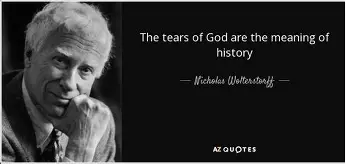
Here comes Nicholas Wolterstorff, another theologian keeping me company on these Saturday mornings, with a fair question: if God knows a changing world, must God change too? I understand the concern because when I learn something new, my knowledge changes. I find out the bread is ready or hear that Patrick’s team won. But there is a difference between coming to know something and simply knowing it. I learn bit by bit. God does not. He does not “find out” what is happening in the world. So, changes in the world do not mean changes in God.
So where does all of this leave me on a Saturday morning with Boethius, Patrick’s baseball game, and bread rising in my kitchen? It leaves me convinced that God can know a changing world without being a changing God. I learn a little at a time. God does not. He knows the world as its Creator, not as a spectator trying to catch up.
“Jesus Christ is the same yesterday and today and forever.” — Hebrews 13:8
And that is why this matters for discipleship. Because God does not change, His love does not waver, His wisdom does not fail, and His promises do not weaken. I can follow Christ even when I do not understand what He is doing in my life. In the end, all my Saturday morning theology brings me here: I can trust the God who sees the whole story when I can barely see the next step.
Prayer:
Heavenly Father,
Thank You that You do not change. When my life feels uncertain and my understanding feels small, help me trust Your steady love, wisdom, and faithfulness. Teach me to follow Christ one step at a time, resting in the truth that You see the whole story and hold me in Your care. In Jesus name we pray. Amen.
Scriptures for Further Reading
- Malachi 3:6 — “For I the Lord do not change.”
- Hebrews 13:8 — “Jesus Christ is the same yesterday and today and forever.”
- James 1:17 — with God there is “no variation or shadow due to change.”
- Psalm 90:1–2 — God’s eternal nature
- Isaiah 46:9–10 — God’s knowledge and purposes
- Psalm 139:1–6 — God’s perfect knowledge of us
- Lamentations 3:22–23 — God’s faithfulness
- Numbers 23:19 — God does not change like human beings do
Resource
Brown, Graham. “God’s Unchanging Knowledge of the World.” Sophia 28, no. 2 (1989): 2–12.