
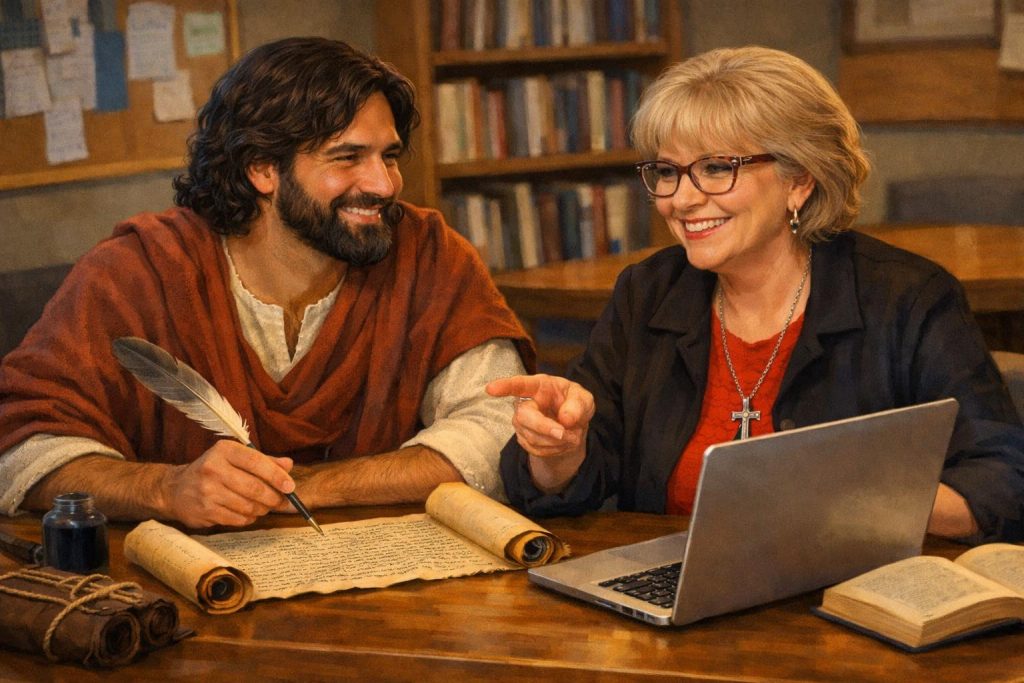
When Mark Came to the Writing Center

 The beginning of the gospel of Jesus Christ, the Son of God. As it is written in Isaiah the prophet, “Behold, I send my messenger before your face,
 who will prepare your way, Mark 1:1-2

Today, I found myself smiling at a funny little thought while working on my commentary on Mark’s Gospel. I imagined Mark himself sitting across from me at the Writing Center—scroll unrolled, ink still fresh—sliding his opening lines in front of me and asking, “Does this sound right?”

So I read his words slowly:

“The beginning of the gospel of Jesus Christ, the Son of God.
As it is written in Isaiah the prophet…”

And I couldn’t help it—I slipped right into tutor mode.

“Mark,” I would say gently, “your ideas are beautiful. Truly. But you’re writing like a first-century Jewish author… and my job is to help modern English readers understand you.”

First, I’d point to that opening sentence. “Friend,” I’d smile, “you don’t have a verb here. Now, in Greek, that works just fine. It’s powerful, almost like a bold title carved into stone. But in English, it reads like a fragment. If this were a paper, I’d just ask you to add one simple word: is.

And suddenly the line breathes a little differently:

“This is the beginning of the good news about Jesus Christ, the Son of God.”

Clear. Direct. Complete.

Then we’d move on to the second line. “Mark,” I’d continue, “you’ve written ‘as it is written in Isaiah,’ but your first quotation actually comes from Malachi. Now, I know why you did that. In your world, you name the major prophet even when you blend passages. That’s a perfectly acceptable practice in your time. But modern readers might get confused.”

So I’d suggest something like:

“As the Scriptures say—first in Malachi, and then in Isaiah…”

And then I’d lean back, smile, and say, “You didn’t do anything wrong. You’re just writing from your own time, your own tradition, your own rhythm. And it works—it really does.”

Because the truth is, Mark’s Gospel doesn’t begin with careful, polished explanations. It bursts onto the page. It feels like someone who can’t wait another second to tell the story of Jesus. There is urgency in his voice. There is movement. There is life.

And maybe that’s the deeper lesson for all of us walking this prayer path.

Sometimes we worry so much about getting every word right, every detail perfect, every sentence polished… that we forget the joy of simply telling the good news. Mark reminds us that the gospel is not primarily about flawless grammar—it is about a living Savior.

He doesn’t linger long in introductions. He doesn’t slow down for perfection. He simply begins:

“This is the beginning of the good news…”

And what a beginning it is.


Prayer

Heavenly Father,
Thank You for the writers of Scripture, who spoke Your truth with passion, urgency, and faith. Thank You for Mark, whose words remind us that the gospel is living and powerful, not confined to perfect sentences but alive in every heart that receives it.

Help us not to hold back out of fear of saying things imperfectly. Give us courage to share the good news boldly, joyfully, and faithfully. Teach us to love Your Word deeply, to understand it responsibly, and to speak it with grace.

And Lord, let our lives themselves become part of that unfolding story—evidence that the good news is still being written today.

In Jesus’ name,
Amen.
Amazing Grace

Scripture, Doctrine, and the Church Family


📖 Scripture

“Therefore, there is now no condemnation for those who are in Christ Jesus.”
— Romans 8:1


Living Free in Christ: Baptist Doctrine

Bernie and I recently joined First Baptist Lubbock, and in this season, we have been intentionally studying Baptist doctrine together. As I’ve leaned into that—especially as a doctoral student in Biblical Studies at a Baptist university—I’ve found something that has deeply encouraged my heart… something I am truly thankful for.

As I studied the doctrine, this is what I found:

At its core, Baptist theology carries a beautiful truth for struggling Christians: receiving new mercies is part of the Christian life —the steady rhythm of God’s grace.

This truth is deeply reflected in Baptist doctrine.

  • Salvation by grace reminds us that we are not defined by our past, but justified through Christ.
  • The priesthood of all believers tells us we can come directly to God—boldly and immediately
  • Soul competency reminds us that we stand personally before God, responsible to Him above all.
  • Sanctification reminds us that growth is ongoing… and stumbling is not the end

And I found myself thinking:

This is amazing grace.


📖 What Does Scripture Say?

As a Bible student, I had to ask:

What does Scripture actually say about living in ongoing renewal without shame through the steady rhythm of God’s grace?

From the very beginning, we see that shame entered through sin.

In the Garden, Adam and Eve didn’t just feel guilty—they hid. Shame whispered, “This is who you are now.” It shifted identity.

But the Gospel tells a different story.

Jesus meets people in their shame—and He restores them.

He does not define them by their failure.
He redefines them through His grace.

In John 8, when the woman was brought before Him, Jesus had every right to condemn her… but instead, He extended mercy, called her out of sin, and lifted her from the shame that once held her. And, He told her to go and sin no more.


What We Are Reminded of in Scripture

  • “If we confess our sins, He is faithful and just to forgive us…” (1 John 1:9)
  • “As far as the east is from the west, so far has God removed our transgressions from us.(Psalm 103:12)
  • “Therefore, if anyone is in Christ, the new creation has come: The old has gone, the new is here!” (2 Corinthians 5:17)

Here is the truth:

Shame may enter through sin, but it is broken through the finished work of Christ.

When Jesus said, “It is finished,” He wasn’t just paying for sin—He was breaking the power of sin and removing the guilt that once defined us, restoring our identity in Him.


Doctrine and Scripture Together

When I compare what I found in Baptist doctrine with what I found in Scripture, they align so beautifully:

  • Doctrine says we can come boldly → Scripture says there is no condemnation for those in Christ.
  • Doctrine says we have access to God → Scripture says we are cleansed and made new for those in Christ.
  • Doctrine says growth is ongoing → Scripture says grace is sufficient for those in Christ.

And this is what I am most thankful for:

Being made new is a natural part of the Christian life—the steady, faithful rhythm of God’s grace.


🤍 Why the Church Family Matters

From my heart, I want to say this:

This is why being part of a church family matters so much.

Yes, we can come to God individually—and that is a beautiful truth.
But we were never meant to walk this out alone.

We need a place where:

  • grace is spoken out loud
  • Truth is lived in community
  • restoration is seen
  • And people remind us who we are when we forget

The church becomes living proof that starting again is possible… not just once, but daily.


🌸 Living This Out

In our home, in our church, and through The House of Prayer, this is what Bernie and I are learning to live: Daily priesthood means daily renewal
Daily renewal means we keep walking forward—restored, renewed, and covered in grace.


🙏 Prayer

Father,
Thank You for the gift of grace that continually renews us in Christ.
Thank You that in Christ, we are not defined by our past or our sin, but made new in Christ.

Teach us to come boldly to You—not hiding, not hesitating, but trusting in Your mercy.
Help us receive Your forgiveness fully and walk in the new identity You have given us.

Strengthen us to keep growing, keep turning, and keep trusting You.
And thank You for the gift of the church—for people who speak truth, extend grace, and walk alongside us.

Let our lives reflect the rhythm of Your grace—again and again.

In Jesus’ name,
Amen.

Green Grass in a Desolate Place

Jesus our Shepherd Who Provides

Psalm 23: A Psalm of David. (NIV)

1 The LORD is my shepherd; I shall not want. 2 He makes me lie down in green pastures.3 He leads me beside still waters. He restores my soul. He leads me in paths of righteousness for his name’s sake. 4 Even though I walk through the valley of the shadow of death, I will fear no evil, for you are with me; your rod and your staff, they comfort me. 5 You prepare a table before me in the presence of my enemies; you anoint my head with oil; my cup overflows. 6 Surely goodness and mercy shall follow me all the days of my life, and I shall dwell in the house of the LORD forever.

Mark 6:30-44 (NIV)

30 The apostles returned to Jesus and told him all that they had done and taught. 31 And he said to them, “Come away by yourselves to a desolate place and rest a while.” For many were coming and going, and they had no leisure even to eat. 32 And they went away in the boat to a desolate place by themselves. 33 Now many saw them going and recognized them, and they ran there on foot from all the towns and got there ahead of them. 34 When he went ashore he saw a great crowd, and he had compassion on them, because they were like sheep without a shepherd. And he began to teach them many things. 35 And when it grew late, his disciples came to him and said, “This is a desolate place, and the hour is now late.36 Send them away to go into the surrounding countryside and villages and buy themselves something to eat.” 37 But he answered them, “You give them something to eat.” And they said to him, “Shall we go and buy two hundred denarii worth of bread and give it to them to eat?” 38 And he said to them, “How many loaves do you have? Go and see.” And when they had found out, they said, “Five, and two fish.” 39 Then he commanded them all to sit down in groups on the green grass. 40 So they sat down in groups, by hundreds and by fifties. 41 And taking the five loaves and the two fish, he looked up to heaven and said a blessing and broke the loaves and gave them to the disciples to set before the people. And he divided the two fish among them all. 42 And they all ate and were satisfied. 43 And they took up twelve baskets full of broken pieces and of the fish. 44 And those who ate the loaves were five thousand men.

Jesus, Our Shepherd Who Provides

“The LORD is my shepherd; I shall not want.”
—Psalm 23:1

There are some words Scripture places so deeply in our souls that they surface without effort. Psalm 23 is one of them. We whisper it in hospital rooms and at gravesides. We carry it through uncertain seasons. It is a psalm for those who know what it is to walk through shadows—and still dare to trust.

Another familiar story meets us in Mark 6: the feeding of the five thousand. Five loaves. Two fish. A crowd too large and resources too small. At first glance, these passages may feel separate—one poetic, one narrative. But when we slow down and listen closely, we begin to hear the same voice.

Jesus is the Shepherd of Psalm 23—now standing among His sheep.

Mark is not offering a coincidence. He is revealing fulfillment.

Sheep Without a Shepherd—Until Jesus Appears

When Jesus steps ashore, Mark tells us He sees the great crowd and is moved with compassion, because they were like sheep without a shepherd (Mark 6:34).

That phrase is heavy with meaning. Throughout Israel’s history, God’s people suffered under failed leaders and were repeatedly described as scattered sheep. Psalm 23 answers that ache with a promise: The LORD is my shepherd.

In Mark 6, that promise takes flesh.

Jesus does not distance Himself from the language of shepherding—He embodies it.He stays with the crowd. He teaches them. He takes responsibility for their hunger and their formation. Before bread is broken, lives are gathered.

The Shepherd has come.

Green Grass in the Wilderness

Then Mark tells us something surprisingly specific. Jesus commands the people to sit down on the green grass.

Green grass—in a desolate place.

Psalm 23 says, “He makes me lie down in green pastures.” Sheep only lie down when they feel safe, when fear loosens its grip, when trust settles deep.

Here, in the wilderness, Jesus creates that same safety. Where the Shepherd stands, the wilderness begins to resemble pasture. Scarcity no longer gets the final word. The kingdom of God often comes quietly—placing rest beneath weary bodies and life where barrenness once ruled.

A Table Prepared by the Shepherd

The disciples see the math and panic. Jesus sees a table.

Psalm 23 declares, “You prepare a table before me…”
Mark tells us, “They all ate and were satisfied.”

Not barely enough.
Not rationed.
Satisfied.

This is shepherd abundance. When the true Shepherd provides, there is not only enough—there is overflow. Twelve baskets remain, a sign that nothing placed in the Shepherd’s hands is ever wasted.

Just before this story, Mark records another meal—Herod’s feast. That feast is shaped by power, ego, and fear, and it ends in death. Jesus’ feast is marked by compassion, simplicity, and trust, and it ends in life.

Two tables.
Two kingdoms.
One Shepherd who gives Himself for His sheep.

Still Waters and a Fearless Walk

Immediately after the meal, Mark leads us onto troubled waters. The disciples struggle. The wind resists them. Then Jesus comes—walking on the sea.

Psalm 23 rises again:
“He leads me beside still waters… Even though I walk through the valley of the shadow of death, I will fear no evil.”

The Shepherd who feeds is the Shepherd who protects. The Shepherd who gathers on the hillside is the Shepherd who stands between His people and chaos. Mark tells us the disciples did not yet understand about the loaves. In other words, they were still learning who Jesus truly is.

He is the Shepherd.

The Shepherd Still Walks With Us

Revelation gathers Psalm 23 once more and carries it forward: the Lamb who is also the Shepherd, no more hunger, no more thirst, God wiping away every tear.

What Jesus does in Mark 6 is not only history—it is promise. Psalm 23 is no longer only poetry. It is prophecy fulfilled in Christ.

So if today feels desolate,
if you come weary,
if you arrive hungry—body or soul—

Jesus, your Shepherd, sees you.

The table is set.
The grass is green—even here.
And the new creation has already begun.

A Prayer for the Path

Heavenly Father,
We thank You for giving us Jesus, our Good Shepherd. In places of weariness or uncertainty, help us recognize His presence and trust His care. Teach us to rest where He leads, to receive what He provides, and to walk without fear, knowing He is with us.
May Your goodness and mercy follow us all the days of our lives, as we dwell in Your presence.
In Jesus’ name, Amen.

Continuing on the Prayer Path

Five Scriptures for Prayer and Reflection

John 10:11 — “I am the good shepherd. The good shepherd lays down his life for the sheep.”
→ Sit with the truth that Jesus does not just guide you—He gives Himself fully for your care and salvation.

Ezekiel 34:15–16 — “I myself will be the shepherd of my sheep… I will seek the lost.”
→ Pray with gratitude that God personally comes after His people, especially in places of weakness or wandering.

Matthew 11:28 — “Come to me, all who labor and are heavy laden, and I will give you rest.”
→ Bring your weariness honestly to Jesus and receive the rest only the Shepherd can give.

John 6:35“I am the bread of life; whoever comes to me shall not hunger.”
→ Reflect on where you seek satisfaction and ask Jesus to nourish the deeper hungers of your soul.

Revelation 7:16–17 — “The Lamb in the midst of the throne will be their shepherd.”
→ Rest in hope, knowing the Shepherd who feeds you now will one day wipe away every tear forever.

Consider the Lilies: Walking the Prayerful Path of Trust

Matthew 6:28

I spent a beautiful afternoon with the Lubbock Christian Women’s Connection, and from the moment I walked in, I knew it would be special. One of our fearless leaders greeted me with such kindness, looked straight into my eyes, and said, “Dee Ann, we need you to be a table hostess.”

Now I will be honest with you—there is an old fear that sometimes tries to rise up in moments like that. It grabs hold of my words and makes them want to dance into a stutter. For just a second, I felt it coming. But instead of letting fear speak, I quietly reached for Jesus’ hand and said, “Of course.”

And oh, how the Lord provides.

Karen Wood became my buddy for the day. By God’s grace, I managed to get us both safely to the Country Club, and we were ready to celebrate sisterhood. But what meant the most was this—Karen leaned in and said so gently, “I’ve been a hostess before… we can do it together.”

Isn’t that just like Jesus?

I whispered a quiet thank-you to Him in that moment—for a sweet friend, for His steadying presence, and for the courage to step into a responsibility I might have once avoided.

The afternoon itself was rich with beauty. Lindy Woods filled the room with songs that seemed to settle right into our hearts, preparing us for what God had in store. Then we heard from Leana Neagle of Willis, Texas, whose message, “On the Heels of Grace,” felt like holy ground.

Her story of miraculous healing was truly unforgettable.

After surviving a horrific wreck—something she should not have lived through—she faced the very real possibility of losing her legs. Doctors doubted. Healing seemed uncertain. Even walking again felt out of reach. And yet, in that place of deep trial, she encountered a word she had never fully understood before: testify.

Through the power and mercy of God, not only did she keep her legs, but she went on to do what once seemed impossible—she walked a marathon. And there she stood before us, whole, strong, and full of faith, declaring the goodness of God.

It was more than a testimony—it was a living picture of grace in motion.

The theme of our gathering was flowers, and as I sat at the table, my heart turned to Scripture:

“And why are you anxious about clothing? Consider the lilies of the field, how they grow: they neither toil nor spin.”
— Matthew 6:28

At Table 4, we gathered as women carrying responsibilities, hopes, and even quiet burdens. And Jesus, knowing hearts like ours, pointed us to something as tender as a flower to teach us about trust.

Throughout Scripture, flowers quietly preach truth:

God’s Provision
Lilies do not strive or strain, yet God clothes them in beauty. If He tends to something so fleeting, how much more will He care for you?

Human Frailty
We are like flowers of the field—here for a moment, then gone. Yet the Word of our God stands forever.

Restoration and Hope
God causes deserts to bloom again. Dry places are never beyond His reach.

Love and Delight
Flowers in Song of Solomon remind us that we are not simply sustained—we are cherished and delighted in.

Flowers bloom for a season, but they return again and again. Their rhythm mirrors our own lives—flourishing, fading, and blooming again through the faithful hand of God.

And after hearing Leana’s story, those flowers seemed to say even more:

God restores what seemed lost.
God strengthens what seemed broken.
God brings life where there was once only fear.

So as I looked at the flowers on our table—and at the women gathered around it—I sensed the Lord gently whispering:

You are seen.
You are sustained.
You are deeply loved.

To the Lubbock Christian Women’s Connection, thank you for such a lovely afternoon, for your warm welcome, and for creating a space where faith and sisterhood bloom so beautifully.

May we all continue walking this Prayerful Path… learning to trust the One who tends every petal.


Prayer

Heavenly Father,

thank You for the gentle lessons You place all around us. In flowers, in friendships, and in testimonies of grace, You remind us that You are always at work.Help us to trust You the way the lilies do—without striving, without fear, simply resting in Your care. Thank You for stories like Leana’s that remind us You still heal, You still restore, and You still call us to testify to Your goodness.For every woman reading this, let Your peace settle deeply.
Where there is weariness, bring rest.
Where there is fear, bring courage.
Where there is dryness, bring new life.Teach us to bloom in every season and to walk faithfully wherever Your grace leads.We love You, Lord.
Amen.

The Moment Good News Broke In

The House of Prayer Bible Commentary

Bernie and I are so excited to begin a new journey together—we are writing a Bible commentary for The House of Prayer. We’re starting where our hearts always seem to go first: the Gospels, and especially the fast-moving, powerful account of Mark. What you’re reading here is a “commentary on the commentary,” a glimpse into our very first entry, Mark 1:1. Our prayer is that these reflections will not only inform but draw others closer to Jesus as His Word comes alive line by line.

The beginning of the gospel of Jesus Christ, the Son of God.

Mark 1:1

Some beginnings simply introduce a story, but others announce that everything is about to change. Mark wastes no time easing his readers in. With striking clarity and urgency, he opens: “The beginning of the gospel of Jesus Christ, the Son of God” (Mark 1:1). In a single line, he sets the tone, declares his purpose, and invites us to step into something far greater than a narrative—a divine revelation unfolding in real time.

From the earliest words of Scripture, we see how powerful a beginning can be. Genesis 1:1 tells us who God is and what He has done with sweeping authority. Likewise, Mark follows this pattern of clarity, but with remarkable brevity. He answers the essential questions immediately. The “who” is Jesus Christ. The “what” is the gospel—the good news. Yet, even in this simplicity, there is depth that cannot be contained in one sentence. Mark does not aim to say everything at once; instead, he opens a doorway into a story that will reveal its fullness as it unfolds.

The phrase “the Son of God” carries both theological weight and a sense of mystery. Some early manuscripts omit it, yet the Gospel itself resounds with its truth. From the voice of the Father at Jesus’ baptism to the confession at the cross, Mark consistently reveals Jesus’ divine identity. Even when Jesus does not frequently speak the title Himself, His actions, authority, and obedience testify to it. He is not merely a teacher or prophet—He is the One through whom God’s power is made known, the obedient Son who walks the path of suffering and surrender for the sake of the world.

What is especially striking is Mark’s use of the phrase “the beginning.” This is not just a starting point in time; it is the launch of something eternal. It reaches back into the promises spoken by the prophets, now coming into fulfillment. It stands firmly in the present moment, where God’s redemptive plan is actively unfolding. And it stretches into the future, where the full impact of this good news will be realized. Mark’s beginning is not confined to a moment—it is the inauguration of a kingdom.

And then there is the word “gospel.” Mark introduces it without explanation, allowing its meaning to emerge through the life, ministry, death, and resurrection of Jesus. The good news is not delivered as a definition, but as a living reality. It is seen in healing, heard in teaching, and ultimately revealed in sacrifice and victory. Mark invites us not just to understand the gospel, but to encounter it.

As readers, we are not positioned as distant observers. From the very first verse, we are drawn in. We are invited to recognize who Jesus is, to receive the good news He brings, and to follow where this beginning leads. Mark’s Gospel reminds us that when God begins something, it is never small. It carries the weight of eternity and the power to transform every life it touches.

This is where the good news begins—and it is where our salvation begins as well.

Prayer
Heavenly Father,

thank You for the power and clarity of Your Word. Thank You for sending Jesus, the Son of God, as the good news our hearts long for. Help us to see beyond the surface and recognize the depth of what You have begun. Draw us into Your story, and give us faith to follow where You lead. Let Your truth shape us, and let Your gospel come alive in our lives each day. In Jesus’ name, amen.

Resources:

Broadman Bible Commentary, vol. 8. Nashville, TN: Broadman Press, 1969.

Rydelnik, Michael, and Michael Vanlaningham, eds. The Moody Bible Commentary. Chicago, IL: Moody Publishers, 2014.

Further Reading

  • Genesis 1:1 – “In the beginning, God created the heavens and the earth.”
  • Isaiah 40:3 – “A voice of one calling: ‘In the wilderness prepare the way for the Lord…’”
  • Malachi 3:1 – “I will send my messenger, who will prepare the way before me…”
  • Mark 1:11 – “And a voice came from heaven: ‘You are my Son, whom I love; with you I am well pleased.’”

Cast It Anyway: Trusting God in the Unknown

by Dee Tackitt

Most mornings, I grind wheat berries and begin making homemade bread. It is a long process. The grain has been planted, grown, harvested, ground, mixed, and kneaded—long before it ever reaches my kitchen table. And even then, I still have to trust the process. I place the dough aside, not rushing it, not forcing it… just waiting.

There is a letting go in breadmaking.
You do your part—and then you trust what you cannot see.

Ecclesiastes 11 speaks to that same kind of faith.


Ecclesiastes 11:1-6

Ship your grain across the sea;
    after many days you may receive a return.
Invest in seven ventures, yes, in eight;
    you do not know what disaster may come upon the land.

If clouds are full of water,
    they pour rain on the earth.
Whether a tree falls to the south or to the north,
    in the place where it falls, there it will lie.
Whoever watches the wind will not plant.
    Whoever looks at the clouds will not reap.

As you do not know the path of the wind,
    or how the body is formed[a] in a mother’s womb,
so you cannot understand the work of God,
    the Maker of all things.

Sow your seed in the morning,
    and at evening let your hands not be idle,
for you do not know which will succeed,
    whether this or that,
    or whether both will do equally well.


🌊 Cast Your Bread (vs. 1)

“Cast your bread upon the waters…”

At first, it sounds like a loss. Like letting go of something valuable without a guarantee of return.

But this is not waste—it is trust.

The bread we cast is the Word of God.
The waters are the movement of the Holy Spirit.

And here is the quiet promise:
When the Word is released into the current of the Spirit, God carries it where it needs to go.

You may not see the result today.
You may not even recognize it when it returns.

But it will not be wasted.


🌱 Don’t Hold Back (vs. 2)

“Invest in seven ventures, yes, in eight…”

Live open-handed.

Love more than feels safe.
Serve in more places than feel comfortable.
Speak truth even when you don’t know how it will be received.

Seven reminds us of God’s perfect work.
Eight reminds us of resurrection—new life where none seemed possible.

When we sow into the gospel—Jesus Christ and Him crucified—we are sowing into eternal life.

And you don’t know which seed will take root…
or if God will cause many to flourish at once.


🌧️ Trust Where It Lands (vs. 3)

“If clouds are full of water, they pour rain…
If a tree falls… there it will lie.”

Some outcomes are simply not yours to control.

Life does not always unfold neatly.
Ministry does not always land where you hoped.
People do not always respond the way you prayed they would.

And yet—God is not hindered by where things fall.

Wherever the seed lands,
wherever the rain pours,
God is still able to bring life.


🌬️ Don’t Wait for Perfect Conditions (vs. 4)

“Whoever watches the wind will not plant…”

If we wait until everything feels certain, we will never begin.

There will always be:

  • One more reason to hesitate
  • one more unknown
  • one more “what if”

But faith does not wait for perfect weather.

Faith plants anyway.
Faith sows anyway.
Faith trusts anyway.


👶 Rest in the Mystery (vs. 5)

“As you do not know… how the body is formed in a mother’s womb…”

There are sacred things only God understands.

A baby growing in secret.
The movement of the wind.
The quiet work of God beneath the surface of your obedience.

You may not see it forming.
You may not feel progress.

But something holy is happening.

God is working—deep, unseen, and sure.


🌅 Keep Sowing (vs. 6)

“Sow your seed in the morning, and at evening let your hands not be idle…”

This is steady faith.

Not rushed.
Not anxious.
Just faithful.

Morning—sow.
Evening—sow again.

Pray.
Encourage.
Speak truth.
Show up.

Because you do not know which effort will bear fruit…

“…or whether both will do equally well.”

And sometimes—
in the kindness of God—
Both do.

A Prayer for the Path

Heavenly Father,

We come to You with open hands.
So much of what we do feels like casting—releasing what we love into places we cannot control.

Teach us to trust You in the letting go.

When we sow Your Word, remind us that it is never wasted.
When we feel uncertain, steady our hearts in Your promises.
When we are tempted to wait for perfect conditions, give us courage to act in faith.

Lord, we confess—we like to understand everything.
But You are the Maker of all things, and Your ways are higher than ours.

So help us rest in the mystery of Your work.

As a child is formed in the womb, unseen but full of life,
let Your purposes grow in ways we cannot yet see.

Give us diligence to sow in the morning and in the evening.
Keep our hands from becoming idle and our hearts from growing weary.

And when the harvest comes—whether soon or after many days—
remind us that every good thing has come from You.

We trust You with the seed.
We trust You with the outcome.
We trust You with the waiting.

In Jesus’ name,
Amen.

Resources:

Beetham, Christopher A., and Nancy L. Erickson, eds. The NIV Application Commentary on the Bible. NIV Application Commentary. Grand Rapids, MI: Zondervan Academic, 2024.

Everett, Gary H. The Book of Ecclesiastes. Study Notes on the Holy Scriptures. 2011.

Hale, Thomas. The Applied Old Testament Commentary. Colorado Springs, CO; Ontario, Canada; East Sussex, England: David C. Cook, 2007.

Scripture for Further Reflection

  • Proverbs 11:24–25 – The principle of generous sowing and return
  • Isaiah 55:10–11 – God’s Word accomplishing His purpose
  • Hosea 10:12 – Sowing righteousness and reaping steadfast love
  • Matthew 13:3–9, 18–23 – The parable of the sower
  • Luke 16:10 – Faithfulness in small things
  • 1 Corinthians 3:6–7 – God gives the increase
  • 2 Corinthians 9:6–8 – Sowing generously
  • Galatians 6:7–9 – Reaping in due season
  • James 1:5 – Trusting God’s wisdom
  • Hebrews 11:1 – Faith in what we do not see

A Threefold Cord: A Prayer Path for Marriage

by Dee Tackitt

Ecclesiastes 4:9–12

April 17 marks Bernie’s and my 44th wedding anniversary.

Forty‑four years of marriage is not marked by perfection, but by perseverance. It is a sacred testimony to commitment, mutual care, and God’s sustaining presence. Scripture speaks directly to couples walking the long road of shared life, and few passages do so as practically and tenderly as Ecclesiastes 4:9–12.

Ecclesiastes 4:9-12 New International Version (NIV)

Two are better than one,
    because they have a good return for their labor:
10 If either of them falls down,
    one can help the other up.
But pity anyone who falls
    and has no one to help them up.
11 Also, if two lie down together, they will keep warm.
    But how can one keep warm alone?
12 Though one may be overpowered,
    two can defend themselves.
A cord of three strands is not quickly broken.

This passage moves beyond romance into the enduring strength of authentic partnership. It describes marriage not as a fleeting feeling, but as a shared life—stronger, steadier, and far more resilient when God Himself is woven into the bond.

This prayer path invites you to pause, reflect, and pray through marriage—your own, or those you hold up before the Lord.


Step One: Gratitude for Partnership

“Two are better than one…”

Marriage begins with God’s design for partnership. From the first days, marriage is about shared work, shared burdens, and shared joy. Over time, the meaning of “together” becomes richer and more layered than we ever imagined.

Forty‑four years ago, Bernie and I said yes to a journey we could not fully see. Today, I understand more deeply what Ecclesiastes affirms: two truly are better than one—not because life is easier, but because it is shared.

Prayer

Lord,
Thank You for the gift of partnership.
Thank You for the one You have placed beside me—
to walk, to work, to endure, and to rejoice with me.
Help us never take for granted the strength that comes from walking together.
Amen.


Step Two: Spiritual Oneness as the Foundation

“…a threefold cord is not quickly broken.”

Marriage is more than physical union; it is a spiritual oneness formed as both husband and wife surrender to God and to one another. Scripture describes marriage as becoming “one flesh”—a union of soul, purpose, and direction.

Over decades, this oneness deepens. “Me and my” quietly shifts into “us and our.” Decisions, prayers, losses, and hopes become shared holy ground.

Prayer

God,
Bind our lives together with Your presence.
Teach us to be one in heart, in mind, and in purpose.
Where selfishness creeps in, replace it with surrender.
Be the third strand that strengthens and steadies our union.
Amen.


Step Three: Mutual Commitment Through Every Season

“If one falls, the other lifts them up…”

Lasting marriage is sustained by covenant commitment. Scripture teaches that the marriage bond endures until death, and couples who walk together faithfully often share this quiet resolve: we do not speak the language of escape.

Forty‑four years includes seasons of joy and seasons that test sincerity. Surviving those seasons does not diminish love—it proves its authenticity.

Prayer

Faithful God,
Thank You for the gift of commitment.
Help us stand firm when life is difficult
and gentle with one another when weakness shows.
Teach us to lift one another when one stumbles,
and to remain faithful in every season.
Amen.


Step Four: Intentional Love in Daily Practice

“They have a good reward for their labour…”

Love that lasts is love that is practiced. Scripture reminds us to treat one another as we wish to be treated—to watch out for one another’s good, and to keep love active, not assumed.

Simple acts sustain great marriages:

  • time together
  • kind words
  • affection
  • forgiveness
  • laughter
  • remembering to say, “I love you”

These practices are not small; they are sacred.

Prayer

Lord,
Teach us to love intentionally.
Help us choose kindness, patience, and forgiveness every day.
May our words build, our actions protect,
and our love reflect Yours.
Amen.


Step Five: Growing Companionship Over Time

One of the quiet surprises of long marriage is this: your spouse becomes more interesting, not less. Shared history, mutual endurance, and God’s shaping work deepen companionship in ways no early romance can yet imagine.

Decades together reveal strengths, wisdom, humor, and grace that only time can uncover.

Prayer

God of all seasons,
Thank You for the gift of growing companionship.
Help us continue to see one another with curiosity, honor, and gratitude.
May time deepen our love rather than dull it.
Amen.


The Vertical Anchor: God at the Center

Marriage flourishes when the vertical relationship with God anchors the horizontal relationship between husband and wife. God promised to walk with us from the day of our vows. When we lean into Him together, our unity becomes steady and God‑honoring.

The threefold cord—your love, your spouse’s love, and God’s faithful presence—is indeed not easily broken.


Closing Blessing & Reflection

Forty‑four years of marriage testify to what Scripture promises:
that spiritual oneness, mutual commitment, intentional love, growing companionship, and God’s sustaining presence create something increasingly beautiful with time.

May every marriage placed before the Lord—young or seasoned—be strengthened by His grace, anchored in His truth, and woven together by His faithful hand.