
by Dee Ann Loving-Tackitt, Liberty University Online Writing Center Tutor (Host)
House of Prayer Ministry

My mission:
To teach with clear purpose and light,
Through grammar and structure done right,
With witness through art,
And Christ at the heart,
Helping students grow as Champions for Christ.
When Writing Becomes Part of Discipleship
We often think of writing as something reserved for teachers, authors, or students, but it can also be a faithful part of the Christian life. The words we write can encourage, teach, comfort, and point people toward truth. Whether we are tutoring a student, sending a note of encouragement, or reflecting on what God is teaching us, writing can become one more way we serve Him. Scripture connects writing and teaching. Habakkuk 2:2 says to “write the vision” and make it plain, and 2 Timothy 2:2 emphasizes passing truth on so that others can teach it as well. Writing can be part of discipleship because it teaches us to reflect prayerfully, speak truthfully, and serve patiently.
What Mike Rose Helped Me See About Teaching Writing
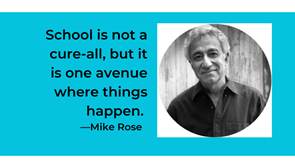
This reflection grows out of my preparation to tutor university students. As I step into that work, I want to do so with humility, wisdom, and a real desire to serve. One article that has helped me think more carefully about that calling is Mike Rose’s Remedial Writing Courses: A Critique and a Proposal. His ideas challenge some common assumptions about teaching writing, and they also remind me that students need more than correction. They need guidance, dignity, and room to grow.
Rose argues that remedial writing courses often fail students because they are too disconnected from actual university writing. Rather than preparing students for college-level work, these courses may rely on simple, personal assignments that do not reflect the kind of reading, analysis, and argument students will eventually be expected to do. As a result, students may complete remedial courses without developing the skills they need for authentic academic writing.
More Than Simple Topics and Grammar Fixes
Rose also criticizes the common use of simple topics and the heavy emphasis on error correction. He argues that easier topics do not necessarily motivate students, nor do they prepare them for more demanding writing tasks. In the same way, an overemphasis on grammar can cause students to think writing is only about avoiding mistakes rather than developing ideas, communicating clearly, and engaging thoughtfully with an audience.
Writing, Reading, and Thinking Belong Together
Another important point in the article is that writing should not be separated from reading and thinking. Academic writing depends on all three. Students must interact with texts, process ideas, and organize their thoughts in meaningful ways. Rose suggests that remedial instruction is most effective when it treats writing as an integrated process rather than as a collection of isolated skills.
Structure Can Support Growth
Finally, Rose argues that academic writing should not be seen as restrictive or lifeless. Students need to learn structures such as analysis, comparison, and argument, but those structures are not meant to limit thought. Instead, they can help students think more clearly and communicate more effectively. For Rose, remedial writers are not deficient; they are capable learners who need meaningful practice, thoughtful guidance, and gradual exposure to authentic academic work.
What This Means for Serving Students Well
This matters to me as I prepare to tutor university students. Rose’s article reminds me that tutoring should involve more than correcting errors. It should help students grow in confidence, think more clearly, and approach academic writing as a meaningful form of communication. Good tutoring should treat students with dignity, patience, and hope, helping them grow rather than simply fixing sentences.
Why This Matters for Christian Service
In that sense, tutoring writing can also be an act of discipleship. It is a way of helping others grow through truth, patience, and instruction. Discipleship involves learning, teaching, and building others up, and writing can participate in that holy work. As Matthew 28:19–20 shows, disciples are called to teach, and Psalm 102:18 reminds us that what is written can serve future generations. Writing, tutoring, and discipleship come together when words are used with care to guide, strengthen, and bless others.
Ways Christians Can Use Writing as Witness
Writing can be a form of witness because it helps us teach, encourage, and preserve truth. It gives us a way to slow down, pay attention, and put into words what God may be teaching us. It can also bless the people around us. Some research suggests that writing can support reflection, well-being, and emotional processing, and studies on expressive writing have found that practices such as gratitude writing and reflective writing may support positive affect and personal growth. That does not make writing a cure-all, but it does remind us that thoughtful writing can do real good.
That is one reason writing can be such a meaningful part of discipleship. I recently joined a group that has pledged to write out the Bible from Genesis to Revelation, and even that simple act feels like a way of lingering over God’s Word with greater attention. Others blog, write letters to shut-ins, help those who are ill record memories for loved ones, create children’s books, write devotionals, or compose hymns. The opportunities are endless, and each one can become a quiet offering of service.
The encouraging part is that getting started is easier than ever. Writing methods, prompts, and guides are widely available online and in bookstores, and self-publishing has become far more accessible through print-on-demand and e-book platforms. Writing is no longer only for professional authors. It is something ordinary believers can use in extraordinary ways. If God has given you something to say, writing may be one of the ways He invites you to serve. A few faithful words, offered to the Lord, can become a source of witness, comfort, and encouragement to someone else.
For Adults Who Want to Improve Writing
Zinsser, William. On Writing Well: The Classic Guide to Writing Nonfiction. New York: HarperCollins, 2016.
Lamott, Anne. Bird by Bird: Some Instructions on Writing and Life. New York: Anchor Books, 1995.
Strunk, William Jr., and E. B. White. The Elements of Style. 4th ed. New York: Longman, 1999.
Pink, Daniel H. A Whole New Mind: Why Right-Brainers Will Rule the Future. New York: Riverhead Books, 2006.
Clark, Roy Peter. Writing Tools: 55 Essential Strategies for Every Writer. New York: Little, Brown, 2006.
Graff, Gerald, and Cathy Birkenstein. They Say / I Say: The Moves That Matter in Academic Writing. 4th ed. New York: W. W. Norton, 2018.
For Children & Young Writers
Cleary, Beverly. Dear Mr. Henshaw. New York: HarperCollins, 1990.
Cummings, Troy. The Notebook of Doom Series. New York: Scholastic, 2013–.
Gutman, Dan. My Weird School Series. New York: HarperCollins, 2004–.
Scieszka, Jon. The Stinky Cheese Man and Other Fairly Stupid Tales. New York: Viking, 1992.
Arnold, Tedd. Fly Guy Series. New York: Cartwheel Books, 2005–.
DiCamillo, Kate. Because of Winn-Dixie. Cambridge, MA: Candlewick Press, 2000.
These resources encourage writers at every stage—from early readers to adult learners—to grow in clarity, confidence, and voice. Whether writing devotionals, testimonies, or academic reflections, the goal is the same: to communicate truth with grace, purpose, and understanding so that others may hear and respond.
Resource
Rose, Mike. “Remedial Writing Courses: A Critique and a Proposal.” College English 45, no. 2 (February 1983): 109–128.