
by Dee Ann Loving-Tackitt
“Let the word of Christ dwell in you richly in all wisdom; teaching and admonishing one another…” — Colossians 3:16 (KJV)
Beginning the Journey
One of the most interesting things I’m learning as I attend Writing training sessions for my job at Liberty University is that not every writer thinks about writing in the same way. Some writers want clear rules and the “right” answer. Others are more comfortable with multiple perspectives. Still others see writing as a process of reflection, revision, and discovery. In other words, here are the three types of writers I may be assisting: dualist, relativist, and reflective writers. Each one has strengths, and each one needs a slightly different kind of support.
Calling in Four Famous Writers
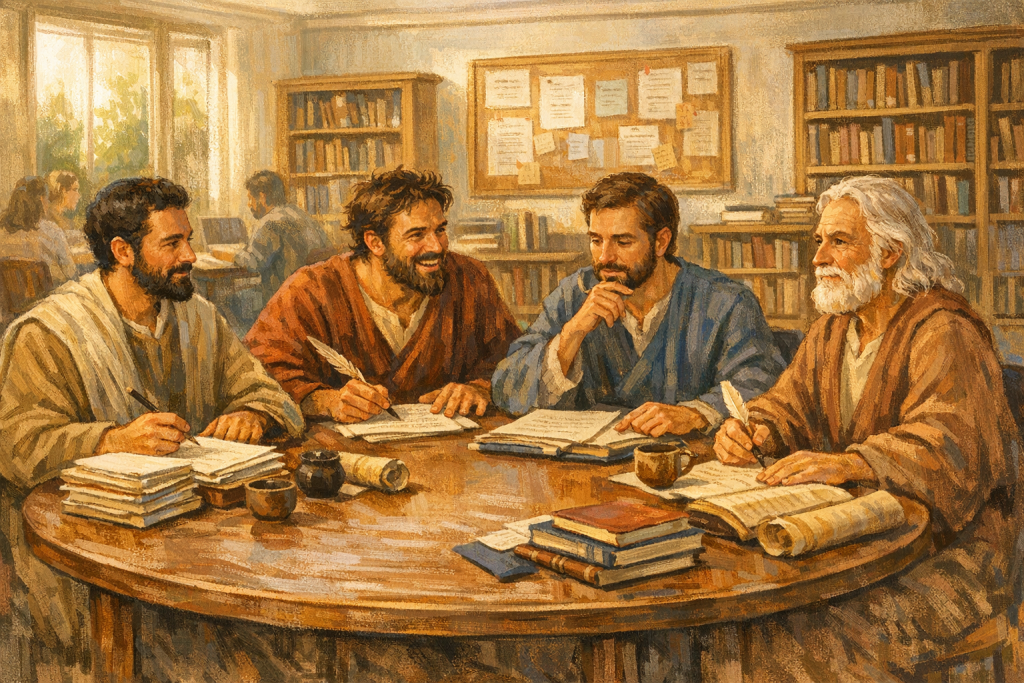
Now for the fun part. Matthew, Mark, Luke, and John have different styles, let’s have some fun and imagine them visiting the Writing Lab.
Matthew: The Structured Writer
Matthew came in first, sat down neatly, and said, “I like structure. I like organization. I like showing how everything connects and fulfills what has already been said.” I nodded and thought, Okay, Matthew definitely wants the assignment sheet, the rubric, and probably a sample paper too. If I were using my Writing Lab categories creatively, I might say Matthew sounds the most like a dualist writer. He values order, clarity, and clear teaching, and he seems very concerned with presenting truth in a direct, purposeful way.
Mark: The Urgent Writer
Then Mark came in, and before I could even offer him a chair, he was already halfway through his explanation. “Immediately,” he seemed to say, “we need to get to the point.” Mark’s style felt urgent, energetic, and fast-moving. He didn’t seem interested in long introductions or unnecessary details. He wanted action. He wanted momentum. Mark was the hardest to classify, but I could imagine him leaning toward a writer who values strong direction and clarity while still pushing forward with intensity, a dualist! He did not seem interested in overthinking the process. He wanted the message on the page.
Luke: The Thoughtful Writer
Luke arrived next with the calm confidence of someone who had actually prepared for the appointment. He opened his notes and explained that he preferred to write in an orderly way, carefully considering details and making sure the account was thorough and understandable. Luke sounded like the kind of writer who understands that ideas need context, explanation, and thoughtful arrangement. He felt much more like a reflective writer to me—careful, balanced, and interested in developing writing with purpose and precision.
John: The Deeply Reflective Writer
Then John walked in, and the entire room changed. John did not seem rushed at all. Instead, he spoke in a way that made me feel like every sentence had layers beneath it. He seemed less interested in simply giving information and more interested in helping the reader see meaning, depth, and truth from a deeper angle. If Matthew brought structure and Mark brought urgency, John brought reflection. He definitely struck me as a reflective writer—the kind of writer who is comfortable with complexity and willing to let ideas unfold thoughtfully.
Back to Studying!
Now that was a fun break, but now it’s back to studying. And if I smile a little longer at my students, it will probably be because I’m thinking of Matthew, Mark, Luke, and John.