by Dee Ann Loving-Tackitt
The Expectation Before the First Note
Beginning with the vision cast by Maestro David Cho in his program notes, Bernie and I found ourselves leaning forward before a single note was played. He had so beautifully prepared the journey that by the time we looked up, it felt as if the entire concert hall had quietly shifted—like someone had tilted the room just enough that we were all perched on the edge of expectation, waiting for the downbeat. This concert, celebrating the 250th birthday of the United States, gathered together a rich tapestry of American sound—music filled with spirit, remembrance, and heartfelt meaning
A Journey Through American Sound
The opening half carried us through familiar melodies and historic voices. Folk tunes like “Johnny Comes Marching Home” stirred something deep and collective, while Charles Ives’ unmistakable American voice added texture and originality. And then came Scott Joplin’s “The Entertainer,” which for me was not just a performance—it was a return home. I could hear it as I once did in my mother’s piano studio, where Bach, Beethoven, Mozart, and Schumann were the steady companions of my childhood. She taught the classics faithfully—but every now and then, she allowed this lively piece to slip in. Perhaps it was because of my dad. When he sat down at that same piano, those well-trained classical keys suddenly found themselves swept into something freer. He played jazz by ear, and when he “tickled the ivories,” the music came alive in a completely different way. It felt like a parade bursting through our living room—I would almost expect to see Macy’s balloons floating overhead. That same spark flickered again as the orchestra brought Joplin to life. Gershwin’s An American in Paris followed, and somehow the sounds of Paris traveled all the way to Lubbock. The taxi horns, the carefree motion, the blending of American energy with European charm—it was all there, alive and vibrant.
Wide-Open Spaces and a Patriotic Finale
The second half opened wide with Aaron Copland, whose music seemed to stretch across vast American landscapes. You could almost see the open plains, feel the dust, and hear the joyful energy of a hoedown that resonates so naturally with West Texas. From there, the program moved into beloved works by Tchaikovsky, Lowden, and Sousa, building toward a celebratory close—complete with triumphant chimes, thunderous cannon blasts, sparkling piccolo lines, and a heartfelt recognition of our veterans. When the audience joined together in “Stars and Stripes Forever,” it wasn’t just a performance—it became a shared voice, honoring 250 years of history.
The Music Comes Alive
And yet, as magnificent as the program was, it was the movement of the music—the life within it—that took my breath away. The bows did not simply move; they caressed the strings, drawing the sound out gently, as if awakening something already alive within the instrument. The violins seemed to breathe under their touch, their voices rising like soft sighs, coaxed into the light. The flutes shimmered, catching the glow of the stage lights like tiny prisms. Their tones danced in the air, as if sunlight itself had been scattered into sound—flickering, sparkling, alive. Behind them, the percussionists waited—not idly, but attentively—as though the music itself were calling to them. You could feel the pull, like a tide rising, until at just the right moment, they stepped in, answering with precision and power. The brass and woodwinds stood like pillars, framing the stage in sound—rich, resonant, and steady. They created a kind of living architecture, surrounding the orchestra with depth and strength. And then there was the harp… It did not simply play; it whispered. Each note fell like a drop of water, like light slipping through something sacred. Time itself seemed to pause and listen.
The Maestro as Artist
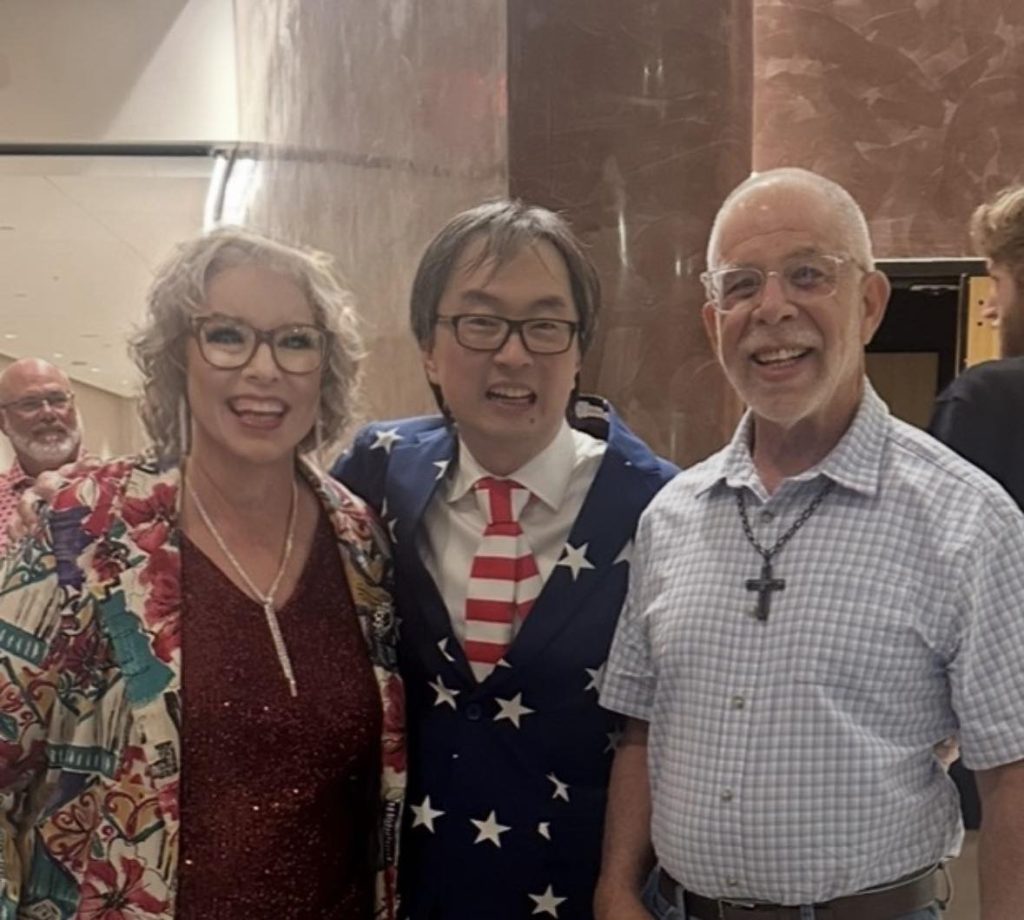
At the center stood Maestro Cho—not merely conducting, but painting. In the first half, dressed in bold red, he moved like an artist before a canvas. His hands became brushstrokes, sweeping color into the air. In the second half, with red still grounding him, he appeared in a blue coat adorned with stars and a striped tie. The music itself became a living flag—unfurling, waving, dancing. His movements rippled through the orchestra like wind through fabric, lifting the sound into something you could almost see.
A Sweet Gift for Two Musicians
For Bernie and me, there was an added sweetness to the evening. These were not unfamiliar works—we had taught many of them to our UIL Music Memory students and even performed some with the Plainview Symphony. To sit side by side without a score, without rehearsal notes, simply listening—it was a gift. We could hear the passion of the musicians not as performers preparing, but as listeners receiving. And what a joy that was.
A Divine Encounter in the Lobby
And as if the evening itself were not already a gift, there was one more moment waiting for us. In the lobby, we didn’t just cross paths—we collided in rhythm with Maestro David Cho, as if our steps had been quietly orchestrated. We congratulated him on a beautiful evening, and then I shared that I will be joining the Teaching Artist program this fall. His face didn’t just smile—it lit with delight. There was a genuine joy, a spark that revealed how deeply he loves children and believes in this work. He immediately began asking about the schools, the students, the possibilities. It felt like one of those meetings heaven arranges—unexpected, perfectly timed, and deeply encouraging. And I walked away even more excited, more inspired, and more grateful to be part of what the Lubbock Symphony is doing in our community.
Looking Ahead
As the final notes faded, we found ourselves already looking forward. The next concert—perhaps right around Bernie’s birthday on September 3—will open the Lubbock Symphony Orchestra’s 80th season, featuring Cliburn Laureate pianist Clayton Stephenson. And we will be there…ready once again, should the room tilt ever so slightly, drawing us to the edge of our seats.