
Mark 1:2–3
Mark Returns
I imagine Mark showing up at the Writing Center again this week—scroll tucked under his arm, sandals dusty, eyes bright with that same urgency he had last time. He sits down across from me, unrolls his parchment, and says, “I’ve added the next part. Can you look at it?”
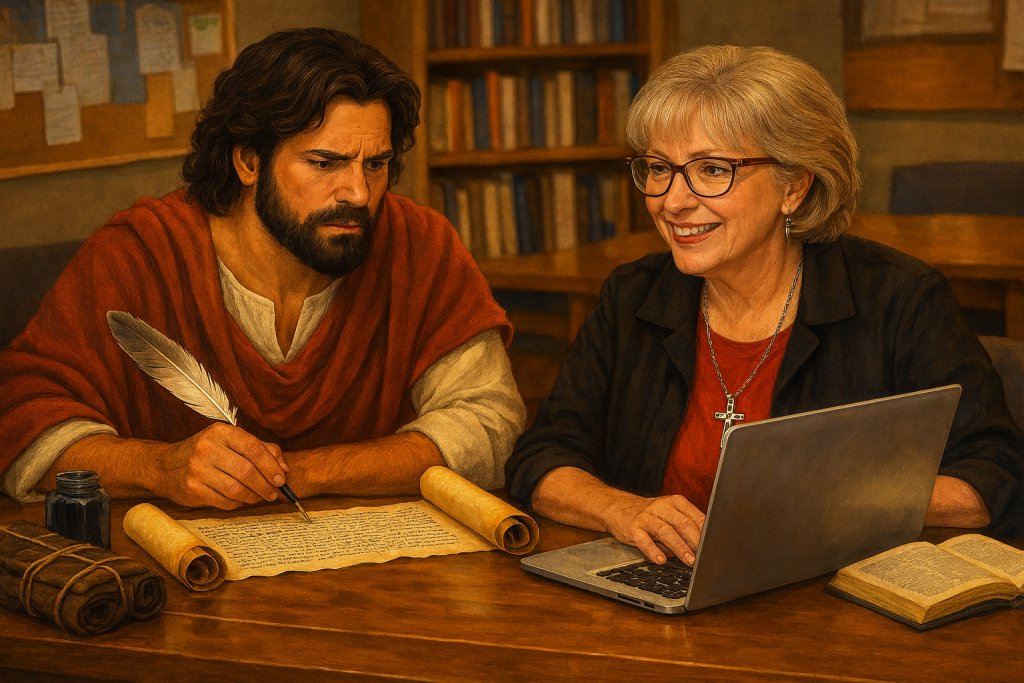
Of course I can.
So I read:
“As it is written in Isaiah the prophet,
‘Behold, I send my messenger before your face,
who will prepare your way,
the voice of one crying in the wilderness:
Prepare the way of the Lord,
make His paths straight.’”
(Mark 1:2–3)
Back at the Writing Center
And once again, I slip right into tutor mode.
“Mark,” I say, “we talked about this last time. You wrote ἐν τῷ Ἠσαΐᾳ τῷ προφήτῃ—‘in Isaiah the prophet’—but your first line is from Malachi. I know why you did it. In your world, you name the major prophet even when you blend texts. That’s normal. That’s expected. That’s how your people cite Scripture.”
He nods, as if to say, Of course. Everyone knows that.
“But modern readers don’t,” I continue. “They’ll think you made a mistake. So if you were turning this in for an English class, I’d suggest something like:
‘As the Scriptures say—first in Malachi, then in Isaiah…’”
He raises an eyebrow.
I shrug.
“Different century. Different expectations.”
The Voice in the Wilderness
Then we move on to verse 3.
“Now this part,” I say, tapping the line with my finger, “this is where your heart shows. φωνὴ βοῶντος ἐν τῇ ἐρήμῳ—‘a voice crying in the wilderness.’ You didn’t soften it. You didn’t polish it. You didn’t modernize it. You let Isaiah thunder straight through your pen.”
Mark grins.
He knows exactly what he’s doing.
What Mark Emphasizes
“And look at what you emphasize,” I continue. “Not the wilderness. Not the voice. Not even the messenger. You emphasize the Lord.
Prepare the way of the Lord.
Make His paths straight.”
I lean back in my chair.
Not Just a Story—An Announcement
“Mark, you’re not just writing a biography. You’re announcing an arrival. You’re telling your readers that the God who spoke through the prophets is stepping onto the stage of history. No wonder your Greek feels urgent. No wonder your sentences run like they’re out of breath. You’re not trying to impress us—you’re trying to wake us up.”
He smiles again, and I realize something:
Mark doesn’t need my help with grammar.
He needs my help with translation—not of words, but of worlds.
The Gospel Doesn’t Whisper
Because Mark writes like a man standing on tiptoe, shouting across centuries, “He’s here! The Lord is here!”
And sometimes, in our careful, polished, modern world, we forget that the gospel didn’t arrive quietly. It arrived like a voice in the wilderness—loud, raw, unignorable.
Walking the Prayer Path
Maybe that’s the deeper lesson for us on this prayer path. We don’t prepare the way of the Lord by perfecting our sentences.
We prepare it by opening our hearts.
By clearing the clutter.
By making straight the paths where He wants to walk.
What a Beginning
Mark reminds us that the gospel is not a literary exercise.
It is an announcement.
A summons.
A beginning.
And what a beginning it is.
A Prayer
Heavenly Father,
You are the One we prepare for—and yet You are the One who prepares us.
Clear the paths of our hearts where they have become cluttered and crooked. Remove the fear, the pride, and the distractions that keep us from seeing You clearly. Teach us to listen for Your voice, even when it comes like a whisper—or like a cry in the wilderness.
Help us not to polish our lives for appearance, but to open them fully to Your presence. Make us ready—not just in word, but in spirit—to receive You and to follow where You lead.
And when You call, give us courage to respond quickly, just as Mark wrote—with urgency, with joy, and with the certainty that the Lord has come.
We love You, Jesus.
Prepare us for Your work.
Amen.
A Resource for Going Deeper
If you find yourself curious about Mark’s urgency, his use of Scripture, or even the texture of his Greek, here are a few trusted resources that open up his Gospel in meaningful ways:
For understanding Mark as a whole:
- James R. Edwards, The Gospel According to Mark (Pillar Commentary)
This is a wonderful, readable commentary that explains the flow of Mark’s story and highlights his urgency and theological focus. It helps you see exactly what Mark is emphasizing—and why it matters for us today. - R.T. France, The Gospel of Mark (New International Greek Testament Commentary)
This one goes deeper, especially into how Mark uses Scripture (like Isaiah and Malachi in Mark 1:2–3). It’s especially helpful for understanding why Mark blends passages and how his original audience would have heard it.
Suggested Scripture Readings
To understand the fuller story behind Mark’s opening, these passages connect beautifully:
- Isaiah 40:3–5 — The original “voice in the wilderness”
- Malachi 3:1 — The promise of the messenger
- Luke 3:1–6 — Another account of John preparing the way
- John 1:19–23 — John the Baptist’s own testimony
- Psalm 24:7–10 — Welcoming the King of Glory